
FINTECH SCB Insight · October 2026 · by Roberto Balbino
Off the Books
How the AI Boom Became a Credit Cycle—and Who Will Hold the Loss
The debate over artificial intelligence is still argued as a stock-market question. The money has already moved somewhere else.
In 2026 the largest spenders on AI stopped paying for the build-out out of their own cash. In the first half of the year, capital expenditure at Microsoft, Alphabet, Amazon, Meta and Oracle absorbed 96 percent of the cash their businesses generated. At Alphabet, Amazon and Oracle it now exceeds it. Their reported debt has more than doubled in less than two years, to about $496 billion. Another $1.2 trillion of leases, signed mostly for data centers not yet delivered, sits outside their balance sheets.
Off the Books follows the contracts. It looks at joint-venture bonds backed by residual value guarantees, vehicles that own the chips, loans secured on hardware that ages faster than the debt, and guarantees written by the chipmakers themselves. It identifies who holds the claims: life insurers and the annuities behind them, semi-liquid private credit funds, and the banks that lend to the lenders. These are the institutions least able to leave when the numbers turn.
The Insight tests its own argument against the strongest objections and sets out three paths to 2028. It also states in advance the evidence that would prove it wrong. It closes with practical guidance and a dashboard of indicators for savers, entrepreneurs, credit investors and policymakers.
Shareholders can sell in a second. The people financing the AI build-out cannot.
78 pages · 23 figures and tables · fully sourced · data to October 29, 2026
EUR 4.99, excluding taxes — one-time payment
…
One purchase includes every language edition of this Insight. Access is linked to the email used at checkout.
Key findings
- AI spending now outruns cash: in 2026 Alphabet, Amazon and Oracle spent more on capital expenditure than their operations generated, and the reported debt of the five largest spenders went from about $226 billion at the end of 2024 to about $496 billion.
- The bigger number is off the balance sheet: about $1.2 trillion of leases signed but not yet started, mostly for data centers, roughly 2.4 times the reported debt of the five companies.
- Four structures keep the obligations out of sight: leases not yet commenced, joint-venture bonds with residual value guarantees, vehicles that own the chips, and guarantees from the chip vendors.
- The hardware loses value faster than the loans against it are repaid: servers are written down over five and a half to six years, while a new generation of accelerators arrives every year.
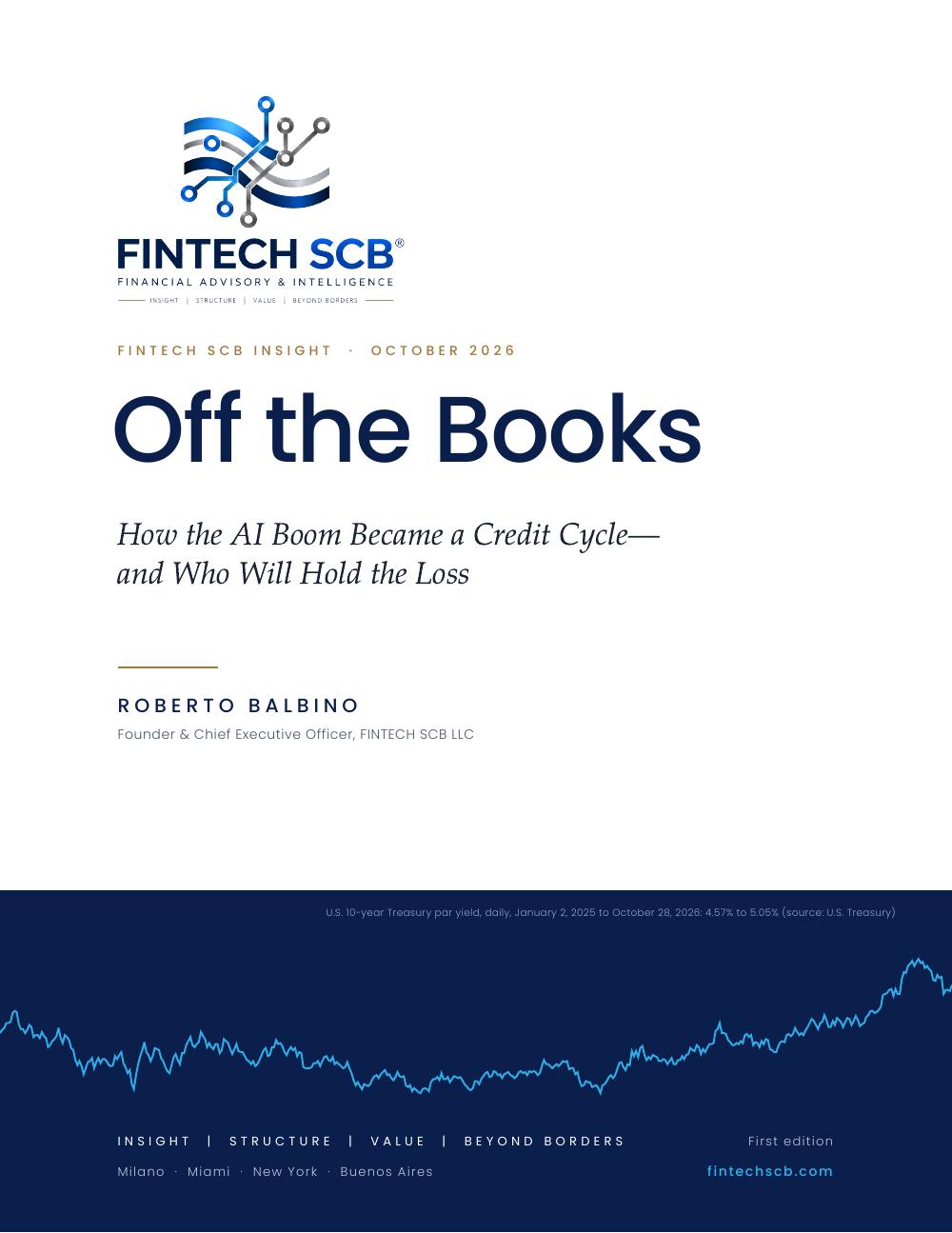
- Interest rates are no longer a cushion: the 10-year Treasury yield closed at 5.31% on October 5, 2026, its highest close since 2002.
- The holders are the ones who cannot sell: U.S. life insurers held $85.2 billion of AI-ecosystem debt at mid-2026, and semi-liquid private credit funds cap withdrawals at about 5% a quarter.
- The base case is a slow repricing rather than a crash, and the Insight states in advance the four observations that would prove it wrong by the end of 2027.
Contents
- 01 From Cash to Credit
- 02 The Architecture of Off-Balance-Sheet Compute
- 03 The Circle: Vendors, Customers and Borrowed Demand
- 04 Collateral That Ages
- 05 The Price of Money Came Back
- 06 Who Holds the Loss
- 07 What the Telecom Bust Actually Teaches
- 08 The Strongest Case Against This Insight
- 09 Three Paths to 2028
- 10 What to Do Now—and What I Will Track