
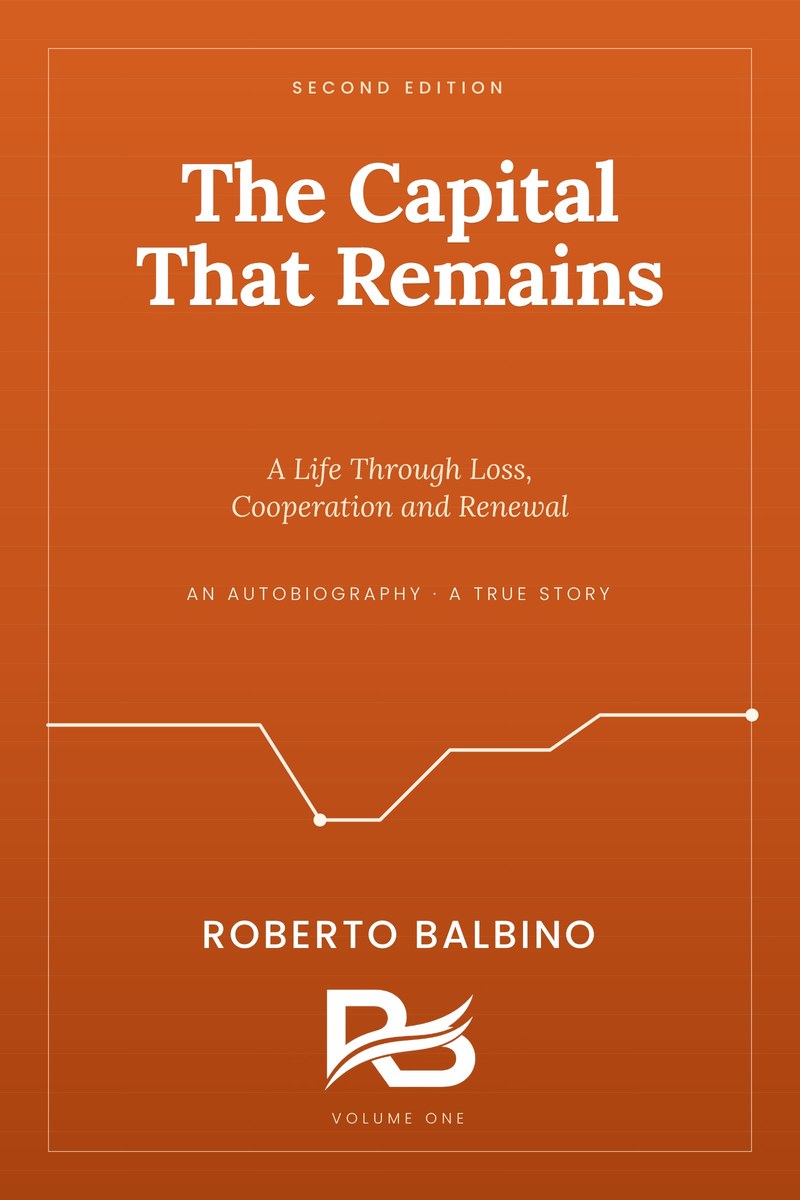
The Capital That Remains
Second Edition, revised and expanded · November 2026
A Life Through Loss, Cooperation and Renewal
- Book language
- English
- Format
- PDF + EPUBPDF
- Pages
- 532
- Price
- …
Roberto Balbino is an international finance executive, entrepreneur and independent analyst of economics, finance, geopolitics and global markets. He is the founder and Chief Executive Officer of FINTECH SCB LLC, an international financial advisory firm with operations in Milan, Miami, New York and Buenos Aires.
His career includes roles as finance director at Colt Telecom and Fastweb, controller at Vodafone and analyst at IBM. He was also CEO of State Capital Bancorp. His experience spans corporate finance, governance, strategic planning, private banking, wealth management and cross-border financial operations.
Alongside his professional work, he writes analysis on contemporary economic and financial issues. He examines the relationships between markets, institutions and political power, with particular attention to international capital flows, the distribution of risk, inequality and the consequences of technological change.
His approach rests on independent judgement, transparent sources and a critical, often contrarian reading of prevailing interpretations. In his writing he questions established narratives, separates data from interpretation and explores the consequences of economic choices for businesses, families and society.
He is the author of The Capital That Remains, which weaves personal experience with economic and financial reflection, exploring the value of knowledge, trust, cooperation and the ability to rebuild after a crisis.
Through books and public contributions, he offers tools for understanding how value is created, distributed and preserved, which interests drive decisions and who bears their costs.
True stories and reflections on economics, finance, geopolitics and technological transformation.
Second Edition, revised and expanded · November 2026
A Life Through Loss, Cooperation and Renewal
Roberto Balbino · Founder & CEO — FINTECH SCB
A true story of ambition, betrayal and renewal.
Born into a working-class Italian family, Roberto Balbino paid for his studies by working and rose to senior finance roles at major international companies. In 2005 he became an entrepreneur. By 2010 he had lost everything: shares paid for and never transferred, partners who had sat at his family's table, and a global crisis that closed every door.
This is his autobiography, the book from which all his other books descend. The collapse, the family that held him up, the years in Latin America, his father's death, two daughters, and the rebirth with FINTECH SCB in Miami, New York, Milan and Buenos Aires.
Why a second edition. The first edition was published in October 2026. This revised and expanded second edition exists because the author needed to add reflections and economic connections that had remained implicit: eight new chapters that read a life through the tools of economics (the price of trust, why we don't stop when we should, who gets paid first when a business fails, the scars that remain, the family as lender of last resort, the work no balance sheet records, the generation that did everything right, protecting what one failed to protect), a new introduction, a chronology and a dedication. Every article and post by the author is cited with its date and platform, and the data are current as of November 2, 2026. The book grows from 45 to 53 chapters, with 239 numbered sources. Nothing from the first edition has been removed except the correction of inaccuracies.
"When I write capital, I think of what remains when the money is gone."
Direct purchase from FINTECH SCB: secure card payment and immediate download of the chosen edition.
Second Edition, revised and expanded · November 2026
A Life Through Loss, Cooperation and Renewal
Seconda edizione, riveduta e ampliata · novembre 2026
Una vita tra perdita, cooperazione e rinascita
Segunda edición, revisada y ampliada · noviembre de 2026
Una vida entre la pérdida, la cooperación y el renacimiento
The full file is available only after the payment is confirmed.
The first 24 pages of each edition, separate from the full book. Choose the excerpt language:
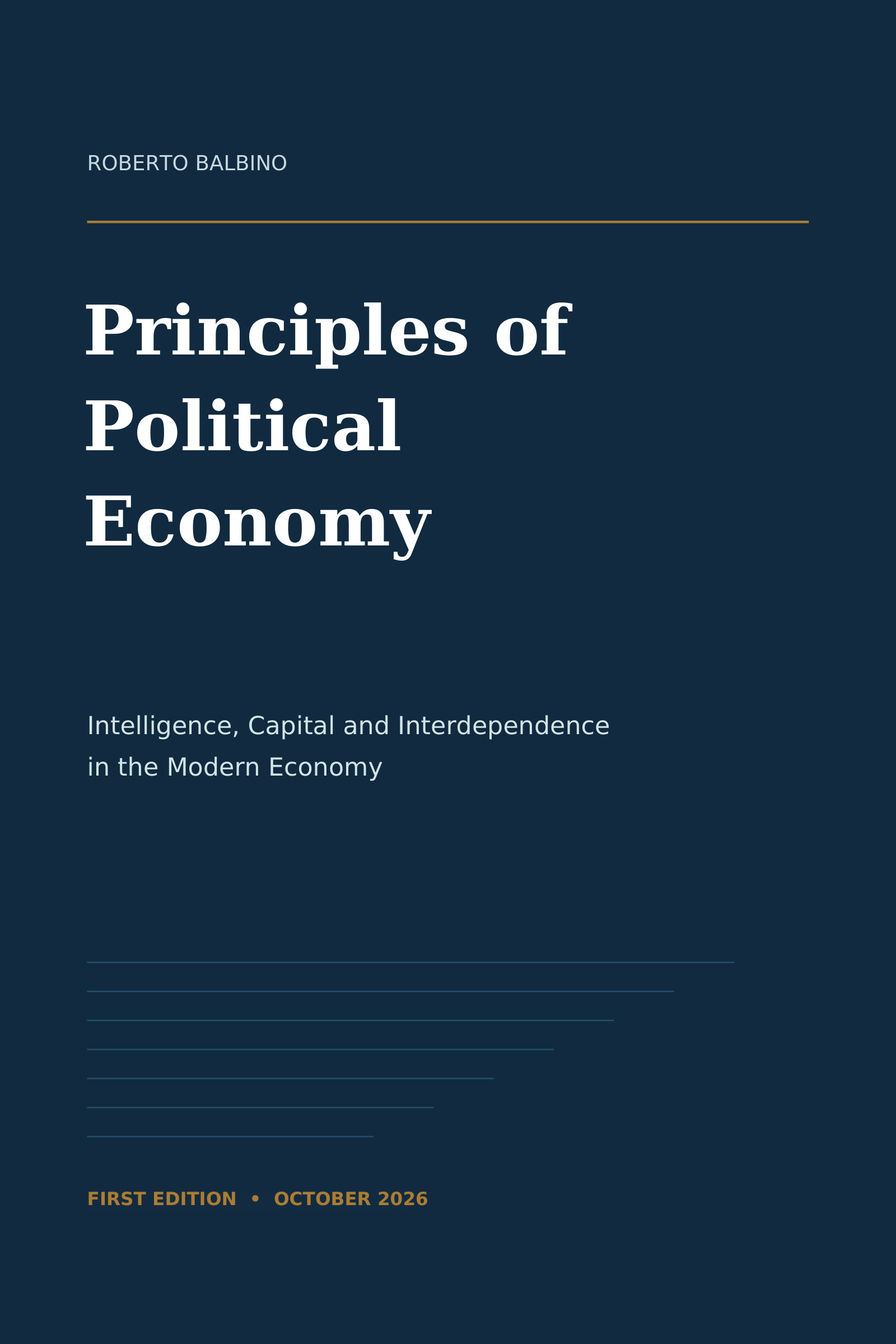
First edition · October 2026
A treatise on political economy connecting production, distribution, exchange, economic progress and government with the contemporary transformations of technology, capital and finance.
The full file is available only after the payment is confirmed.

His Highness Has a Business Plan
Entrepreneurs, investors, and the conduct of power
Roberto Balbino · English · First edition
PDF: 333 pages · EPUB
Every empire has a weakness. The modern ones can hide it behind a rising share price.
A brilliant product can leave its inventor dependent on someone else’s platform. A charismatic founder can attract billions while making his company dangerously dependent on his judgment. An investor can recognise the future and still lose money buying it.
Power runs through all these stories.
In The Prince — His Highness Has a Business Plan, Roberto Balbino brings Machiavelli into the worlds of entrepreneurship, technology and investment. Territories become markets. Fortresses become competitive advantages. Armies become capabilities, infrastructure and capital. The court becomes a boardroom where the most expensive mistake may be the truth nobody dares to tell.
Through the businesses and decisions associated with Mark Zuckerberg, Elon Musk, Jeff Bezos, Jensen Huang, Warren Buffett, Jamie Dimon and Larry Fink, Balbino examines how modern power is built, financed, defended and lost. Voting rights, debt agreements, distribution channels and access to cash reveal who can act freely—and who remains dependent on another person’s permission.
The analysis is unsparing. Markets can reward a compelling story long before its promises are fulfilled. Cooperation can create strength while concealing an unequal distribution of risk. A successful leader can become the greatest obstacle to the institution he built. And the investor who imitates a founder’s boldness may discover that he owns none of the founder’s control.
Across 26 chapters, supported by primary sources, charts and worked examples, the book explores judgment under pressure: recognising traps, preserving alternatives, choosing allies, managing liquidity, hearing unwelcome information and preparing for succession.
For entrepreneurs, investors and readers of economic power, this is a demanding examination of what ambition requires once applause gives way to obligations.
Who controls the decision? Who can afford to wait? Who absorbs the loss? What survives when the leader leaves?
His Highness has a business plan. The difficult part begins when reality refuses to follow it.
Beyond Debasement: Money, Power and the Freedom to Choose
First edition · October 2026
An investment can survive a crisis and recover in value. An owner who has had to sell it to meet a mortgage payment, support a family or keep a business running may miss that recovery. The Price of Standing Still begins with this gap between the market’s horizon and the owner’s deadline.
Roberto Balbino examines how inflation, income, debt, taxation and institutions shape purchasing power and the choices people can actually make. The book tests the claims that money creation alone explains every price increase and that owning financial assets or property provides protection in itself.
From Italy’s inflation history to the experiences of Argentina and Japan, from financial crises to everyday household decisions, the analysis follows the mechanisms through which opportunities, risks and losses are distributed. The capacity to remain an owner is central: available resources and manageable commitments allow people to withstand difficulty without a forced sale.
Across 24 chapters, cash, bonds, equities, gold, property and digital money are examined alongside their owners’ obligations. Four illustrative cases set in Milan, Buenos Aires, Miami and New York connect the argument to buying a home, running a business, retirement and professional income. A concluding workbook translates the analysis into calculations, scenarios and decisions that readers can examine.
As the founder and CEO of FINTECH SCB, Balbino brings experience in international finance and business to the book, alongside personal episodes of loss and rebuilding. Written for savers, professionals and entrepreneurs, it examines the conditions under which wealth can continue to support the choices that matter throughout life.
The full file is available only after the payment is confirmed.
New release · First edition 2026
The Pandemic’s Structural Legacy in Finance, Business and Work
Roberto Balbino · English · First edition · 2026
PDF: 420 pages · EPUB
One purchase includes both the PDF and the EPUB edition.
The emergency ended. The invoices are still arriving.
In 2021 the Federal Reserve sent the US Treasury $107.4 billion in profits. On October 28, 2026, it still had to earn back $232.5 billion before it could resume regular payments. American banks, after the largest one-year deposit increase in nearly eighty years, still carried $326.7 billion of unrealized losses in mid-2026. None of these losses vanished. They were moved in time and handed to someone else.
Normality, Repriced is a book about where the money went. Roberto Balbino follows the structural economic, financial and organizational consequences of the Covid-19 pandemic through central banks and commercial banks, corporate balance sheets, offices, factories, airlines, supply chains, contracts and laws. His thesis is simple and uncomfortable: the emergency was financed by deferring and relocating losses, and normality is the period in which the bills arrive.
The argument rests on cases a reader can check. In June 2020 United Airlines valued its frequent-flyer program at about $21.9 billion, by the author’s calculation roughly 1.9 times the stock-market value of the entire airline, aircraft and routes included, and lenders were ready to write the checks. Between the end of 2019 and mid-2025, US office vacancy rose by nearly four percentage points and delinquency on office loans by about eleven. A $5.8 billion sale of fifteen luxury hotels was decided in Delaware not by the famous material-adverse-effect clause but by a quieter promise to run the business in the ordinary course. Between 2021 and 2026 the European Union assembled most of a sovereign yield curve, and the market still prices it between Germany and France.
Across nine parts and 66 chapters, the book moves from the plumbing of finance to the cost of remote work, inventory, business travel, supply chains and continuity planning. An operational economic atlas of 24 illustrative models, in euros, lets owners and investors replace the assumptions with their own figures. A statute book of 27 legal measures shows which pandemic-era rules were still moving money at the end of October 2026, and who pays first.
There is no political analysis and no verdict on public-health decisions. Every factual statement leads to a dated source, the author’s own calculations are labeled as such, and each central thesis is stated together with the observation that would prove it wrong, including a full chapter titled “The strongest case against this book.”
For entrepreneurs, investors, finance professionals and boards, the question asked of every measure is the same: what did it cost, and who still pays?
Roberto Balbino is Founder & CEO of FINTECH SCB and an independent analyst of finance, economics, geopolitics and global markets.