
China's Uneven Recovery
Factories surge. Investment retreats.
A factory can be busy while its owner decides against building the next one. An export order can rise while a household postpones buying an apartment. An economy can produce more without persuading its private sector that the future has become sufficiently attractive to invest in.
These are not contradictory statements. They describe different decisions, made by different people, over different time horizons.
China’s latest economic release makes that distinction particularly important. Reading the GDP headline alone produces a reassuring story of resilience. Reading the weakest investment numbers alone produces a story of collapse. Neither captures the structure of what is happening.
My interpretation is that China possesses substantial productive capabilities while its domestic economy still struggles to distribute confidence, income and investment incentives widely enough. Industrial strength can coexist with a weak appetite to commit private capital.
The risk for the rest of the world is not limited to a Chinese downturn. A China that remains highly competitive in production while domestic demand remains uneven can also intensify pressure on foreign producers and trade relationships.
The data behind the tension
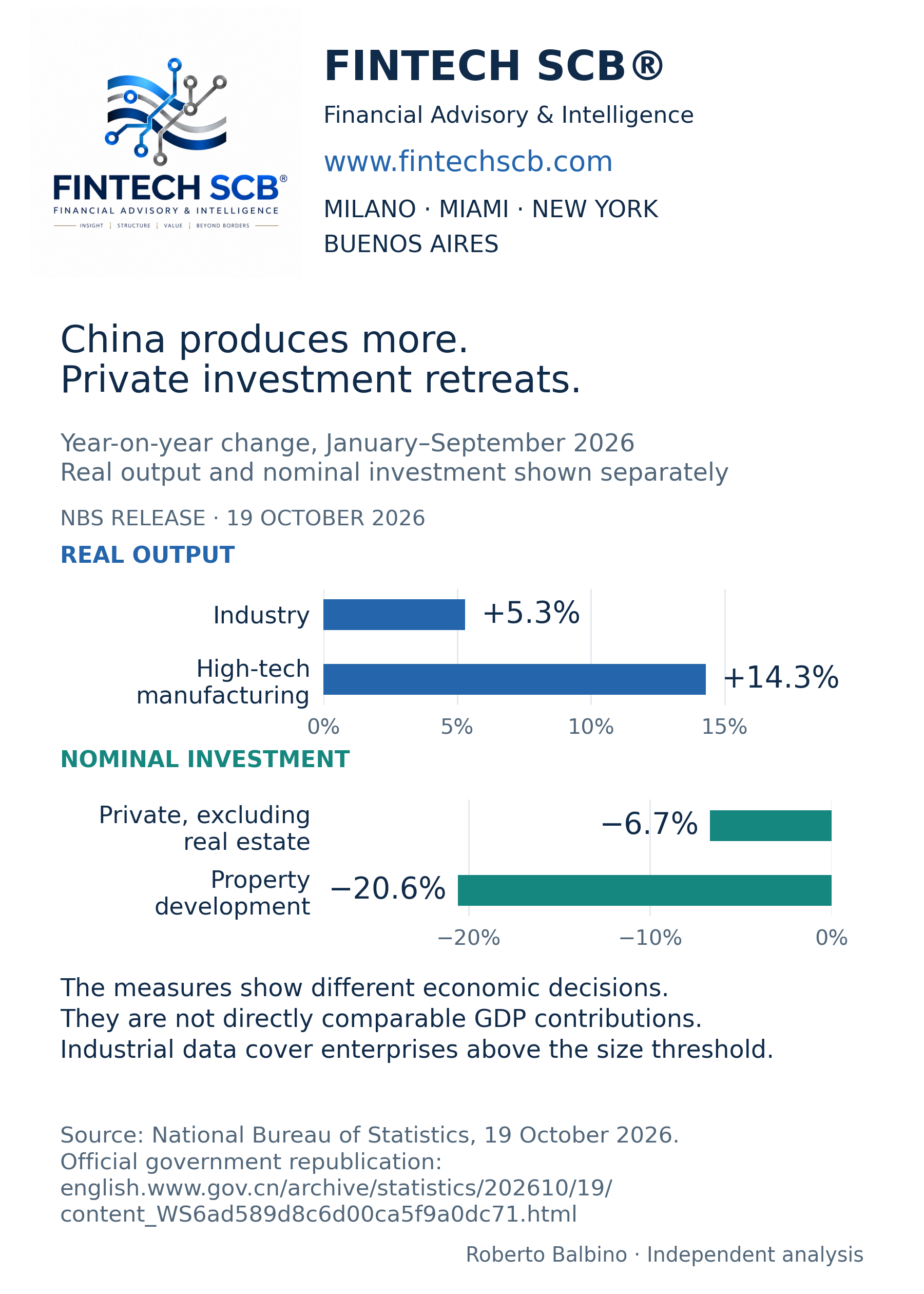
The National Bureau of Statistics release of 19 October reports real GDP growth of 4.5% year on year in the third quarter and 4.6% for January–September. Over those nine months, industrial value added rose 5.3%, with high-tech manufacturing up 14.3%. [1]
Meanwhile, nominal private fixed-asset investment fell 10.4%; excluding real estate, it fell 6.7%. Property development investment declined 20.6%. These investment measures are not national-accounts contributions to GDP, and their nominal growth rates should not be compared mechanically with real output growth.
The accompanying chart deliberately separates output from investment. The point is the divergence in direction and breadth, not a subtraction between incompatible series.
The property adjustment plainly matters. But the private-investment measure excluding real estate makes it difficult to explain the entire weakness as a direct contraction in property development alone.
Why output and investment can move apart
Output is a flow from productive capacity that already exists. Investment adds to, replaces or improves that capacity. The decision to produce today need not imply confidence about expanding tomorrow.
Consider an illustrative manufacturer with a plant able to produce one million units a year. It has been running at 70% utilisation. New export orders raise utilisation to 80%. Production increases substantially without a second plant being built.
The owner may even reduce investment because the first plant is now adequate, because borrowing is unattractive or because the expected margin on future orders is uncertain. Higher current production and lower capital spending can therefore coexist without any statistical mystery.
There are other possibilities. Earlier investment may now be coming into operation. Firms may be improving processes rather than adding floor space. Production may be shifting toward larger, more technologically capable firms while smaller competitors retrench.
Each mechanism has different implications. Rising utilisation can support profits. Excess capacity filled through heavy discounting can weaken them. Productivity improvements can sustain competitiveness. A temporary order surge can disappear.
That is why output should be read alongside margins, cash collection, inventories and the expected return on incremental capital. “More production” is an observation. “A healthier private economy” is a conclusion that requires additional evidence.
The strength is real
An analysis focused only on property misses the sophistication of China’s industrial economy.
An industrial ecosystem has value beyond the sum of its factories. Suppliers, technicians, logistics, specialised machinery and accumulated production knowledge can make it easier to develop and manufacture a product. A foreign competitor cannot recreate that network simply by announcing a subsidy.
Scale can support learning. A large domestic production base can spread fixed costs over more units. Closely connected suppliers can shorten the time between a design change and a commercial product. These are mechanisms of competitiveness, not proof that every company earns an adequate return.
This distinction is essential for foreign investors and policymakers. A competitor can remain formidable even when some of its producers earn weak margins. Consumers abroad may benefit from cheaper or better products while domestic manufacturers abroad face a more difficult market.
China’s industrial capability therefore deserves serious analysis even when its domestic financial model deserves criticism. Treating economic strength as an all-or-nothing condition obscures both.
The weakness is also real
Private investment is a decision about the future. Its weakness can signal uncertainty about demand, profitability, property values, regulation, financing or the ability to retain the returns from a successful project.
The aggregate data do not identify the relative contribution of these explanations. They nevertheless raise a question that a strong production number cannot answer: why are private firms reluctant to commit more capital?
Suppose a business can borrow cheaply but expects weak sales and intense price competition. A lower interest rate improves the spreadsheet, yet may not make the project attractive. Cheap finance is most powerful when profitable investment opportunities exist and firms trust the assumptions behind them.
This is the difference between easing a funding constraint and repairing expected returns. A credit programme can address the first. The second may require stronger household demand, a more predictable business environment, resolution of distressed assets or a change in how resources are allocated.
The World Bank’s mid-2026 China Economic Update describes financing conditions that had not translated into stronger credit demand, alongside cautious household spending. That diagnosis helps frame the October figures, but the earlier report should not be mistaken for a new October observation. [2]
Property is an economic relationship
A property downturn affects more than construction activity.
For households, a home can represent savings, collateral and confidence about future security. For developers, sales fund commitments to suppliers, lenders and buyers. For local authorities, property-related activity can influence revenue and spending choices. For banks, the issue includes both direct loans and the wider cash flows of connected borrowers.
This is why building more industrial capacity does not automatically repair a property balance sheet. A factory and an unfinished apartment serve different owners and creditors. Their cash flows cannot be merged merely because both enter a national economic narrative.
The central policy challenge is allocation of losses and restoration of credible expectations. A household deciding whether to buy needs confidence about delivery and value. A lender needs to understand the recoverability of its claim. A local government needs a sustainable financing arrangement for public services.
Postponing recognition may protect measured stability for a time, but can keep capital trapped. Abrupt liquidation can destroy value and confidence. The difficult middle course is orderly resolution that makes obligations and available resources explicit.
That is a balance-sheet problem. It requires more than a growth target.
The household is the missing transmission mechanism
The familiar proposal is that China should consume more. The useful question is what would make a household comfortable doing so.
A family saves for reasons that extend beyond the current deposit rate. Employment security, healthcare, education, retirement, housing and responsibility for relatives all influence the amount it wants to keep aside.
If uncertainty around those obligations remains high, a temporary spending incentive can bring a purchase forward without changing long-term behaviour. A subsidy for a durable good may alter the month of purchase more than the household’s lifetime consumption plan.
By contrast, reliable public services and a more predictable income outlook can reduce the need for precautionary saving. That is a slower institutional change, but potentially a more durable source of demand.
The IMF’s February 2026 consultation recommended a transition toward consumption-led growth and a shift in spending composition away from inefficient investment. It also identified aging and weaker productivity growth as medium-term constraints. These are structural observations, not evidence that every component of current investment is wasteful. [3]
The political economy is difficult because redirecting resources toward households can alter the interests of established recipients of credit, land and public spending. An economic rebalancing is also a distributional decision.
Technology does not remove the labour problem
Advanced manufacturing can raise productivity without creating enough suitable jobs for every worker leaving another sector. A highly efficient plant may require fewer people per unit of output than the business it replaces.
The resulting transition depends on skills, location and mobility. A construction worker, a graduate seeking an office position and a technician needed by a modern factory cannot be treated as interchangeable units of labour.
The World Bank’s special focus on skills for the low-carbon transition is useful here. It points to mismatches between emerging demand and available skills. The wider lesson is that industrial success needs complementary investment in people, training and mobility. [2]
This is also a household-demand issue. Workers need to experience industrial upgrading as an improvement in their own employment and income prospects. A national production milestone has limited power to change spending behaviour if personal economic security remains uncertain.
The transition may ultimately deliver that improvement. The important point is that it must be measured, rather than assumed from the output of selected industries.
The inflation diagnosis needs care
China’s January–September consumer inflation was 0.9%, according to the October release. That is weak price growth, not a falling headline consumer-price level over the period. [1]
Nor can one indicator settle the condition of every market. Consumer prices, industrial selling prices, wages, property values and company margins can move differently. Energy costs can raise some prices while weak domestic demand restrains others.
For a business, the relevant calculation often concerns the price of its own output relative to its inputs and debt obligations. A rise in input costs alongside limited pricing power can squeeze profits even when headline inflation increases.
An analyst should therefore avoid turning “inflation” or “deflation” into a universal description of a large, heterogeneous economy. The distribution of price changes can matter as much as the national average.
What the rest of the world sees
When domestic investment and demand are uneven, external markets can become more valuable to producers. That creates opportunities for international buyers and tensions for competing industries.
The October release reports strong growth in both nominal exports and imports. Those gross flows cannot, on their own, establish the contribution of net exports to real GDP. Currency, prices, composition and the national-accounts calculation all matter. [1]
The geopolitical question is broader than the latest trade balance. How much room will other economies allow for an expansion in Chinese market share in industries they consider strategic? How much duplication of supply chains are they willing to finance to reduce dependence?
Tariffs and subsidies can redistribute production, but they also impose costs. A protected domestic producer may gain investment while consumers or downstream businesses face higher prices. Diversification can improve resilience while reducing some of the efficiencies created by scale.
This is why the global effect of China’s uneven recovery is not simply positive or negative. It depends on whether one is buying equipment, producing competing goods, supplying commodities or attempting to build domestic industrial capacity.
Three scenarios, with different evidence
The constructive scenario is a broader domestic expansion. Household confidence improves, property uncertainty becomes more manageable and private investment outside real estate stabilises. Industrial capability is then supported by a stronger domestic customer base. The key evidence would be breadth: cash flow, income confidence and investment improving beyond selected sectors.
The second scenario is continued divergence. Industrial output remains resilient while private capital spending is weak. The economy grows, but the sources of growth are concentrated and the external political friction becomes harder to manage. In this case, a respectable GDP rate can coexist with persistent debate about the sustainability of the model.
The adverse scenario combines weaker external demand with unresolved domestic balance-sheet pressure. Manufacturers lose some of the demand that supported utilisation before households and private firms become willing to spend more. The relevant risks then reinforce each other rather than offsetting one another.
These are analytical scenarios, not probability-weighted forecasts. The release does not contain enough information to assign reliable numerical odds.
What would change the argument
I would watch private investment excluding real estate, profitability and cash collection, household income expectations, property delivery and resolution, and the breadth of employment improvement.
I would also distinguish capital spending that replaces obsolete assets from spending that adds capacity to an already competitive market. The same investment total can represent productive renewal or a future margin problem.
A sustained broadening across these measures would weaken the argument that the recovery is uneven. Continued industrial strength alongside weak private commitments would reinforce it. A fall in output would require a different assessment again.
The evidence supports neither casual dismissal of China’s industrial power nor automatic confidence in its domestic growth model. Its capability to produce is substantial. The harder task is making the returns, income and confidence generated by that capability circulate more broadly.
China’s next economic achievement will be more meaningful if private firms want to build the next factory and households feel secure enough to buy what the current factories produce.
Sources and data notes
[1] National Bureau of Statistics of China, third-quarter and January–September 2026 economic release, 19 October 2026; official government republication. Real output, nominal investment and consumer-price measures have different definitions and are kept separate throughout.
https://english.www.gov.cn/archive/statistics/202610/19/content_WS6ad589d8c6d00ca5f9a0dc71.html
[2] World Bank, China Economic Update: Rebalancing Growth, mid-2026 edition, with a data cutoff of 30 June 2026. The PDF cover says June; internal pages identify the July edition. Used as structural context, not as an October release.
https://thedocs.worldbank.org/en/doc/0cb2fc6dd88d4db3816dc0433b5cb49b-0070012026/original/CEU-July-2026-EN.pdf
[3] IMF, conclusion of the 2025 Article IV consultation with China, published 18 February 2026. Forecasts and assessments reflect that publication date.
https://www.imf.org/en/news/articles/2026/02/18/pr-26053-china-imf-executive-board-concludes-2025-article-iv-consultation
Factory and household examples are analytical illustrations. No investment series is presented as a direct contribution to GDP. The scenarios are the author’s interpretation, not institutional forecasts.
Roberto Balbino — Founder & CEO, Fintech SCB
Independent analysis of finance, economics, geopolitics and global markets
www.fintechscb.com
#China #GlobalEconomy #Manufacturing #Investment #Geopolitics #Macroeconomics #RobertoBalbino #FintechSCB
Originally published on Substack.
Segui Roberto Balbino su Substack