
Europe’s €10 Trillion Missing Link
Financing the future requires a different financial system.
The Sunday Long Read | 11 October 2026
Europe keeps asking how to catch up in artificial intelligence. A more uncomfortable question is what kind of financial system it has built to pay for the attempt.
A company with property, predictable cash flows and assets that can be repossessed speaks a language a bank understands. A company with researchers, software, substantial initial losses and an uncertain route to global scale presents a different proposition.
Both may be economically valuable. They require different forms of capital.
A system centred on deposits and bank lending can finance businesses with predictable revenues and collateral effectively. It struggles when the assets are intangible, losses arrive early and outcomes remain highly uncertain.
This is the starting point of our proposal at FINTECH SCB. Europe should build a permanent, competitive channel connecting long-term savings to professionally managed innovation finance. It should give that channel measurable objectives, institutional investors, commercial discipline and an explicit accounting of who bears losses.
The ambition should be aggressive. The implementation should be financially literate.
The €10 trillion figure needs an explanation
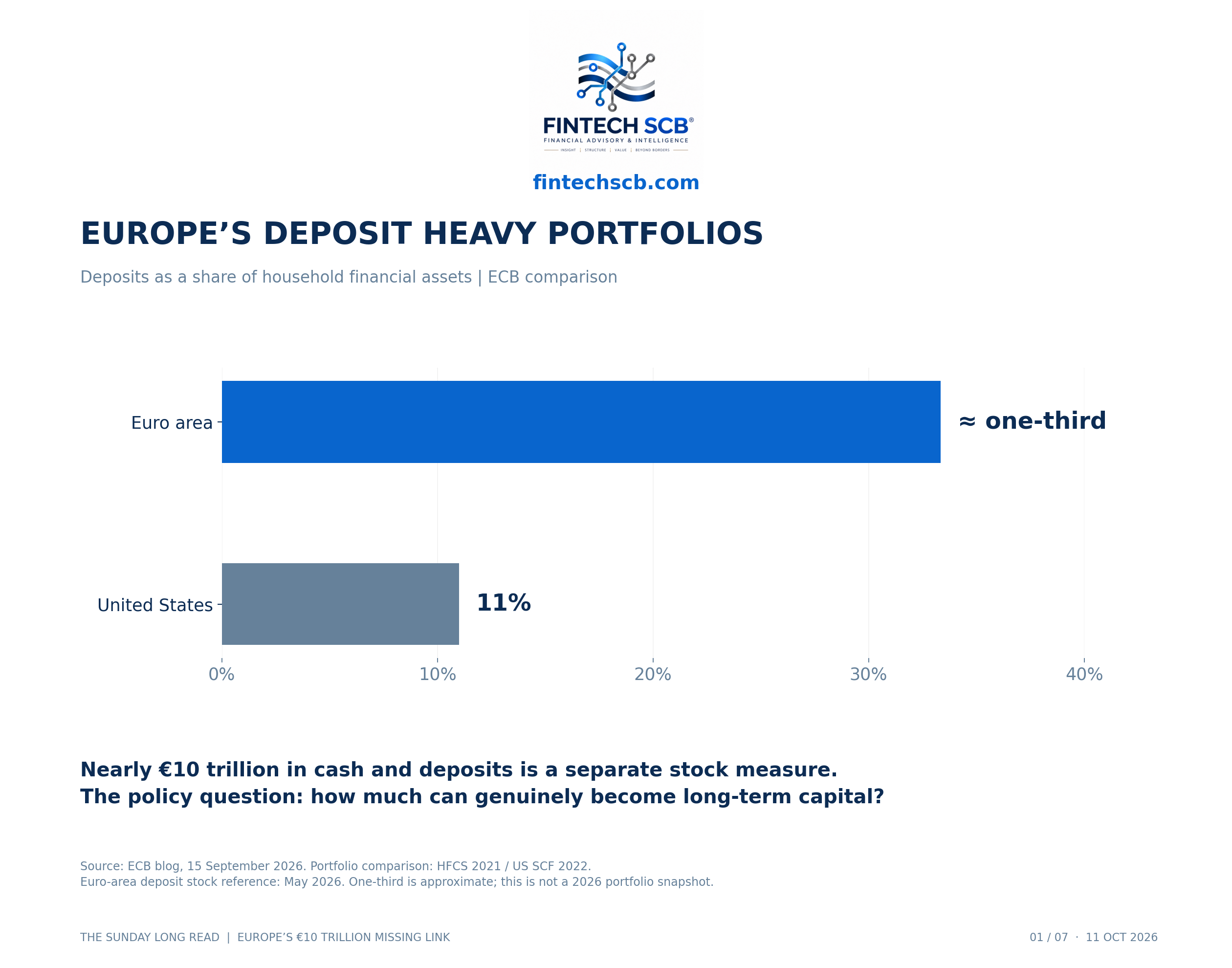
In September 2026, an ECB analysis highlighted nearly €10 trillion held by euro-area households in cash and bank deposits. Its portfolio comparison put deposits at approximately one-third of household financial assets in the euro area, against 11% in the United States.
The dates matter. The deposit-stock reference is May 2026. The portfolio comparison draws on the European HFCS 2021 wave and the US Survey of Consumer Finances 2022. These are separate observations, rather than one perfectly synchronised 2026 snapshot. “Euro area” also does not mean the whole of Europe. [1]
Chart 1 makes the structural contrast visible without disguising those differences.
Deposits are private property. Some pay next month’s bills. Some cover illness, unemployment or a planned purchase. Some belong to households for whom a capital loss would be devastating. Governments cannot responsibly treat this stock as an unclaimed industrial-policy budget.
Nor is money in a bank account economically inactive. Deposits are a source of bank funding. Banks also create deposits through lending; they do not simply redistribute a fixed jar of pre-existing savings.
The relevant question is how much wealth could voluntarily accept a longer horizon, and which institutions could convert that willingness into productive investment.
Moving money from a deposit into a fund does not necessarily remove deposits from the banking system: the seller or recipient may hold the proceeds in another account. But it changes ownership, funding relationships and the allocation of risk. Those changes deserve analysis.
Why the credit model reaches a boundary
Consider two hypothetical businesses.
The first operates a warehouse under established contracts. Its lender can examine rents, occupancy, asset values and debt-service capacity. If the borrower defaults, the building may retain substantial value.
The second develops an AI application for industrial research. Its main assets are a team, code, specialist knowledge and customer relationships still being established. It needs several years of funding before its business model is proven.
A secured loan may be appropriate for the warehouse. Loading the second business with scheduled repayments may make its development harder. If the technology succeeds spectacularly, a conventional lender generally receives the contracted interest and principal. If it fails, recoveries may be poor.
Equity provides a different bargain: investors accept losses in exchange for participation in the upside. A venture portfolio can accommodate individual failures, although diversification cannot guarantee that its winners will compensate for them.
Europe cannot expect tomorrow’s companies to arrive already equipped with yesterday’s collateral.
This is our structural hypothesis, not a claim that every European bank rejects innovation. Venture debt, specialised lending and bank-sponsored investment platforms already exist. The question is whether the overall system provides sufficient risk-bearing capacity at each stage of company development.
Weak growth opportunities can also cause households to favour deposits. Energy costs, fragmented markets, demographics and regulation influence both investment demand and financing supply. Two regional statistics cannot establish a causal relationship by themselves.
Our argument identifies a mechanism that policy can change and results that can be tested.
Who actually finances the American AI expansion?
The first answer is large, established companies with substantial cash generation.
Alphabet generated $164.7 billion of operating cash flow in 2025 and spent $91.4 billion on purchases of property and equipment. Microsoft reported $136.2 billion of operating cash flow and $64.6 billion of property-and-equipment additions in its fiscal year ending June 2025. Meta reported $115.8 billion and $69.7 billion respectively for the calendar year. [2–4]
Chart 2 compares those cash-flow measures. It excludes finance-lease principal payments from the equipment-purchase bars, distinguishes Microsoft’s reporting period and does not label all capital expenditure as AI spending.
The implication is substantial. Existing commercial success creates the resources to finance another technological cycle. Customers pay for advertising, software and cloud services. Those businesses generate cash. Management can then reinvest, alongside borrowing and other financing arrangements.
This does not prove that every dollar is wisely spent. It explains why an already profitable platform can finance an expansion that would be impossible for a young company reliant on external funding.
The second answer is venture and growth capital. Professional managers raise money from institutional and private investors and take equity positions in businesses with uncertain outcomes. Pension funds, endowments, foundations and other investors can participate without asking every individual beneficiary to select a startup.
The third answer is a broader financing and exit system. Bonds, bank lending, infrastructure finance, listings and acquisitions support different stages and risks. Successful exits can return capital to investors and make future commitments possible.
An acquisition or a secondary share purchase does not necessarily inject money into the company. Nevertheless, the prospect of a credible exit can make an initial investment more attractive.
These channels interact. They should not be added together carelessly: an investment in a startup, followed by that startup purchasing cloud services, can appear at different points in the same economic chain.
Europe has investors. Its problem is reaching sufficient scale
The claim that Europe has no significant venture capital is too broad. The more useful question is whether promising firms can repeatedly raise enough money to become global competitors.
The EIB’s scale-up study found that, by age ten, the European firms examined had raised approximately 50% less capital than their San Francisco peers. This is a comparison of selected company cohorts, not an aggregate estimate covering every American and European business. [5]
Chart 3 expresses that finding as an index: San Francisco peers at 100 and the European cohort at approximately 50. It does not invent a year-by-year funding curve.
A company can survive an early funding shortage by moving slowly. A persistent shortage during expansion can alter its competitive position: hiring is delayed, customer acquisition weakens and an overseas competitor establishes itself first.
The strategic issue is the continuity of financing. Europe needs a system that supports invention, commercial validation, expansion and eventual reinvestment by profitable companies.
That is how today’s externally financed challenger can become tomorrow’s internally financed investor.
FINTECH SCB’s proposal: a European Innovation Savings Compact
We propose a European Innovation Savings Compact: a framework joining voluntary long-term savings, institutional capital, specialist managers and commercially accountable public participation.
This is our policy proposal. It is not an existing product, a promise of returns or a request to transfer household deposits into a government-selected AI fund.
Its first principle is that household caution can coexist with collective capacity to finance uncertain projects. Institutions can spread investments across businesses, managers and years, while matching commitments to realistic holding periods.
Its second principle is that different risks need different investors. The framework should contain three distinct financing channels.
Infrastructure finance would support projects such as computing facilities and energy assets where contracts, counterparties and cash flows can be assessed. A data centre is not automatically a low-risk investment: equipment can become obsolete, customers can be concentrated and electricity supply can constrain operations.
Growth equity would finance businesses with demonstrated commercial traction that need capital for expansion, acquisitions or entry into new markets.
Venture capital would support earlier and less certain opportunities. Its investors would explicitly accept high failure rates, long holding periods and the possibility of losing capital.
Chart 6 sets out this architecture. Its purpose is to make responsibility legible: who supplies capital, who selects investments and which risks each channel bears.
Start with institutions; build a credible route for households
Institutional investors should anchor the framework. Their participation can provide continuity, negotiate fees and challenge investment assumptions. Their fiduciary obligations must remain central: a pension portfolio exists to serve its beneficiaries, not to conceal a government subsidy.
Household participation should be voluntary and appropriate to the investor’s circumstances. Access could be through diversified long-term vehicles, with investment limits and clear information about losses, valuation uncertainty and redemption restrictions.
A fund-of-funds structure can provide exposure to several managers and investment years. It can also create additional fees. Any publicly supported structure should disclose total costs across every layer, including distribution and performance fees.
Retail investors should not become the convenient destination for assets that sophisticated investors refuse to buy at the offered price.
Nor should an illiquid portfolio be sold with an implausible promise of immediate redemption. A secondary market can help, but the ability to sell at a discount is different from guaranteed access to the original investment amount.
Trust depends on explaining these features before subscriptions, and demonstrating fair treatment when conditions deteriorate.
Give the proposal an ambitious benchmark
Using a rounded €10 trillion base, 1% represents €100 billion. Spread evenly over five years, that would be €20 billion annually. The equivalent arithmetic for 3% and 5% is €300 billion and €500 billion, or €60 billion and €100 billion annually.
Chart 5 presents these as illustrative scenarios. They are not estimates of available household wealth, predicted subscriptions or an appropriate allocation for any individual.
We propose using the 1% scenario as a five-year design benchmark: can Europe create credible investment capacity capable of attracting that order of voluntary long-term funding?
An annual €20 billion benchmark is demanding enough to force operational choices. Which managers can deploy it responsibly? Which companies can absorb it? How much supports new issuance? How much reaches later-stage businesses? What fees are investors paying?
The answer may justify a slower deployment schedule. A numerical ambition must never become a requirement to fund weak projects.
This programme would not replicate the cash-generating power of the American technology giants immediately. It could help more European businesses reach the stage where they generate and reinvest substantial cash themselves.
What governments should change
Governments should reward duration and additional investment through stable, understandable incentives. Benefits should be capped and evaluated. Otherwise, an expensive tax measure may merely subsidise investors who would have bought the same assets anyway.
Public coinvestment should use independent selection and commercial scrutiny. Where a limited guarantee or first-loss commitment is justified, its exposure should be published and budgeted. Someone still bears the loss; changing its location does not make it disappear.
Public participation should also share appropriately in successful outcomes. Permanent protection of private upside at public expense would undermine both legitimacy and market discipline.
Europe must improve the commercial environment alongside financing. Public procurement can give young firms reference customers. Simpler cross-border operations can expand their reachable market. Predictable insolvency processes, workable employee incentives and credible exit routes can improve the investment proposition.
Competition policy still matters. Making acquisitions possible does not require endorsing every acquisition of a potential rival. The objective is a credible range of outcomes for founders and investors, including independent growth.
Finance alone cannot resolve shortages of electricity, specialist skills or customers. If a government supplies capital while leaving these obstacles untouched, it may inflate valuations faster than productive capacity.
Banks need a new commercial proposition
Banks should remain disciplined lenders. The policy challenge is to expand their role in a wider financing system.
They can identify suitable businesses, assess projects, distribute investment products, arrange financing and connect emerging companies with established corporate customers. Specialist equity managers should make venture decisions under clear mandates; ordinary credit committees should not be required to pretend that startup risk resembles mortgage risk.
The commercial incentive must be explicit. A bank benefits from inexpensive, stable deposits. It needs a sustainable business case for helping customers place some long-term wealth elsewhere.
The Compact should make transparent distribution, advisory services, custody and corporate financing commercially viable. Publicly supported programmes should disclose conflicts and total investor costs, with remuneration rules that discourage unsuitable sales.
Banks would gain an opportunity to serve companies as they grow: payments, treasury, international expansion, lending and capital-market transactions. The value of the relationship can extend beyond the original product sale.
A bank can help finance the future without carrying every venture investment on its own balance sheet.
Implementation should also monitor funding costs and credit conditions. Reallocation may affect banks differently. A programme that expands innovation equity while unnecessarily damaging viable small-business credit would need adjustment.
Europe must become a customer of its own innovation
Capital is only one side of a company’s growth equation. Revenue provides validation, reduces dependence on external financing and eventually creates capacity to reinvest.
Our proposal therefore includes a demand commitment: public bodies and participating corporations should publish accessible routes for innovative suppliers to compete for real contracts, with proportionate qualification requirements and prompt payment.
This should be competitive procurement, not automatic preference for an inferior product. A paid contract with demanding customers provides information that another subsidised pilot may not.
The European opportunity also extends beyond the most expensive frontier-model race. Industrial applications, scientific tools, enterprise software and productivity-enhancing adoption deserve capital on their commercial merits.
Success should be measured by valuable businesses and better economic performance, rather than by the size of a press release announcing computing capacity.
The crypto evidence complicates the cultural explanation
It is tempting to explain the funding gap by assuming that Americans naturally accept risk while Europeans avoid it. Crypto ownership provides a useful test of that story.
Gemini’s 2025 survey reported ownership among 24% of respondents in the United Kingdom, 22% in the United States and 21% in France. It surveyed 7,205 people across six countries, using an online sample restricted to ages 18–75 and household incomes of at least $14,000. It was commissioned by a crypto business. [6]
Chart 4 uses those three country observations from the same survey. It does not manufacture a European average or claim that the small differences are statistically significant.
These figures do not support a sweeping claim of dramatically higher American participation. They also cannot establish equal risk preferences: ownership says little about how much wealth is exposed, why an asset was bought or how long it will be held.
An easily accessible, tradable speculative asset is a different proposition from a venture commitment lasting many years.
The lesson for our proposal is that participation depends on product design, access, trust and liquidity as well as culture. Europe should test those barriers instead of using an assumed national temperament as the final explanation for its financing gap.
Build on existing initiatives—and demand evidence
The European Commission and EIB launched the European Institutional Investors Pact on 22 September 2026. Thirteen institutional investors had expressed intentions to channel investments into the innovation and scale-up ecosystem. The announcement connects this effort with ETCI 2.0 and a Scaleup Europe Fund targeting €5 billion in commitments. [7]
These initiatives demonstrate that the institutional financing problem is recognised. Announced targets, intentions and money actually invested remain different measures.
Our Compact would connect institutional initiatives to a broader distribution and demand strategy, with a common reporting discipline.
Chart 7 proposes four stages: commitments, capital paid in, completed investments and company outcomes. Each programme should separate new company financing from secondary purchases and disclose fees, public exposure and realised returns.
Independent evaluation should ask whether supported firms obtained financing they otherwise lacked, whether private investment was additional, and whether benefits justified public costs. Performance should be assessed over appropriate horizons and against credible comparisons.
The programme also needs stopping rules. Persistently weak underwriting, excessive fees or dependence on repeated subsidies should trigger redesign, manager replacement or closure.
The proposal must survive failure
An innovation strategy that cannot tolerate failed investments will eventually finance only projects that look safe in advance. That recreates the original financing gap.
Tolerance for commercial failure must coexist with intolerance for mis-selling, political favouritism and misleading valuations.
The household keeps a suitable liquidity buffer. The investor accepts a defined exposure. The manager is accountable for selection and costs. The bank explains what it distributes. Public authorities disclose the risk they assume.
This division of responsibility gives Europe a realistic way to combine private prudence with economic ambition.
Our position is clear: Europe should stop expecting a deposit-centred financial system to produce, on its own, the risk-bearing capacity required for technological leadership.
Build the equity channel. Give it institutional scale. Make participation voluntary, costs visible and public support accountable. Create customers for the businesses it finances. Judge the results by capital deployed and companies built.
The €10 trillion figure describes the scale of the question. Europe’s answer will be determined by the institutions it is prepared to build.
Roberto Balbino
FINTECH SCB — Financial Advisory & Intelligence
https://fintechscb.com
Sources and chart methodology
[1] ECB, “Why Europeans save differently — and how to put those savings to work,” 15 September 2026. Deposit stock: May 2026; portfolio comparison: HFCS 2021 and SCF 2022.
https://www.ecb.europa.eu/press/blog/date/2026/html/ecb.blog20260915~dacebb4a6f.en.html
[2] Alphabet, fourth-quarter and full-year 2025 results, cash-flow statement.
https://s206.q4cdn.com/479360582/files/doc_financials/2025/q4/2025q4-alphabet-earnings-release.pdf
[3] Microsoft, FY2025 fourth-quarter earnings release and cash-flow statement. Fiscal year ended 30 June 2025.
https://www.microsoft.com/en-us/Investor/earnings/fy-2025-Q4/press-release-webcast
[4] Meta, fourth-quarter and full-year 2025 results. Chart uses $69.691 billion of PPE purchases, excluding $2.524 billion of finance-lease principal repayments.
https://investor.atmeta.com/investor-news/press-release-details/2026/Meta-Reports-Fourth-Quarter-and-Full-Year-2025-Results/default.aspx
[5] EIB, The Scale-up Gap (2024). Chart index is calculated from the reported approximately 50% funding shortfall at age ten.
https://www.eib.org/en/publications/online/all/the-scale-up-gap
[6] Gemini, Global State of Crypto 2025. Industry-sponsored survey; selected countries are not a European aggregate.
https://www.gemini.com/blog/introducing-the-2025-global-state-of-crypto-report
[7] EIB / European Commission, European Institutional Investors Pact announcement, 22 September 2026.
https://www.eib.org/en/press/all/2026-306-european-commission-and-eib-group-launch-institutional-investors-pact-to-boost-investment-in-tech-scale-ups
Charts 5–7 contain FINTECH SCB scenario calculations and policy proposals, rather than observed funding flows or forecasts. The article advances a financing hypothesis; it does not claim an estimated causal effect of household deposits on AI investment. Information checked on 11 October 2026.
Originally published on Substack.
Segui Roberto Balbino su Substack