
Inflation Before the Oil
Prices arrive first
Imagine a coastal town receiving extraordinary news. A commercially promising oil field has been discovered offshore. Engineers will arrive. A port may expand. The government talks about roads, schools and a different economic future.
Commercial production is still years away.
The town's landlords do not necessarily wait. A property owner expects future tenants with larger budgets. A contractor bids for land. A bank considers lending against the prospect of rising activity. A young worker begins training for the energy sector. A government ministry commissions a project.
There is no new stream of petroleum revenue available to distribute yet. There is already a new set of prices, expectations and commitments.
For a household that rents its home and works outside the emerging industry, the first experience of national wealth may be a higher living cost.
This is an illustrative town, not a report of a particular discovery. It captures an economic mechanism that deserves more attention: credible expectations about future income can change present behaviour before the productive asset starts delivering that income.
The political celebration concerns what the country may eventually earn. The economic adjustment can begin much sooner, and its benefits and costs need not reach the same people.
What the new research says
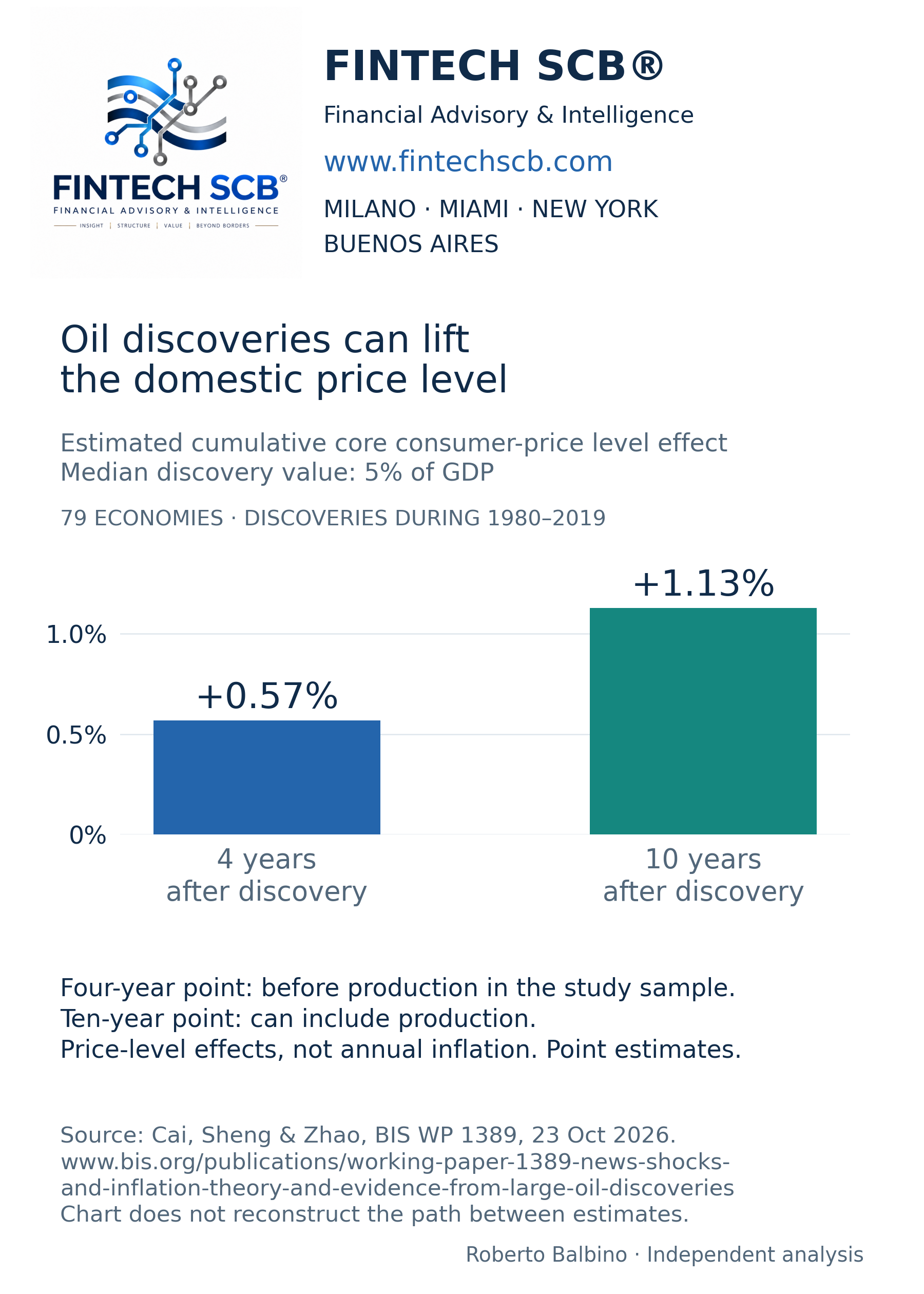
A BIS working paper published on 23 October 2026 studies 1,309 large oil and gas discoveries across 79 economies during 1980–2019. For a discovery with a median estimated value of 5% of GDP, the estimated cumulative increase in the core consumer-price level is 0.57% after four years and 1.13% after ten. [1]
Those are price-level differences relative to an estimated counterfactual, not annual inflation rates. The sample focuses on discoveries with at least five years before realised production. The results identify an average historical relationship, not a forecast for any current discovery.
The accompanying chart shows only the four-year and ten-year point estimates. The four-year point precedes production under the sample design; the ten-year point can include production and is not a pure anticipation estimate. The chart does not invent a path between them or imply that every country experiences the average.
The analytical question is how a future income stream changes today's claims on land, labour, credit and public spending.
Wealth is a claim on future goods
A resource in the ground can have economic value before it produces cash. Its value reflects an expectation of future output, prices, costs, taxes and risk. That expectation can influence borrowing and investment decisions immediately.
But a valuation is not a warehouse full of available goods. It does not instantly create additional housing, skilled workers, transport capacity or public administration.
This distinction explains why a country can become wealthier in a balance-sheet sense while some domestic prices rise before living standards broadly improve. People and institutions attempt to bring future income into present spending. Supply takes time to respond.
Consider a purely illustrative community with 1,000 suitable rental homes and little ability to add more in the next year. If an anticipated project brings additional demand for 100 homes, the adjustment cannot occur entirely through new construction. Some will occur through prices, occupancy or the displacement of other tenants.
The community's problem is not that the discovery has no value. It is that future value and current capacity operate on different calendars.
The effect may be milder if accommodation can be imported, built quickly or supplied from nearby areas. It may be stronger when land, permits, infrastructure or skilled construction workers constrain the response. Geography and institutions shape the outcome.
Why local services matter
Many internationally traded goods can be imported when domestic demand increases. A country can buy machinery or vehicles from abroad, subject to financing, logistics and trade conditions.
A home near the worksite, a local electrician, a school place or a medical appointment cannot be imported in quite the same way. Additional demand for such services can meet a comparatively rigid short-term supply.
The result is a distributional change. Property owners and businesses serving the new industry may gain. Workers whose wages adjust slowly may lose purchasing power. Public employees can face higher living costs while the government's durable revenue improvement is still prospective.
This can create an apparently paradoxical public mood. National expectations are optimistic, yet some households feel poorer. Their experience is not necessarily a misunderstanding of the macroeconomic news. They may be facing costs before receiving benefits.
The policy problem is therefore more precise than “avoid inflation”. It is to expand the relevant capacity and manage the timing of claims on it, while deciding how the gains and transitional costs will be shared.
The exchange rate changes the route
An economy with a flexible currency can absorb part of an expected resource windfall through nominal appreciation. Imported goods then become cheaper in domestic currency, other things equal. That can offset some price pressure.
The adjustment has another side: domestic firms selling into world markets may become less competitive in foreign-currency terms. A local producer that cannot match the resource sector's wages can also lose workers or face higher costs.
With a relatively inflexible exchange rate, less of the adjustment can occur through the currency's nominal value. Domestic prices and wages may have to do more of the work. The BIS research finds a stronger inflation response in less flexible exchange-rate regimes. [1]
That is not a universal argument for floating. Exchange-rate arrangements involve credibility, financial contracts, trade structure and policy capacity. A sudden currency movement can create its own balance-sheet problems when obligations are denominated in foreign currency.
The appropriate lesson is that the regime affects the channel of adjustment. It cannot abolish the underlying scarcity of resources or ensure that every group benefits equally.
The fiscal temptation arrives early
The government's problem is especially difficult because political demands respond to announcements faster than revenue systems respond to production.
Citizens reasonably ask why a country with a valuable discovery should continue to tolerate poor roads, limited healthcare or unreliable electricity. A government can finance investment before the oil arrives, potentially improving the economy's ability to benefit from it.
Some advance investment may be highly productive. Port improvements, skills, basic infrastructure and administrative capacity can support both the energy project and the wider economy.
But future revenue is contingent. Project execution, financing, recovery costs, international prices and contractual terms can all change the amount and timing available to the budget. A geological discovery and a fiscal windfall are not interchangeable concepts.
The critical distinction is between spending that increases productive capacity and commitments that permanently raise expenditure before a robust revenue base exists.
A hospital building is a capital project. Operating the hospital requires staff, supplies and maintenance year after year. The budget must evaluate both. Counting the construction cost while ignoring the continuing commitment understates the fiscal decision.
Borrowing against an optimistic revenue path can make the government dependent on that path before it has materialised. A delay then becomes a financing problem as well as a project problem.
The danger of one shared forecast
Suppose, illustratively, a government, several banks and local property developers all expect large new revenue from year five. Each makes a commitment that appears manageable under that scenario.
The government raises spending. Banks expand credit. Developers acquire land. Households take on obligations in anticipation of better employment. Each decision may look prudent in isolation because the expected discovery is valuable.
If production is delayed or net public revenue disappoints, the common assumption fails across several balance sheets at once. Public spending slows, borrowers struggle, property demand weakens and banks reconsider credit.
The source of fragility is correlated confidence in one future event. Diversifying the names on a loan book does little if their cash flows ultimately depend on the same project schedule.
This suggests a practical discipline: stress the economy against later production, lower prices and lower fiscal receipts separately and together. The objective is to understand what must adjust, not to select a pessimistic forecast for its own sake.
Guyana shows why the outcome is not predetermined
Guyana provides a useful contemporary comparison, although it is already an oil-producing economy and therefore is not a clean test of a pre-production mechanism.
The IMF's 8 October 2026 assessment reports that real GDP grew by more than 19% in 2025 while average inflation was 3.3%. It also records approximately US$3.3 billion in the Natural Resource Fund at end-2025 and calls for continued attention to wages and competitiveness. [2]
The coexistence of extraordinary growth and comparatively contained average inflation is a reminder that a resource expansion does not mechanically imply an inflation crisis. Imports, policy, savings and supply capacity can alter the outcome.
At the same time, a national consumer-price average cannot describe every housing market, occupation or region. Nor can rapid aggregate GDP growth reveal how much of the additional income reaches a particular household.
The analytical task is to separate petroleum output, non-oil activity, domestic capacity, distribution and public wealth. Compressing them into a single growth number produces impressive headlines and limited understanding.
Suriname illustrates the importance of sequencing
The IMF's February 2026 consultation assessment of Suriname discusses anticipated offshore production from 2028 and substantial oil-investment imports financed largely by foreign direct investment. It also identifies fiscal and monetary slippages as sources of renewed instability. [3]
The distinction matters. A current-account deficit associated with imported equipment for a productive project is different from one caused by a consumption boom financed with unstable borrowing. The headline external balance needs its financing and composition alongside it.
Equally, inflation in an economy awaiting oil cannot automatically be attributed to oil expectations. Fiscal decisions, monetary conditions, exchange-rate movements and existing vulnerabilities may be central.
The useful lesson is about sequencing. Building institutions, maintaining credible macroeconomic management and preparing productive capacity before large receipts arrive can be as important as negotiating the project itself.
This is why current country examples should illuminate mechanisms rather than be used as convenient proof of a cross-country average.
Norway's framework asks a different question
Norway's framework, operating since 2001, channels the state's net petroleum cash flow into its sovereign wealth fund. Withdrawals are guided over time by the expected real return, with the benchmark reduced from 4% to 3% in 2017. It also allows attention to the economic cycle. [4]
The conceptual achievement is the separation of three decisions: extracting a finite asset, investing financial wealth and deciding how much domestic spending the economy can absorb.
A newly wealthy country cannot simply copy Norway's starting conditions. Public infrastructure needs, administrative capacity, access to finance and the scale of existing savings may differ substantially.
Still, the principle is portable. A deposit of oil is a finite asset. Spending all the proceeds as they arrive converts that asset into current expenditure. Saving some abroad can preserve wealth and limit the pressure created by injecting the entire windfall into a small domestic economy at once.
The harder judgment concerns worthwhile investment today. Underinvestment in basic services can be costly, but calling expenditure “investment” does not make its return attractive. Projects need appraisal, procurement capacity and realistic operating budgets.
A fiscal rule helps discipline the decision. It cannot substitute for the institutions that implement it.
The geopolitical dimension
A major discovery can change bargaining power before it changes national income. Companies seek contracts, governments pursue access, and foreign partners offer financing or infrastructure.
The resource-owning state faces a negotiating problem under uncertainty. It wants investment and expertise without giving away an excessive share of potential value or accepting obligations it cannot manage.
The quality of the agreement depends on more than the headline tax rate. Cost recovery, timing, risk allocation, environmental responsibilities, local procurement and transparency can all affect the eventual public benefit. These considerations vary by contract and jurisdiction; no universal optimum follows from a single discovery.
There is also strategic dependence. An economy that builds its budget and external relationships around one resource may gain immediate attention while becoming more exposed to an international commodity cycle.
The durable opportunity is to use the windfall to broaden domestic capability. The opposite outcome is an economy whose institutions, banks and political promises all become claims on the same barrel.
What should be measured before the celebration
I would examine rents and service prices separately from the national CPI. I would track wages across resource and non-resource sectors, credit secured on land, the share of spending backed by current rather than expected revenue, and the quality of the public-investment pipeline.
I would also publish alternative revenue schedules. What happens if commercial production starts two years later? What remains affordable with lower net receipts? Which commitments can be adjusted, and which are permanent?
These questions are not arguments against development. They are a way to make development more likely to improve living standards.
The new research has limitations. Discovery locations, exploration activity and exchange-rate regimes are not randomly assigned; valuation assumptions and sample selection matter. Its average estimate should therefore be treated as evidence to investigate, rather than a mechanical inflation coefficient for an individual country.
My broader conclusion is that resource wealth has a timing problem as well as a governance problem. The country can begin spending, borrowing and repricing long before it can distribute the cash.
The first economic effect of a discovery may arrive in the rent paid by a household that owns no oil. A successful national strategy must recognise that household early enough for the eventual prosperity to mean something beyond a larger GDP number.
Sources and data notes
[1] Bohou Cai, Liugang Sheng and Hongyan Zhao, News shocks and inflation: theory and evidence from large oil discoveries, BIS Working Paper 1389, published 23 October 2026. Historical sample: 1980–2019. Cumulative core-price estimates are relative to a counterfactual, not annual inflation forecasts.
https://www.bis.org/publications/working-paper-1389-news-shocks-and-inflation-theory-and-evidence-from-large-oil-discoveries
[2] IMF, 2026 Article IV consultation with Guyana, 8 October 2026. The quoted growth, inflation and fund figures refer to 2025 or end-2025, not 2026 outcomes.
https://www.imf.org/en/news/articles/2026/10/08/pr26330-guyana-article-iv
[3] IMF, 2025 Article IV consultation with Suriname, publication of 11 February 2026. Production dates are projections from that assessment, not guarantees.
https://www.imf.org/en/news/articles/2026/02/11/pr-26043-suriname-imf-executive-board-concludes-2025-article-iv-consult
[4] Norwegian Ministry of Finance, The Norwegian Fiscal Policy Framework, updated 7 October 2022. Historical description of the framework and its 2017 adjustment.
https://www.regjeringen.no/en/topics/the-economy/economic-policy/economic-policy/id418083/
Town, housing and financing examples are the author's illustrations. The chart contains published point estimates only; it is not a country forecast or a reconstructed annual series. Policy conclusions and scenarios are independent analysis.
Roberto Balbino — Founder & CEO, Fintech SCB
Independent analysis of finance, economics, geopolitics and global markets
www.fintechscb.com
#Oil #Inflation #EnergyEconomics #SovereignWealth #EmergingMarkets #Geopolitics #RobertoBalbino #FintechSCB
Originally published on Substack.
Segui Roberto Balbino su Substack