
LSEG, OCTUS AND THE PRICE OF TRUST IN THE AI ECONOMY
Why a $3.535 billion acquisition challenges the idea that cheaper artificial intelligence will automatically make financial intelligence cheaper.
By Roberto Balbino
22 October 2026
Artificial intelligence promises to reduce the cost of producing analysis. Financial markets still have to decide who will capture the saving.
An investment team may be able to search documents, compare companies and prepare research faster. Its information bill could nevertheless increase if the most useful evidence remains scarce, legally restricted or embedded in a small number of essential platforms. Productivity gains and supplier pricing power can rise together. Whether the customer benefits depends on the relationship between them.
The Financial Times report on LSEG’s agreement to buy credit intelligence specialist Octus provides a useful starting point for examining that tension. The FT describes an expansion of LSEG’s financial data business. My interpretation is that the transaction also reveals a strategic response to AI: strengthen control over the evidence, expertise and distribution that an increasingly interchangeable analytical interface still needs. [1]
That interpretation requires two qualifications. Valuable data does not automatically justify any acquisition price. And an expensive transaction does not, by itself, prove that a buyer is overpaying or that customers will face higher charges. Both conclusions require evidence beyond the headline.
The official announcement supplies the essential facts. LSEG agreed to pay $3.535 billion in cash, funded through external debt. Completion is expected in the first half of 2027, subject to regulatory approval. LSEG forecasts Octus revenue above $300 million in 2026 and an adjusted EBITDA margin around 40%. It describes a business with 750 customers and more than 40,000 individual users. The agreement has been announced; the acquisition has not yet completed. [2]
Those customer and user figures measure different things. An institutional account may contain many users, products and contractual arrangements. Dividing revenue by individual users would not reveal the price of a subscription, while dividing it by customers would conceal substantial differences between contracts. Even a simple revenue-per-customer calculation needs a consistent period and customer definition before it becomes useful.
A credible critique must also acknowledge what happened under the seller’s ownership. Permira says Octus more than tripled its annual recurring revenue during roughly four years and nearly doubled its product count. The business also acquired FinDox, Sky Road and LevPro. This is evidence of substantial expansion, although it does not separate organic growth from purchased revenue. [3]
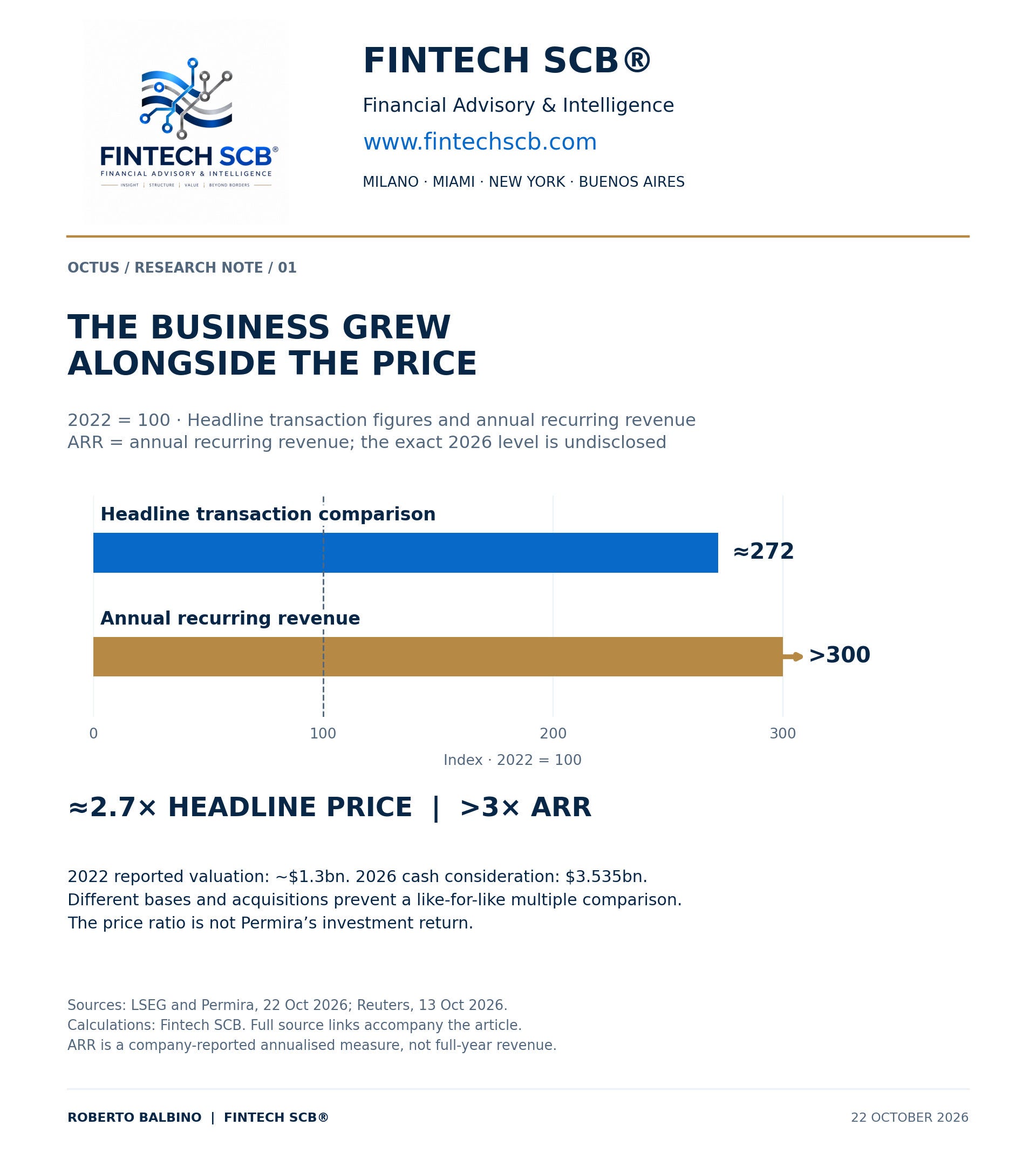
Reuters previously reported a valuation of approximately $1.3 billion when Permira acquired control in 2022. Comparing that figure with the new announced consideration produces a headline ratio of about 2.7 times. It is not Permira’s investment return: ownership percentages, debt, additional investment, acquisitions and distributions matter. [4]
Figure 1 compares these two developments using 2022 as an index of 100: the headline transaction figure reaches approximately 272, while reported annual recurring revenue exceeds 300. The ARR bar ends with an arrow because its exact endpoint is undisclosed.
The comparison prevents a misleading argument that a static business has simply been resold at a dramatically higher price. It does not establish that the valuation multiple fell. The transaction basis, business perimeter and revenue measure are not sufficiently aligned for that conclusion. Annual recurring revenue is also a point-in-time annualised measure, rather than revenue recognised over a financial year. What we can say is that operating expansion belongs at the centre of the valuation discussion.
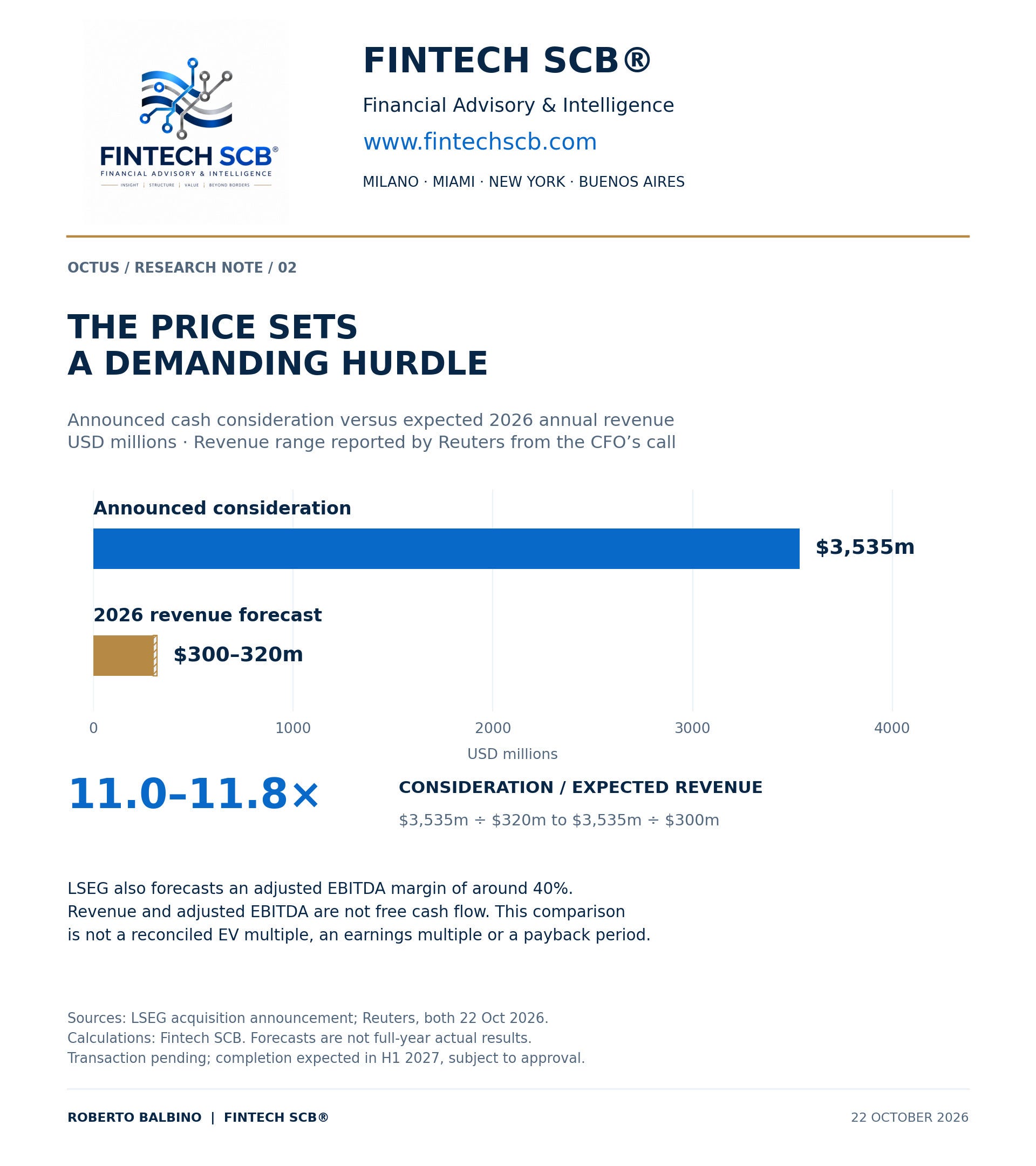
The financial hurdle remains demanding. Reuters reported the CFO indicating expected 2026 revenue of $300 million–$320 million. On that range, the announced cash consideration is approximately 11.0–11.8 times annual revenue. Figure 2 shows the calculation. This is a consideration-to-revenue comparison, not a fully reconciled enterprise-value multiple, an earnings multiple or a payback period. [2, 5]
A revenue ratio cannot tell us how many years it takes to recover an investment. Revenue pays for people, technology, data acquisition, sales, administration and the other resources required to keep the business useful. Adjusted EBITDA then requires its own reconciliation to cash: taxes, investment, working capital, financing and adjustments all affect what ultimately reaches the owner.
The relevant valuation question is whether future incremental cash flows, after integration and reinvestment, compensate for the purchase price and risk. A business can be strategically attractive while leaving its buyer a thin financial margin for error. Conversely, a high initial revenue ratio can be justified by durable growth and cash generation. The announcement does not provide enough evidence to settle that argument through a single multiple.
LSEG expects the deal to be neutral to adjusted earnings per share in the first full year after completion and accretive thereafter. [2] That is a financing and earnings expectation. It is not an assurance that the investment will earn more than its economic cost of capital. Shareholders should assess the price paid, the cash conversion and the persistence of growth alongside the presentation of accretion.
My central thesis concerns what becomes scarce when analytical processing becomes cheaper. Producing another summary can become inexpensive. Obtaining a current document, checking its provenance, reconciling it with earlier versions and connecting its provisions to a specific security can remain costly. These tasks require continuing work, access and judgement. A collection of files becomes commercially valuable when customers can use it reliably in decisions that matter.
There are several distinct sources of value here. Some information is public but difficult to assemble and maintain. Some is available only to authorised recipients. Some value comes from original reporting or expert interpretation. Further value comes from linking borrowers, instruments, guarantees, financial statements and amendments into a consistent record. These sources should be analysed separately because they have different competitive and legal foundations.
A public document can support competing products. A proprietary analytical conclusion can face a better rival interpretation. A permissioned document may be available to several authorised organisations without becoming public. An acquisition of the service provider does not turn every underlying borrower document into unrestricted intellectual property. The durability of the business depends partly on the rights it actually holds and the usefulness it adds.
Octus’s March 2026 CreditAI announcement describes a product combining its intelligence with permissioned documents and source references. Those are company descriptions of capabilities, not an independent accuracy audit. [6] The meaningful implication is that a specialist provider can supply both the evidence and a way to interrogate it. It does not establish that every answer is correct or that a general model connected to equivalent evidence could never compete.
This distinction matters when evaluating the claim that proprietary data is protected from AI. A general model without authorised access cannot retrieve a restricted source merely by sounding confident. A rival with lawful access, effective document processing and an experienced team may nevertheless build a competing service. The competitive defence must be assessed against that stronger alternative, not against an empty chatbot.
There is also a distribution argument. LSEG describes its Model Context Protocol connection as a way of delivering licensed content into customers’ AI applications while respecting access permissions. [7] This permits a possible change in where the customer sees the product: the interface can move into another application while the underlying data relationship remains commercial.
In my view, that is one of the most consequential features of the transaction. A data provider may preserve its economic role even when it loses exclusive control of the screen. It can charge for the information and services consumed inside a customer’s preferred workflow. The commercial advantage then depends less on requiring a user to open a particular terminal and more on providing something the workflow needs.
An open technical connection can lower integration costs without changing the price of the content it carries. Equally, it can make it easier to compare suppliers and combine competing sources. Both effects are plausible. The outcome will depend on contractual terms, portability, the availability of substitutes and the customer’s ability to negotiate. It would be premature to treat interoperability as either the end of incumbent pricing power or a guarantee of its survival.
Private credit makes the distinction between information and interpretation particularly important. The IMF estimated that the market exceeded $2.1 trillion in assets and committed capital in 2023, while identifying valuation opacity and gaps in information about interconnected exposures. That is a dated benchmark, not an estimate of today’s market size. It establishes the scale at which information weaknesses already mattered. [8]
Consider what an analyst actually needs to know about a loan. A headline interest rate and a reported leverage ratio are only the beginning. The contractual definition of earnings can differ from an accounting figure. A covenant may apply only under specified conditions. Debt can sit at different entities with different guarantees and priorities. An amendment can change the economic meaning of a document that remains searchable in an archive.
These are general examples of analytical problems, not allegations about an Octus customer or product. They illustrate why extracting a number is only one stage of credit research. The analyst must establish what the number represents, when it applied, which obligations it covers and whether the source is complete.
Payment-in-kind interest provides another example. Where a contract allows it, interest can be added to the outstanding principal rather than paid in cash. Federal Reserve staff describe this contractual flexibility in their analysis of private credit. [12] Its presence alone does not prove distress. But a system that places capitalised interest and cash interest into one undifferentiated category can make a borrower’s financing position harder to understand. The quality of the classification matters as much as the speed of extraction.
The same discipline applies to covenant changes. A borrower may obtain a waiver or amendment that prevents a technical breach while leaving its underlying cash generation unchanged. A research system should help users distinguish changes in legal terms from changes in economic performance. A polished answer that blurs those differences can be more dangerous than an incomplete answer that clearly identifies what is missing.
Source citations improve auditability, but a citation is the beginning of verification. A model can cite the wrong version, retrieve a relevant passage while missing an exception, or apply the correct clause to the wrong entity. A serious evaluation therefore needs difficult cases: amendments, conflicting documents, missing information, ambiguous definitions and situations where the appropriate response is to decline a conclusion.
I would assess such a system through error severity and detection as well as average accuracy. Missing a material restriction and misformatting a date should not carry the same weight. Useful measures include document coverage, update delay, false negatives on critical provisions, correction time and the ability to reproduce an answer from the evidence available at the time. These are proposed evaluation criteria, not performance results reported for Octus.
Better information can improve underwriting and monitoring. It cannot manufacture a buyer for an illiquid asset, compel a borrower to generate cash, or remove uncertainty about recovery values. A more detailed dashboard may help investors discover a problem earlier while leaving the problem itself intact. That distinction should discipline both product marketing and expectations about the wider benefits of financial data.
There is a further commercial tension. Simplifying the user’s workflow can increase dependence on the provider that supplies it. When research, portfolio monitoring, document history and analytical conventions become integrated, switching involves more than replacing a login. Customers may need to rebuild processes, check mappings, retrain teams and establish which historical materials they can retain.
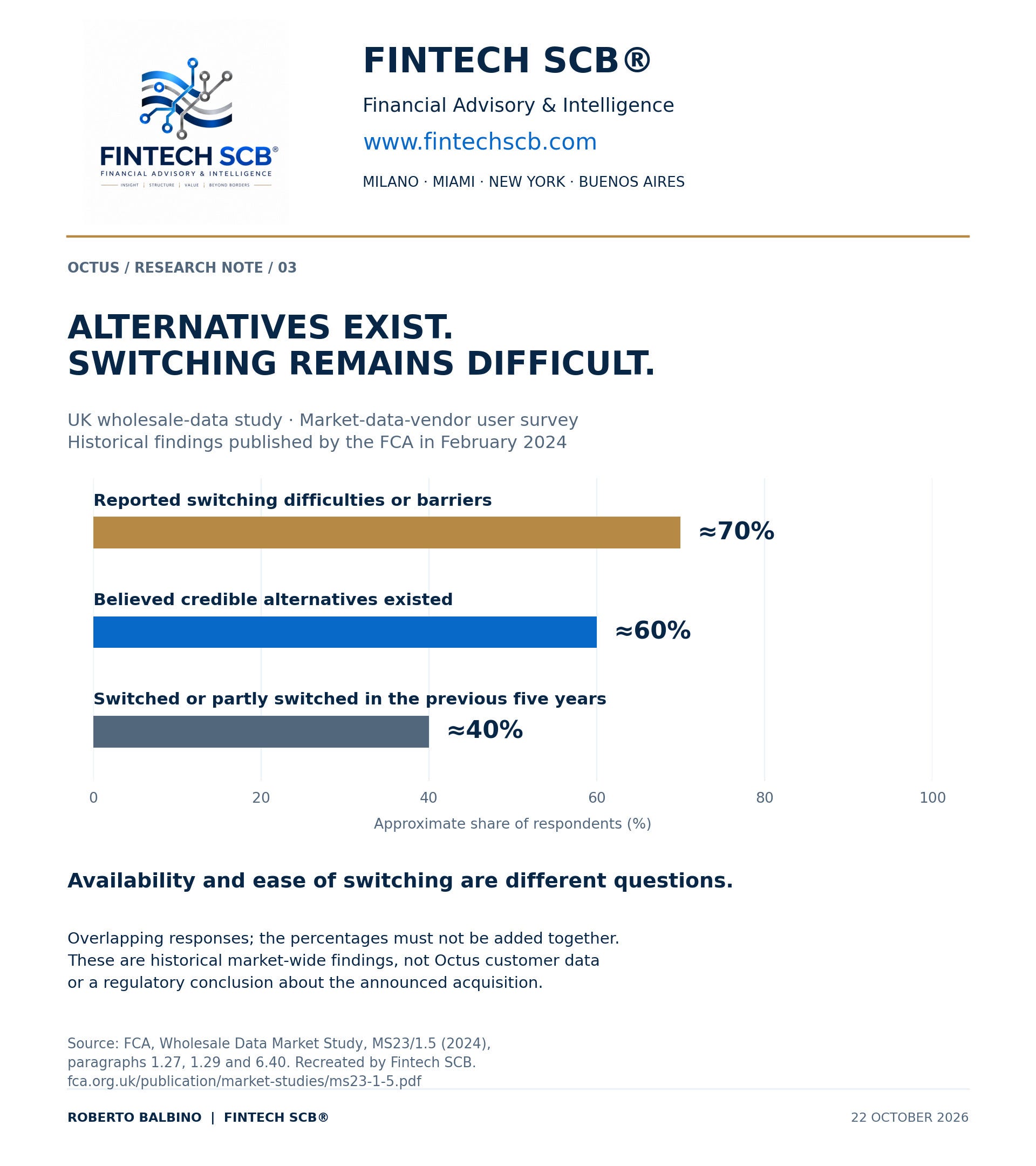
The FCA’s 2024 Wholesale Data Market Study supplies relevant context. Among surveyed market-data-vendor users, around 60% saw credible alternatives, around 70% reported switching difficulties or barriers, and around 40% had switched or partially switched during the preceding five years. These are overlapping answers to different questions. They are not percentages of Octus customers. Figure 3 presents them on that basis. [9]
The FCA also found that firms generally could obtain the data they needed, while identifying market power and competition concerns. [9] Both findings deserve attention. A market can deliver useful products and still leave customers with limited bargaining power. Equally, a high renewal rate can reflect genuine satisfaction. Retention alone cannot distinguish exceptional value from costly exit.
This is why I would avoid treating subscription revenue as automatically defensive. Its quality depends on why customers renew, what they purchase, how much they use it and what happens when their budgets tighten. A renewal supported by better coverage and measurable time savings has a different economic foundation from one sustained mainly by the cost of replacing embedded processes.
Annual recurring revenue also needs a bridge. Management should distinguish new customers, expansion within existing accounts, contractual price changes, cancellations, currency movements and acquisitions. Gross retention and net retention answer different questions: expansion at large accounts can conceal losses elsewhere. Headline growth becomes more informative when investors can see the underlying customer cohorts and the cash required to serve them.
AI adds a potential complication to seat-based pricing. If automation allows a team to complete the same work with fewer individual users, a provider may face pressure on seat counts even as its data becomes more important. Charging for usage, enterprise access or particular workflows could address that pressure, but each approach changes the customer’s incentives and the predictability of spending. This is a business-model risk to examine, not a prediction that Octus’s current pricing will fail.
The cycle also deserves a more careful treatment than the assumption that financial information always sells. Credit stress may increase demand for restructuring research and covenant analysis. The same stress may reduce assets under management, suppress new transactions and squeeze customer budgets. Those forces can coexist. Whether a specialist provider benefits requires evidence about its revenue mix, customer exposure and renewal behaviour through different conditions.
Integration creates another test. LSEG intends to combine Octus content with its existing products and distribution. [2] The potential benefits are understandable: customers may obtain broader coverage with less reconciliation work. But additional sales are valuable only after considering implementation costs, duplicated products, migration burdens and the possibility that clients consolidate spending rather than expand it.
The expertise that produces a useful dataset also needs protection. If acquisitions are followed by cost reductions that weaken original reporting, legal interpretation or data maintenance, an attractive margin can temporarily conceal deterioration in the asset being purchased. I am describing a risk to monitor, not claiming that LSEG plans such cuts. The appropriate evidence would include coverage, correction rates, update frequency and retention of specialist capability.
There is a system-wide question beyond the buyer and its customers. The Financial Stability Board’s 2024 report on AI identified third-party concentration, market correlations, cyber risk and weaknesses in models, data and governance as potential vulnerabilities. [10] These concerns do not establish that this acquisition creates a systemic threat. They help explain why common infrastructure requires scrutiny even when individual users find it efficient.
My concern is that institutions can diversify their portfolios while becoming less diversified in the evidence and models used to evaluate them. A classification error, missing amendment or faulty mapping shared across many workflows could affect multiple decisions. Faster processing may allow an error to propagate sooner, just as faster correction may limit its impact. The operational design determines which effect dominates.
Independent checks therefore retain value in an automated investment process. A second data source is useful only if it provides meaningful independence; two interfaces may rely on the same underlying feed. Human review is useful only if reviewers have the time, authority and evidence to challenge the output. A nominal control that always approves the machine’s conclusion contributes little.
For customers, the practical response is to negotiate the information relationship as carefully as the software demonstration. Contracts should make permitted uses, internal AI access, export rights, correction processes and termination arrangements understandable. Investment teams should ask what remains available after a subscription ends and how historical research can be reproduced within the applicable rights. Procurement needs a view of total operating cost, including integration and validation, rather than the licence fee alone.
For investors in the acquirer, my preferred evidence would be organic growth separated from acquisitions, retention separated from price effects, incremental sales separated from product substitution, and adjusted earnings reconciled to cash. I would also want evidence that customers obtain better decisions or measurable workflow savings. That is more informative than counting how many new AI features appear in a product announcement.
For the wider market, the desirable outcome combines investment in original information with practical scope for customers to compare, combine and replace services. That does not require every proprietary dataset to become free. It does require attention to whether contractual and technical arrangements preserve meaningful choice. Productivity gains are more valuable when users can retain part of them and competitors can still challenge established suppliers.
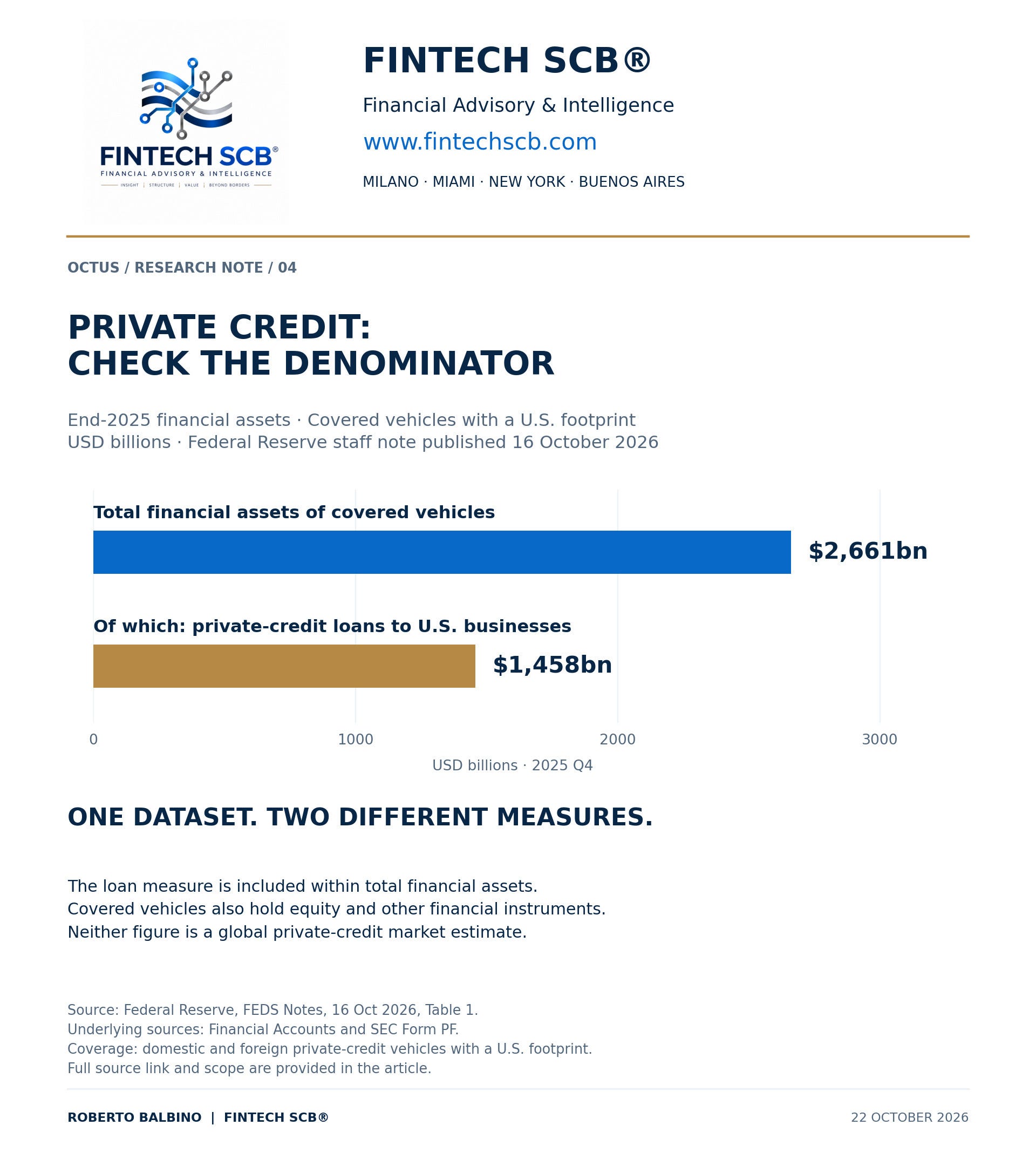
Public measurement is already improving. A Federal Reserve staff note published on 16 October 2026 explains the addition of private-credit sectors and instruments to the Financial Accounts, beginning with the September release. Its end-2025 table reports $2.661 trillion of financial assets for covered vehicles with a U.S. footprint, including $1.458 trillion of private-credit loans to U.S. businesses. Figure 4 compares those measures. They are not competing estimates of the same market, and neither is a global total. [11]
That distinction is financially consequential. Assets held by a credit vehicle can include equity and other financial instruments; they cannot all be described as loans to domestic businesses. Likewise, committed capital, invested assets, outstanding credit and the revenues available to data suppliers describe different economic quantities. Selecting the largest available headline and calling it the addressable market creates an illusion of precision rather than a valuation argument.
My inference from the improvement in public measurement is that no supplier should assume every information gap will remain commercially defensible. More accessible aggregate statistics could reduce the value of basic market summaries while leaving substantial demand for timely borrower-level evidence and interpretation. A provider’s advantage must evolve with the quality of public alternatives. Better public information can also increase demand for specialist analysis by revealing questions that aggregate data cannot answer.
My thesis would weaken if competing providers could assemble comparable evidence at materially lower cost, if customers reduced specialist data spending without sacrificing research quality, or if standardisation made switching substantially easier. It would strengthen if demand for verified information grew faster than processing costs fell, customers demonstrated sustained willingness to pay, and providers converted that demand into durable cash generation without deteriorating service.
Those are observable tests. They leave room for the transaction to succeed, disappoint or benefit customers differently from shareholders. They also prevent the argument from becoming a claim that every financial database is an irreplaceable asset merely because AI exists.
LSEG’s proposed acquisition of Octus is a substantial bet on the continuing value of evidence in an industry learning to automate its interpretation. The growth already reported deserves recognition. The purchase price requires disciplined scrutiny. The customer’s share of the productivity gain remains an open question.
My view is that financial intelligence will increasingly be judged by the reliability, usability and rights attached to its evidence. Faster answers create opportunity. The lasting value will depend on whether those answers help people make decisions they can explain, verify and defend.
Roberto Balbino
Founder & CEO, Fintech SCB
Financial Advisory & Intelligence
www.fintechscb.com
The interpretations and evaluation criteria in this article are my own. Company projections are identified as forecasts; supplier descriptions of AI capabilities are not presented as independently verified performance. Information checked as of 22 October 2026.
Sources and chart methodology:
[1] Financial Times, “LSEG agrees to buy credit data specialist Octus for $3.5bn”, 21–22 October 2026. Reporting that prompted this analysis.
https://www.ft.com/content/abe0ee90-b0ad-45c2-95db-93f0663af34b
[2] LSEG, “LSEG to acquire Octus, creating market leader across public and private credit solutions”, 22 October 2026. Primary announcement: consideration, financing, forecast financials, customer figures and expected completion.
https://www.lseg.com/en/media-centre/press-releases/2026/lseg-acquire-octus-public-private-credit-solutions
[3] Permira, “Permira Agrees Sale of Octus to LSEG”, 22 October 2026. Seller’s account of ARR growth, product expansion and acquisitions.
https://www.permira.com/news-and-insights/announcements/permira-agrees-sale-of-octus-to-lseg/
[4] Reuters, “LSEG in talks to buy Permira-owned Octus data group for about $3.5 billion”, 13 October 2026; reproduced by Euronext. Source of the reported 2022 valuation.
https://live.euronext.com/en/financial-news/lseg-talks-buy-permira-owned-octus-data-group-about-35-billion
[5] Reuters, “LSEG to buy Octus in $3.5 billion deal to shield from AI disruption”, 22 October 2026. Reports the CFO’s $300 million–$320 million expected revenue range.
https://www.reuters.com/business/finance/lseg-buy-octus-35-billion-data-analytics-push-2026-10-22/
[6] Octus, announcement of the unified CreditAI experience, 10 March 2026. Primary product description; a supplier statement rather than an independent evaluation.
https://octus.com/company/news/octus-unveils-a-unified-creditai-experience/
[7] LSEG, “Trusted Financial Data for AI”, accessed 22 October 2026. Primary description of licensed content, MCP connectivity and entitlements.
https://www.lseg.com/en/solutions/ai-finance-solutions/lseg-mcp
[8] IMF, “Fast-Growing $2 Trillion Private Credit Market Warrants Closer Watch”, 8 April 2024; based on the April 2024 Global Financial Stability Report. Historical 2023 market-size benchmark, not a 2026 estimate.
https://www.imf.org/en/blogs/articles/2024/04/08/fast-growing-usd2-trillion-private-credit-market-warrants-closer-watch
[9] FCA, Wholesale Data Market Study, MS23/1.5, February 2024; paragraphs 1.27, 1.29 and 6.40. Historical survey of wholesale-data users, not an assessment of the Octus transaction. Approximate percentages; responses concern different questions and must not be added together.
https://www.fca.org.uk/publication/market-studies/ms23-1-5.pdf
[10] Financial Stability Board, “The Financial Stability Implications of Artificial Intelligence”, 14 November 2024.
https://www.fsb.org/2024/11/the-financial-stability-implications-of-artificial-intelligence/
[11] Federal Reserve, FEDS Notes, “Introducing Private Credit into the Financial Accounts of the United States”, 16 October 2026, Table 1. End-2025 observations, USD billions; covered domestic and foreign vehicles with a U.S. footprint. Staff research, not an Octus assessment.
https://www.federalreserve.gov/econres/notes/feds-notes/introducing-private-credit-into-the-financial-accounts-of-the-united-states-20261016.html
[12] Federal Reserve, FEDS Notes, “Private Credit Growth and Monetary Policy Transmission”, 2 August 2024. Staff analysis describing PIK clauses and contractual flexibility; the authors’ views need not represent the Board or System.
https://www.federalreserve.gov/econres/notes/feds-notes/private-credit-growth-and-monetary-policy-transmission-20240802.html
Figure 1: 2022 index = 100. Headline transaction comparison = 3.535 / 1.3 × 100 = approximately 272; ARR index exceeds 300 on Permira’s statement. The exact ARR endpoint is undisclosed. Different measurement bases and changing business scope prevent an inference about sponsor returns or valuation-multiple changes.
Figure 2: announced cash consideration divided by the CFO’s expected 2026 revenue range, as reported by Reuters: 3,535 / 320 = 11.05 and 3,535 / 300 = 11.78, rounded to 11.0–11.8 times. This is a consideration-to-revenue comparison, not a reconciled enterprise-value multiple or investment-return forecast.
Figure 3: approximate FCA survey results published in 2024: switching barriers 70%; credible alternatives 60%; switched or partially switched over the previous five years 40%. These are overlapping observations across different questions.
Figure 4: Federal Reserve Table 1, 2025 Q4: total financial assets of covered private-credit vehicles, $2,661 billion; private-credit loans to U.S. businesses within that total, $1,458 billion. Different, nested measures; they must not be added together or treated as competing global market-size estimates.
#FintechSCB #LSEG #Octus #FinancialData #PrivateCredit #ArtificialIntelligence #CapitalMarkets #InvestmentResearch #FinancialInfrastructure
Originally published on Substack.
Segui Roberto Balbino su Substack