
Nepal and Tibet: The Tragedy at the Roof of the World
A disaster that reveals the history, economy, genetics and geopolitics of a region most of the world barely understands
There are places on Earth that appear remote but are, in reality, central to the future of humanity.
The Himalayas are one of them.
For most people in the Western world, Nepal means Mount Everest.
Tibet means the Dalai Lama.
China means political control.
And the Himalayas mean mountains, monasteries, trekking and spectacular photographs.
That image is profoundly incomplete.
The catastrophic floods and debris flows that struck the Nepal–Tibet border on August 26, 2026, have exposed a much deeper reality.
A massive collapse of ice and rock in the Himalayas triggered devastating flooding across the border region, destroying roads, bridges, homes and infrastructure and cutting one of the most important corridors between Nepal and Tibet.
By August 27, the reported death toll had risen dramatically, with hundreds dead and more than 1,400 people reported missing across Nepal and Tibet. Hundreds of foreign nationals were among the missing, including pilgrims travelling toward Mount Kailash. (Al Jazeera)
The tragedy is still unfolding.
But it already tells us something important:
The Himalayas are not the edge of Asia. They are one of the centres of Asia.
To understand what happened, we have to understand the geography, history, people, economics and strategic importance of this extraordinary region.
1. The first misconception: Nepal and Tibet are not the same thing
The first thing most Western readers need to understand is the difference between Nepal and Tibet.
Nepal is a sovereign and independent country.
Tibet is today administered by the People’s Republic of China as the Tibet Autonomous Region.
Politically, therefore, they are very different.
Historically, however, their relationship is much more complicated.
The Himalayas were never simply an impenetrable wall.
They were also a network of passes, rivers and trade routes.
For centuries, people moved between the Tibetan Plateau and the valleys of Nepal and northern India.
Merchants transported salt, wool, grain and other goods.
Monks travelled between monasteries.
Pilgrims crossed mountain passes.
Communities settled on both sides of the mountains.
And populations mixed.
This is why the political map of the 21st century cannot fully explain the human geography of the Himalayas.
The border is modern.
The human history is ancient.
2. Nepal: a small country trapped between giants
Nepal is geographically extraordinary.
It is a relatively small country situated between two of the world’s largest powers:
India to the south, east and west.
China to the north.
This creates a permanent geopolitical dilemma.
Nepal needs India.
Nepal needs China.
But Nepal does not want to become dependent on either.
This balancing act influences everything from infrastructure and energy to trade, tourism and foreign policy.
The geography makes development difficult.
Roads are expensive.
Bridges are vulnerable.
Air transport is crucial.
Communities can become isolated after landslides or floods.
And economic activity is concentrated in relatively limited corridors.
The recent disaster demonstrates the problem with brutal clarity.
A mountain road is not simply a road.
It can be the only connection between a community and the rest of the country.
A bridge can be the difference between economic activity and isolation.
A border crossing can connect entire economies.
When it disappears, the economic consequences spread far beyond the immediate disaster zone.
3. The hidden pillar of the Nepalese economy: migration
There is another aspect of Nepal that many Western readers underestimate.
Nepal’s economy depends enormously on its citizens working abroad.
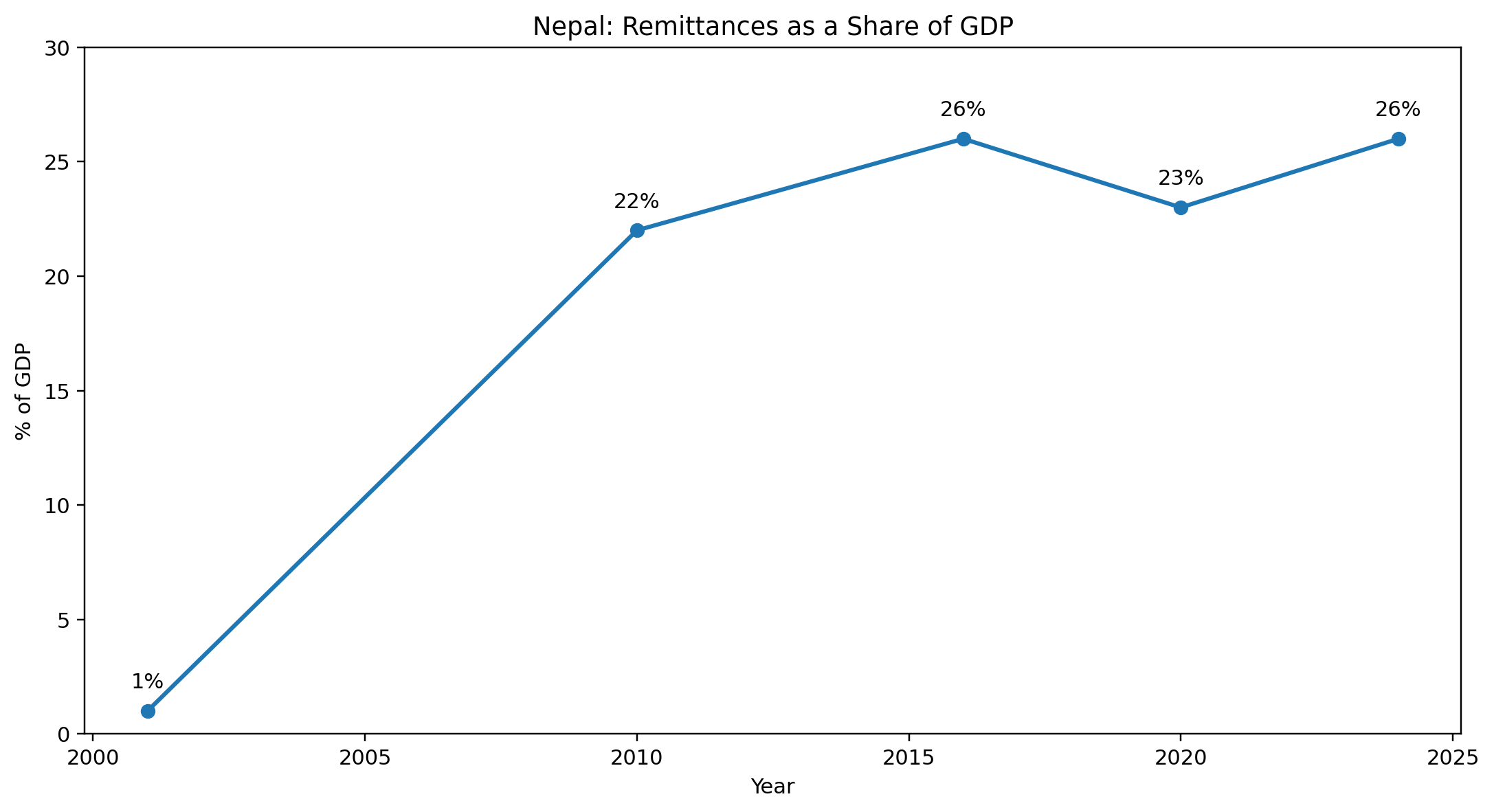
Remittances have become one of the country’s most important sources of foreign exchange.
World Bank data show remittances equivalent to approximately 26% of Nepal’s GDP in 2024. (World Bank Open Data)
This is extraordinary.
It means that a significant portion of Nepal’s economic stability does not come from exports of manufactured goods or large industrial companies.
It comes from Nepalese workers earning money abroad and sending it home.
The economic model is therefore unusual:
migration → foreign earnings → remittances → household consumption → domestic economy.
This has helped millions of families.
But it also reveals a structural weakness.
A country cannot easily become a high-income economy if one of its principal exports is its own labour force.
4. Everest turned geography into an economic asset
And then Nepal discovered something extraordinary.
Its greatest geographical disadvantage could also become its greatest economic asset.
Tourism.
Mount Everest transformed Nepal into a global destination.
But Everest is only the beginning.
Nepal offers trekking, mountaineering, Hindu pilgrimage, Buddhist culture, wildlife, temples, monasteries and access to some of the world’s most extraordinary landscapes.
The tourism industry is therefore much larger than the image of wealthy Western climbers paying to reach Everest.
It involves:
airlines;
hotels;
restaurants;
guides;
porters;
trekking companies;
transportation;
equipment;
permits;
telecommunications;
insurance;
local agriculture;
retail;
financial services.
Tourism creates an entire economic ecosystem.
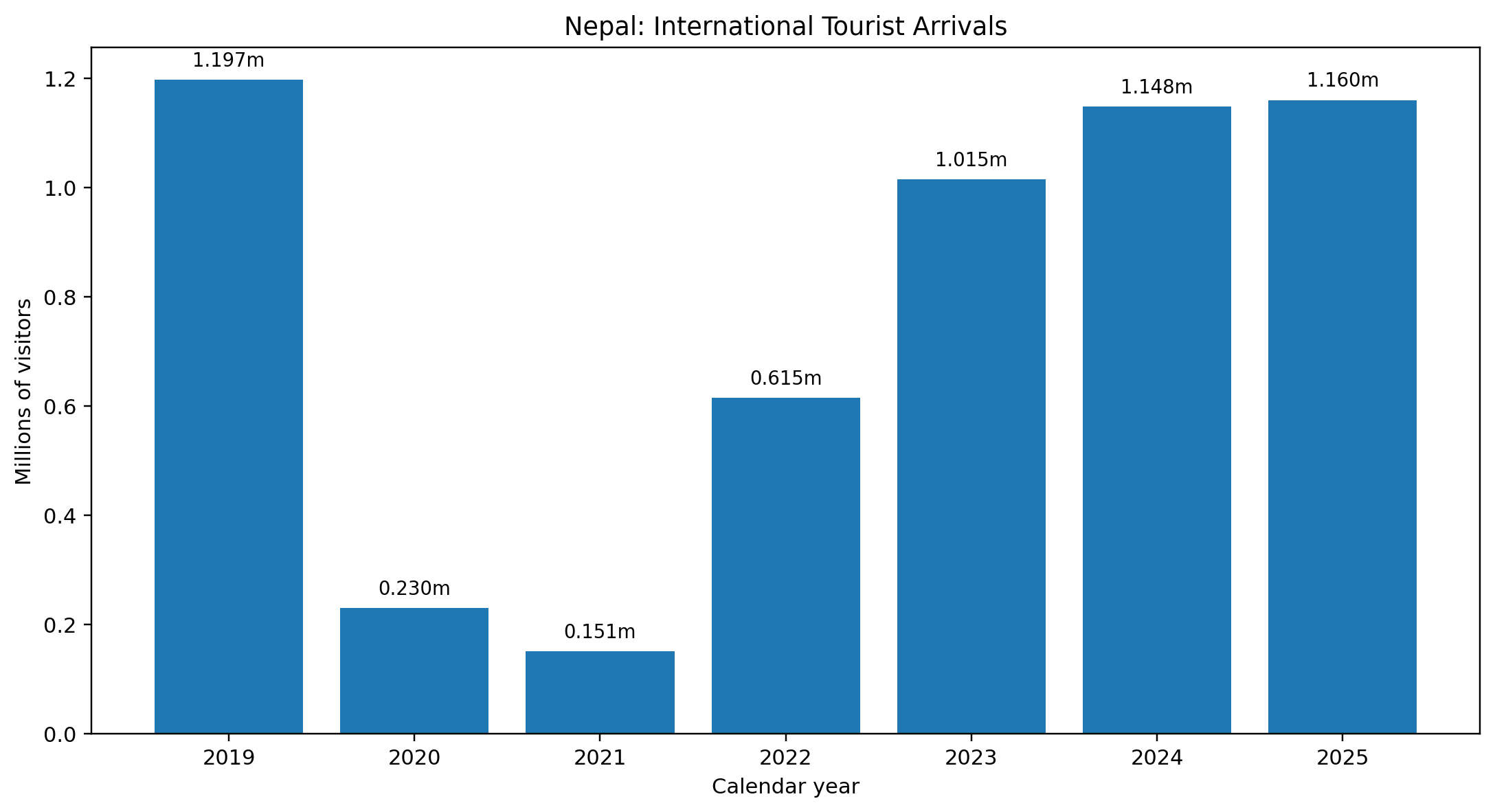
The Nepal Tourism Board expected approximately 1.16 million international visitors in 2025. (Nepal Tourism Board)
The recovery from the pandemic is visible in the numbers.
But the graph also reveals something important:
Nepal’s tourism economy is extremely vulnerable to shocks.
A pandemic can destroy it.
An earthquake can destroy it.
A geopolitical crisis can damage it.
And now climate-related disasters can threaten the infrastructure upon which it depends.
5. Tourism is also a bridge between Nepal and Tibet
The current disaster demonstrates this connection.
Many of those caught in the disaster were not simply tourists.
They were pilgrims.
They were travelling toward Mount Kailash and Lake Manasarovar in Tibet.
Kailash is one of the most sacred mountains in Asia.
For Hindus it is associated with Shiva.
For Buddhists it is deeply connected to Buddhist cosmology.
It is also sacred in Jainism and the Tibetan Bon tradition.
The pilgrimage economy surrounding Kailash is therefore not merely commercial.
It is religious, cultural and international.
People travel from India, Nepal, China and many other countries.
The tragedy therefore struck a region where tourism, religion, geography and geopolitics overlap.
6. Kailash: when religion becomes geopolitics
Mount Kailash is located in southwestern Tibet, close to Nepal and India.
Its importance goes far beyond tourism.
Access to the region is controlled by China.
For India, Kailash is an important religious destination.
For China, the region is part of Tibet and therefore part of its territorial and strategic system.
For Nepal, the border corridor represents an opportunity for tourism and trade.
This creates an extraordinary intersection:
religion + tourism + borders + infrastructure + geopolitics.
And the recent disaster occurred precisely inside this intersection.
7. Why Tibet matters so much to China
To understand China’s position, one must stop thinking about Tibet as simply a remote mountainous region.
Tibet is strategically important.
First, there is geography.
The Tibetan Plateau sits at extraordinary altitude and forms a vast natural frontier between China and South Asia.
Second, there is security.
Tibet borders India, Nepal and Bhutan.
Third, there is water.
The Himalayas and Tibetan Plateau are the source region for some of Asia’s most important rivers.
Fourth, there is infrastructure.
China has invested heavily in roads, airports and railways connecting Tibet with the rest of China.
The result is a transformation of a region that was historically extremely difficult to access.
8. The Tibetan question cannot be understood without history
The modern political relationship between China and Tibet developed during the 20th century.
After the establishment of the People’s Republic of China in 1949, Beijing consolidated control over Tibet.
The 1959 uprising and the departure of the Dalai Lama to India became a defining moment in modern Tibetan history.
Large numbers of Tibetans subsequently fled into neighbouring countries, particularly India and Nepal.
This created a permanent political sensitivity.
Nepal has historically hosted Tibetan refugees and communities.
But it is also a small country living beside China.
The result is an extraordinarily delicate diplomatic balance.
Kathmandu cannot afford to ignore Beijing.
But it also cannot erase centuries of cultural and human connections across the Himalayas.
9. The extraordinary story hidden in the DNA
This is where the story becomes even more fascinating.
The people of the Himalayas existed long before today’s borders.
Modern genetic research provides evidence of deep relationships between Tibetan populations and Sherpa communities in Nepal.
Sherpas are not simply “Nepalese mountain guides.”
They are a distinct Himalayan population with a strong Tibetan ancestral component.
Research examining Sherpas in Nepal and Tibet found substantial overlap in genetic variants associated with high-altitude adaptation, including variants involving the EPAS1 and EGLN1 genes. (PubMed Central (PMC))
Other research suggests that the divergence between Sherpa and Tibetan populations is relatively recent in genetic terms, with some estimates placing certain lineage splits at less than 1,500 years. (Nature)
This is remarkable.
It means that political borders that seem absolute today can divide populations whose biological history is relatively recent and deeply interconnected.
But there is an important caveat.
This does not mean that Nepalese and Tibetans are one people.
Nepal contains enormous ethnic and linguistic diversity.
Genetics does not define nationality.
Nor does DNA determine political identity.
What genetics does show is something more profound:
human migration and adaptation preceded the modern political map.
10. The Denisovan connection
The story becomes even more extraordinary.
Some of the genetic adaptations associated with life at high altitude appear to involve an ancient genetic contribution associated with Denisovans, an archaic human population.
The EPAS1 region is particularly important.
Research has identified a high-altitude-adaptive haplotype associated with Denisovan ancestry in Tibetans and Sherpas, and similar variants have been found in other Himalayan populations. (PubMed Central (PMC))
In simple terms:
part of the extraordinary ability of some Himalayan populations to live at extreme altitude may have an ancient human story written into their DNA.
This is not mythology.
It is evolutionary biology.
And it is one of the reasons the Himalayas are such an extraordinary natural laboratory for understanding human adaptation.
11. Humans learned to live where most humans cannot
At 4,000 or 5,000 metres, oxygen availability is dramatically lower than at sea level.
For most humans, long-term residence at such altitude is physiologically demanding.
Tibetan and Sherpa populations have developed adaptations that allow them to function in these conditions far more efficiently.
This is a remarkable example of natural selection and human adaptation.
The mountain shaped the people.
And the people developed societies adapted to the mountain.
That relationship is essential to understanding the region.
12. But the mountain is changing
And this is perhaps the most important part of the story.
The Himalayas are not static.
The cryosphere — glaciers, snow and permafrost — is changing rapidly.
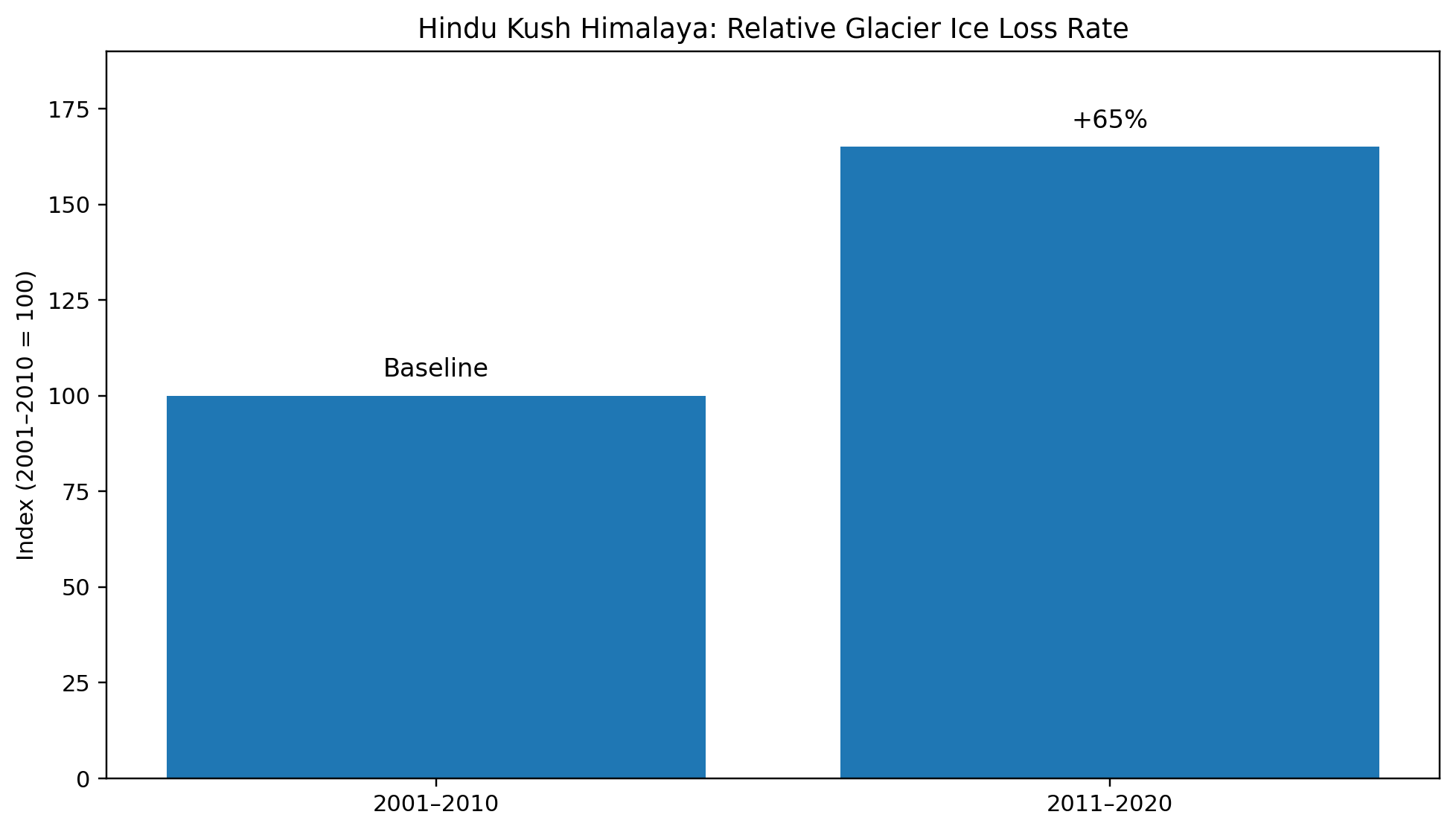
ICIMOD reported that glaciers across the Hindu Kush Himalaya lost ice 65% faster during 2011–2020 than during 2001–2010. (ICIMOD)
The organisation describes the changes as unprecedented and largely irreversible over human timescales. (HimalDoc)
This is not merely an environmental story.
It is an economic story.
It is a security story.
It is a food story.
It is a water story.
And increasingly, it is a geopolitical story.
13. The Himalayas are Asia’s water tower
The Hindu Kush Himalaya is sometimes called the “Third Pole”, because of the enormous quantity of frozen water stored there outside the polar regions.
ICIMOD estimates that the region’s water resources support the lives of approximately 1.3 billion people. (ICIMOD)
This changes the meaning of the word “glacier.”
A glacier is not simply ice.
It is infrastructure.
Natural infrastructure.
Water infrastructure.
Agricultural infrastructure.
Hydropower infrastructure.
And ultimately economic infrastructure.
When glaciers change, entire downstream economies can change with them.
14. The disaster of August 2026 is therefore more than a flood
The initial shock was geological.
A collapse of ice and rock generated a powerful flow of debris that entered the river system and produced catastrophic flooding.
The US Geological Survey subsequently clarified that what was initially interpreted as a possible earthquake was actually seismic energy generated by the collapse itself. (Reuters)
This distinction matters.
The event was not simply a conventional rainfall flood.
It was a cascading mountain hazard:
ice + rock + gravity + river + infrastructure + human settlement.
And once the material entered the river system, geography amplified the disaster.
15. Climate change does not mean every disaster is “caused by climate change”
This distinction is important.
It would be scientifically irresponsible to say that one specific collapse was caused solely by global warming.
Natural geological processes occur in the Himalayas.
But warming changes the environment in which those processes occur.
Rising temperatures accelerate glacier melt.
Permafrost can become less stable.
Glacial lakes can expand.
Mountain slopes can become more fragile.
And extreme rainfall can increase the speed with which a local geological event becomes a regional disaster.
Reuters reported that experts have linked climate change to conditions that can increase instability in the Himalayan environment. (Reuters)
The real issue is therefore not:
“Did climate change cause this disaster?”
The better question is:
“How is climate change changing the probability and potential scale of disasters in a region that is already extraordinarily unstable?”
That is a much more serious question.
16. The economic geography of vulnerability
Consider what happens when a bridge disappears.
A village loses access to markets.
Tourists cannot arrive.
Hotels lose customers.
Food cannot be delivered.
Fuel becomes more expensive.
Hospitals become harder to reach.
Workers cannot travel.
Exports stop.
Imports become more expensive.
A single piece of infrastructure can therefore affect an entire regional economy.
This is why the cost of Himalayan disasters cannot be measured only by the value of destroyed buildings.
The real cost includes:
lost income + lost tourism + reconstruction + interrupted trade + disrupted transport + lost agricultural production + human capital.
For a poor country, the multiplier effect can be enormous.
17. Nepal’s economic paradox
Nepal therefore finds itself in a remarkable position.
It possesses some of the world’s greatest natural assets.
But it also possesses some of the world’s greatest natural risks.
Its mountains attract tourists.
The same mountains can destroy roads.
Its rivers provide hydropower potential.
The same rivers can become deadly.
Its proximity to China creates trade opportunities.
The same border creates strategic dependency.
Its population works abroad and sends billions home.
But that also reveals the limitations of domestic employment opportunities.
Nepal’s challenge is therefore not simply economic growth.
It is economic resilience.
18. China changes the equation
China has the capital, technology and infrastructure capacity to transform the Tibetan side of the Himalayas.
Roads, airports and rail connections have fundamentally altered the accessibility of Tibet.
For Nepal, Chinese infrastructure offers opportunities.
Greater connectivity can mean:
more trade;
more tourism;
greater access to Chinese markets;
infrastructure investment;
alternative routes beyond India’s traditional economic dominance.
But connectivity also creates dependence.
A small country must always ask:
Who controls the infrastructure?
Who finances it?
Who controls the trade route?
Who benefits from it?
These are not merely economic questions.
They are geopolitical questions.
19. India is equally important
Any analysis of Nepal that focuses exclusively on China is incomplete.
India remains Nepal’s most important economic and cultural partner in many areas.
The two countries share an unusually open border.
Indian citizens represent roughly a quarter to a third of Nepal’s international tourist arrivals, according to the Nepal Tourism Board. (Nepal Tourism Board)
India is also deeply connected to Nepal through religion.
Lumbini, the birthplace traditionally associated with Buddha, is in Nepal.
Hindu pilgrimage routes connect northern India and Nepal.
The cultural relationship is therefore much deeper than trade statistics suggest.
Nepal sits between two civilizational and economic giants.
That is its opportunity.
And its permanent strategic problem.
20. The real geopolitical triangle
The Himalayas can therefore be understood as a triangle:
China
Infrastructure, Tibet, security, trade and strategic depth.
India
Markets, religion, migration, trade, energy and historical connections.
Nepal
The country physically located between the two, trying to preserve strategic autonomy while benefiting from both.
This is why Nepal matters more than its GDP would suggest.
Small countries can possess enormous geopolitical value when they sit between major powers.
21. The forgotten economic value of water
There is another reason the Himalayas will become more important.
Water.
The region feeds river systems that support hundreds of millions — potentially more than a billion — people downstream.
Water affects:
agriculture;
electricity;
industrial production;
cities;
food security;
migration;
public health.
As climate patterns change, water management becomes increasingly strategic.
The future politics of the Himalayas may therefore be shaped not only by territory.
It may be shaped by water.
22. Tourism may become both the opportunity and the vulnerability
The tragedy also forces Nepal to rethink tourism.
The traditional model has been:
more visitors → more income.
The future may have to become:
more resilient tourism → sustainable income.
That means better early-warning systems.
Better roads.
Stronger bridges.
More resilient airports.
Emergency communications.
Evacuation routes.
Insurance.
Satellite monitoring.
Glacier and landslide surveillance.
And better coordination between Nepal and China.
The most valuable tourist infrastructure in the Himalayas may eventually not be another hotel.
It may be a warning system.
23. A border that nature does not recognize
The most profound lesson may be the simplest.
The disaster crossed a political border.
The glacier did not know whether it was in Nepal or Tibet.
The river did not know.
The mud did not know.
The rock did not know.
Nature ignored the political map.
This is why Himalayan security cannot be managed entirely through national borders.
A glacier collapse in Tibet can threaten Nepal.
A flood in Nepal can affect India.
A river system can cross several countries.
Climate change therefore forces governments to cooperate even when politics pushes them apart.
24. The Himalayas are a warning for the 21st century
The tragedy is therefore not simply a story about Nepal.
It is a warning about the future of mountain regions around the world.
Climate change is colliding with:
population growth;
tourism;
infrastructure expansion;
geopolitical competition;
fragile ecosystems;
growing water demand.
The result is a new kind of risk.
A natural event can become an economic event.
An economic event can become a political event.
A political event can become a geopolitical event.
And a local mountain collapse can suddenly become international news.
25. The world sees a postcard. The Himalayas see a civilization.
Perhaps this is the greatest misunderstanding of all.
We see Everest.
They see home.
We see adventure.
They see livelihoods.
We see monasteries.
They see centuries of culture.
We see mountains.
They see water.
We see a remote border.
They see the centre of their world.
The Himalayas are not an empty wilderness.
They are inhabited, economically active, culturally complex and strategically vital.
And the people who live there have adapted to one of the most extreme environments on Earth for generations.
Conclusion: The tragedy should change the way we look at the Himalayas
The disaster of August 2026 should not be remembered only as another terrible natural catastrophe.
It should force the international community to look more closely at the Himalayas.
Because beneath the images of destroyed roads and flooded villages lies a much larger story.
A story about Nepal’s fragile economy.
A story about Tibet and China’s strategic ambitions.
A story about India’s influence.
A story about tourism and pilgrimage.
A story about migration and remittances.
A story about ancient human migration.
A story written partly into the DNA of Sherpas and Tibetans.
A story about glaciers and water.
A story about climate change.
And ultimately, a story about the future of Asia.
The Himalayas are often described as the roof of the world.
Perhaps that description is incomplete.
They are also the water tower, cultural crossroads and geopolitical fault line of Asia.
And the tragedy of 2026 has reminded the world of something that should never have been forgotten:
what happens on the roof of the world does not necessarily stay there.
Roberto Balbino — CEO, Fintech SBB
More than 30 years of experience in finance, financial markets and international business.
Independent analyst of finance, economics, geopolitics and global markets.
Originally published on Substack.
Segui Roberto Balbino su Substack