
The AI Productivity Reckoning: Who Captures the Value When Intelligence Gets Cheaper?
The AI boom is reaching a more demanding phase. Capability still matters, but the financial question is becoming unavoidable: how much economic value survives after the technology has been purchased, integrated, supervised and used?
A company can generate more documents, write more code and process more requests while earning little additional profit. It can also spend more than planned and create an exceptionally valuable business. The difference lies in the relationship between resources consumed and outcomes customers or the organization actually value.
McKinsey’s July 2026 interview with Stanford economist Erik Brynjolfsson, “Is the AI productivity story at a turning point?”, provides a useful starting point. Its central argument is that substantial gains require changes to processes, skills and organizational design. Installing a model leaves much of that work unfinished.
The financial implication deserves more attention. AI adoption creates an opportunity. Management determines whether that opportunity becomes an asset, a recurring expense or an expensive distraction.
The figures circulating alongside this debate need careful handling. McKinsey’s enterprise AI FinOps research reported budget overruns among 93% of its 75 qualified respondents across five industries. Its observation of spending rising nearly fourfold concerned the transition from isolated applications to enterprise adoption; it should not be read as a universal annual growth rate. Budget overruns alone establish neither investment failure nor negative returns. (mckinsey.com)
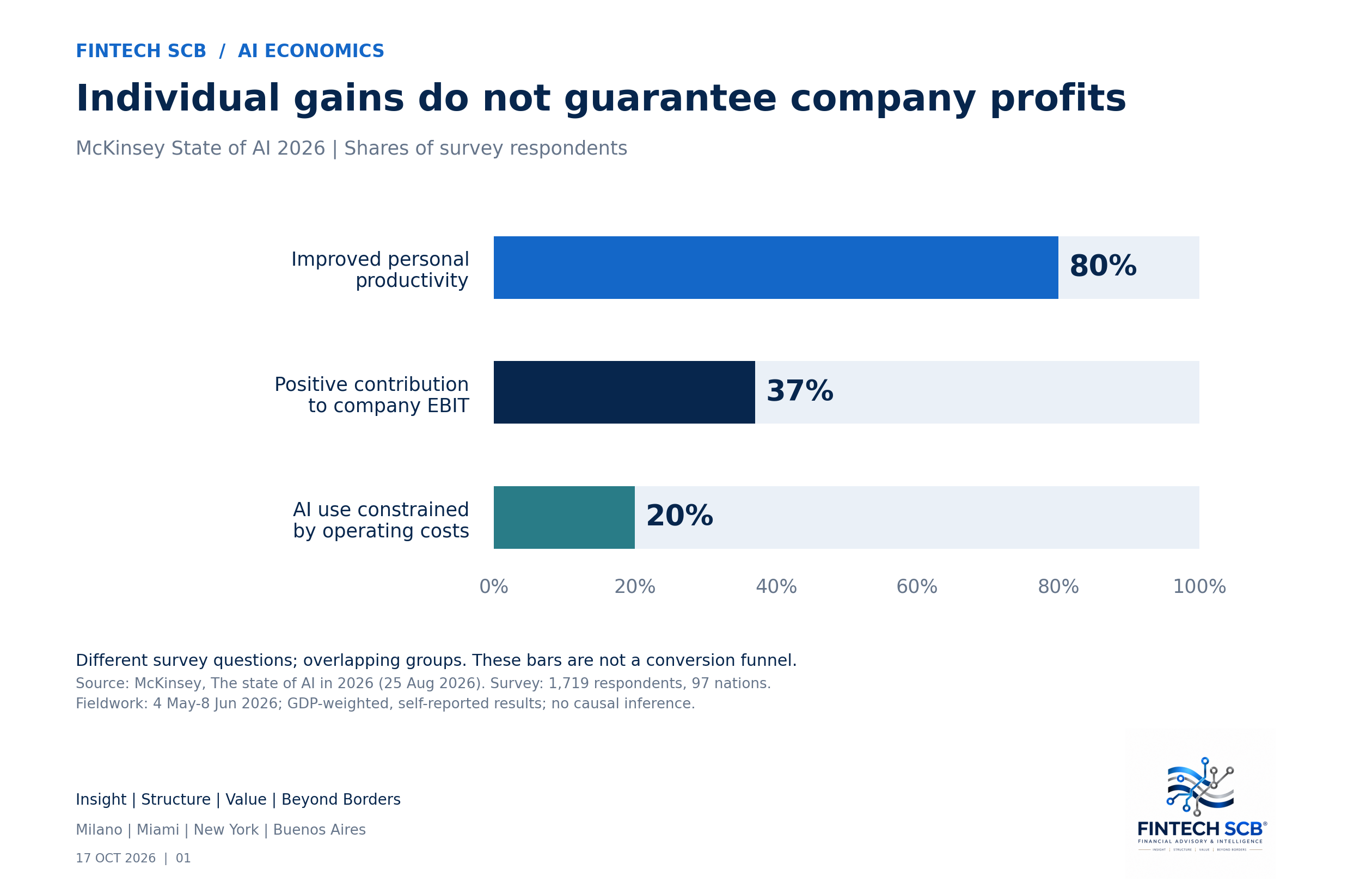
A separate McKinsey global survey, published in August 2026, found that 80% of respondents reported improved personal productivity, while 37% reported a positive contribution from AI to enterprise EBIT. Those are self-reported answers to different questions. They cannot be converted into an audited return on investment or a precise rate at which personal gains become corporate profits. (mckinsey.com)
They nevertheless frame a question that every board should ask: where, exactly, does the value go?
The J-curve offers an explanation for delayed returns. Organizations incur costs while learning, changing processes and developing complementary capabilities. Benefits may emerge only after those investments begin working together. An early deterioration in measured performance can therefore coexist with a worthwhile long-term project.
But the J-curve also creates an attractive excuse. Management can describe almost any disappointing deployment as an investment whose rewards have yet to arrive.
The distinction must be observable. A credible investment should produce evidence of learning: better acceptance rates, less rework, shorter complete workflows, stronger customer outcomes or a clearer route to revenue. If spending rises while those measures remain unchanged, the promise of a future turning point becomes increasingly difficult to defend.
Patience needs milestones.
The empirical evidence also demands specificity. In “Generative AI at Work,” Brynjolfsson, Danielle Li and Lindsey Raymond studied 5,172 customer-support agents and found an average 15% increase in issues resolved per hour, with substantial variation across workers. That is meaningful evidence of a productivity gain in a defined setting. It is not an estimate of the effect on every occupation or company. (arxiv.org)
Other settings have produced different results. METR’s early-2025 randomized study found that 16 experienced developers took 19% longer to complete tasks when permitted to use the AI tools tested. Its February 2026 update suggested that newer tools were probably helping developers more, while warning that participant and task selection made the later estimates unreliable. The original slowdown should therefore not be presented as a current verdict on AI coding. Together, these findings show why evidence must specify the tools, tasks, workers and period being examined. (arxiv.org, metr.org)
For a business, the practical unit of measurement is the accepted outcome.
A generated answer is an intermediate product. So is a draft contract, a software patch or a proposed marketing campaign. Value depends on what happens after review, correction, integration and use.
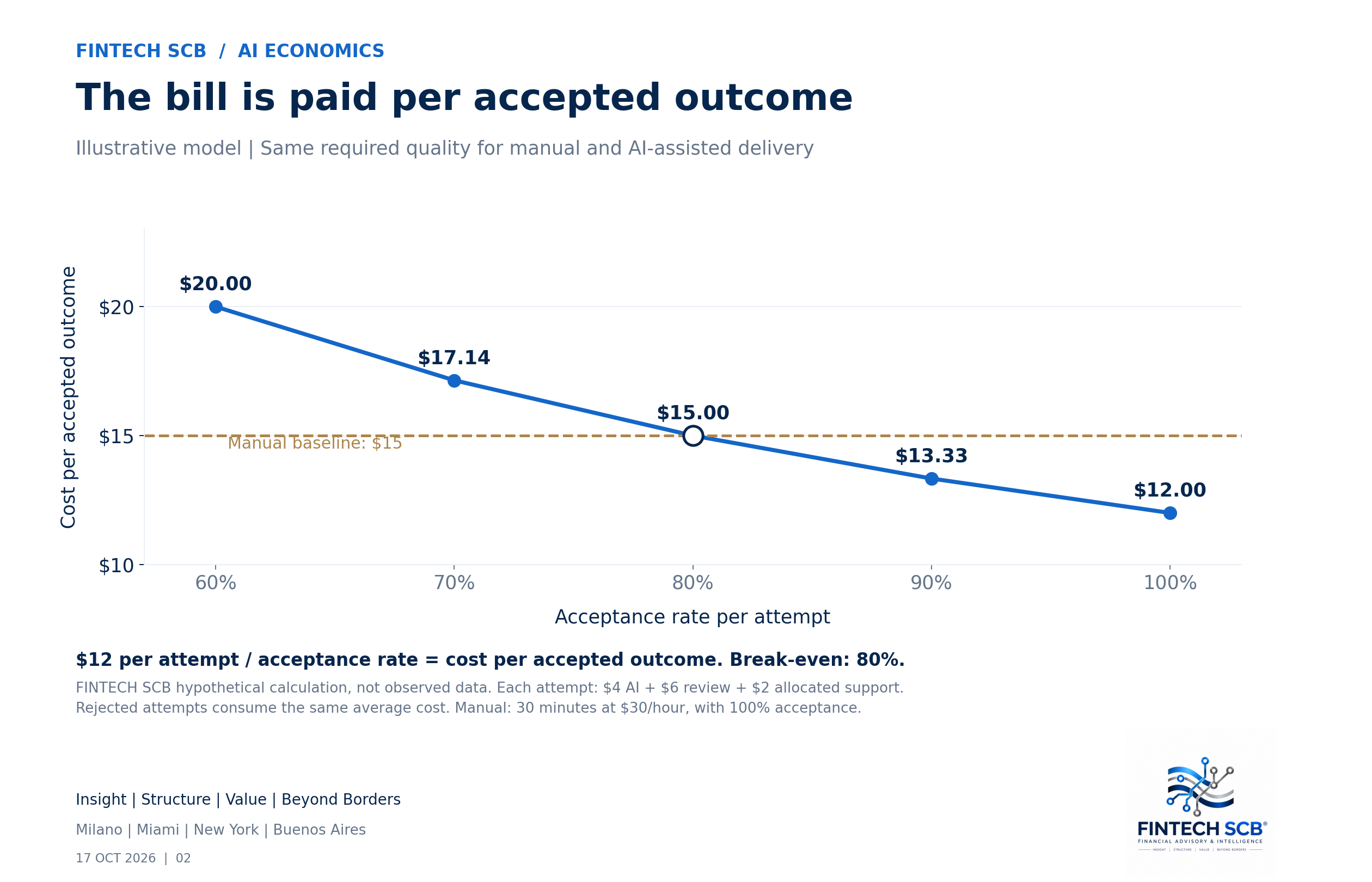
Consider a simplified FINTECH SCB illustration. A manual task requires 30 minutes at a fully loaded hourly cost of $30, giving a $15 baseline. Assume that the manual result meets the required quality standard.
An AI-assisted attempt consumes $4 in model services, $6 in human review and $2 in allocated support. Its total resource cost is $12. If 80% of attempts meet the same acceptance standard, average cost per accepted outcome is $12 divided by 0.8, or $15. If acceptance falls to 60%, the figure rises to $20.
These are hypothetical assumptions, not observed industry averages. Rejected attempts are assumed to consume the same average resources, and the comparison holds the required output quality constant.
The example reveals why the cheapest model call may lead to an expensive business process. Review effort, failed attempts and support costs can absorb the apparent saving. Conversely, a more capable model may justify a higher price if it substantially improves acceptance and reduces total delivery effort.
The useful comparison is the entire cost of producing a result the business can use.
A second calculation is necessary before anyone declares a cash saving. Valuing employees’ time measures a resource. It does not prove that expenditure has fallen.
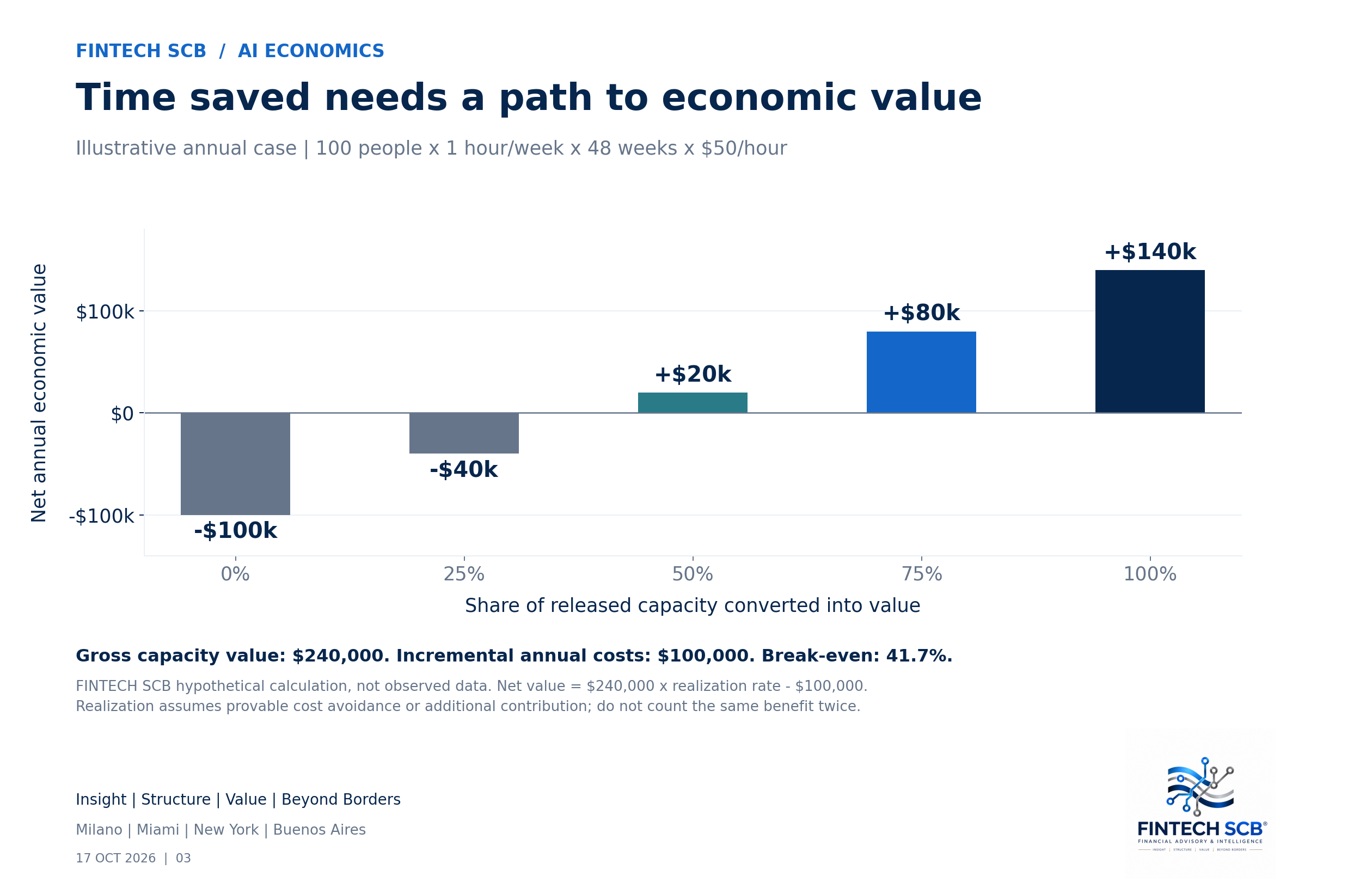
Imagine 100 employees each saving one hour a week for 48 weeks. At $50 an hour, the released capacity has a gross value of $240,000.
That figure is easy to put on a slide. Realizing it is harder.
If half the released capacity produces demonstrable cost avoidance or additional contribution, the realized benefit is $120,000. If incremental annual costs are $100,000, net annual economic value is $20,000. Under these assumptions, the project breaks even when approximately 41.7% of the gross capacity value is realized.
The organization could realize value through additional customer work, lower overtime, avoided recruitment or improved retention. Each route requires evidence. The same released hour cannot simultaneously be counted as a payroll saving and as the labor supporting additional revenue.
Where salaries remain unchanged and the released time produces no useful additional output, an accounting presentation of “hours saved” can greatly overstate the financial result.
This is why workflow design matters. If document production accelerates but approval remains the bottleneck, the business may simply accumulate a larger queue. If marketing generates more leads but sales cannot qualify them, additional activity may produce little contribution. If coding accelerates while integration and maintenance demands increase, delivery economics can deteriorate.
The board needs to understand the constraint that limits the complete process.
In banking, useful measures might include cost per correctly completed case, processing time and subsequent error rates. In ecommerce, additional conversion should be evaluated alongside discounts, returns, fulfillment costs and customer retention. In professional services, a faster draft matters when it helps deliver better advice, serve additional demand or improve the economics of an engagement.
These are examples of management design, rather than claims that a single metric fits every company.
The same discipline changes the discussion about employees.
Brynjolfsson challenges the reflex of measuring AI returns primarily through headcount reduction. There is a strong financial reason to take that challenge seriously. Employees contribute to current production, but they also create knowledge, develop relationships and train the people who will deliver future production.
Eliminating entry roles without replacing their learning function can undermine the supply of experienced professionals. Reducing senior expertise after encoding some of it into systems can weaken the organization’s ability to solve unfamiliar problems and refresh that knowledge.
The labor-market evidence warrants concern without exaggeration. Stanford’s August 12, 2026 revision of “Canaries in the Coal Mine?” reported that employment among workers aged 22–25 in AI-exposed occupations stood 19% below a benchmark based on the employment growth of less-exposed peers. The divergence operated mainly through reduced hiring. The authors explicitly describe the findings as descriptive rather than causal, identify limitations, and find no evidence of widespread economy-wide displacement. This is neither a 19% unemployment rate nor proof that AI caused a 19% loss of all junior jobs. (digitaleconomy.stanford.edu)
For companies, the strategic response should include redesigning how expertise develops. Junior professionals can work with AI while receiving structured feedback, handling progressively harder cases and learning to verify outputs. Senior specialists can be rewarded for improving the knowledge and judgment available across the organization.
That approach has an economic objective: preserve the ability to generate new expertise while distributing existing expertise more effectively.
The investment implications extend beyond the workforce.
Productivity gains do not automatically become durable shareholder returns. Suppose comparable competitors adopt similar tools and reduce delivery costs. Some of the benefit may be competed away through lower prices. Customers gain, adoption expands and the technology succeeds, while producers retain less incremental profit than investors expected.
Value capture therefore depends on market structure, differentiation, distribution, customer relationships and switching costs. Access to a capable model alone may offer little protection when competitors can buy comparable access.
There is a further distinction between growth and value. A company can expand revenue while taking on enough computing, support and implementation costs to weaken its returns. It can also improve margins on existing work while failing to develop the products that will sustain future demand.
Both possibilities belong in investment analysis.
For companies supplying AI infrastructure, the questions include utilization, customer economics and the cash required to support growth. For businesses adopting AI, the questions include realized delivery improvements, incremental demand and the share of savings retained after competition. Neither group should receive a valuation premium merely for being associated with the technology.
Small businesses may find considerable opportunity here. A limited team can gain access to analytical, operational and creative capabilities that were previously difficult to afford. But additional capability becomes valuable only when the business can direct it toward a real need and supervise the result.
The scarce resource increasingly becomes judgment: choosing the problem, setting an appropriate standard and deciding whether further effort is worth its cost.
My FINTECH SCB view is that boards should treat AI as a portfolio of investments with different purposes and evidence requirements. Experimental projects need a learning objective, a budget and a decision date. Established deployments need reliable measures of quality, total cost and realized benefit. Growth initiatives need evidence of demand.
Each project should have an accountable owner and a credible baseline. Where feasible, comparable groups or phased deployment can help distinguish the effect of the technology from seasonal demand, staffing changes or other improvements. Results should be assessed after including the work required to review and maintain the output.
Scaling should follow demonstrated economics. Projects with strategic option value can still deserve funding, but that rationale should be explicit rather than disguised as immediate savings.
The opportunity remains substantial. AI can extend expertise, improve services and make previously uneconomic activities viable. Realizing those benefits requires a level of organizational and financial discipline that impressive demonstrations do not supply.
The turning point will become convincing when businesses can show how greater capability produces better outcomes and how those outcomes create sustainable economic value.
Intelligence is becoming easier to purchase.
The ability to invest it profitably will remain a competitive advantage.
Roberto Balbino / FINTECH SCB
Sources
McKinsey, “Is the AI productivity story at a turning point?”, July 31, 2026. Full interview supplied for this analysis: :codex-file-citation{path=“sandbox:/workspace/scratch/60cbcac3678b/upload/is-the-ai-productivity-story-at-a-turning-point.pdf” purpose=“source”}
McKinsey, “The cost of intelligence: How CIOs can manage AI demand at scale”, July 20, 2026.
McKinsey, “The state of AI in 2026: On the road to ROI”, August 25, 2026.
Erik Brynjolfsson, Danielle Li and Lindsey Raymond, “Generative AI at Work”, The Quarterly Journal of Economics, 2025.
METR, “Measuring the Impact of Early-2025 AI on Experienced Open-Source Developer Productivity”, July 10, 2025; and “We are Changing our Developer Productivity Experiment Design”, February 24, 2026.
Erik Brynjolfsson, Bharat Chandar and Ruyu Chen, “Canaries in the Coal Mine? Six Facts about the Recent Employment Effects of Artificial Intelligence”, revised August 12, 2026.
FINTECH SCB: original illustrative calculations. All scenario assumptions are stated in the text and charts.
#ArtificialIntelligence #Productivity #CorporateFinance #CapitalAllocation #FutureOfWork #FINTECHSCB
Originally published on Substack.
Segui Roberto Balbino su Substack