
The Global Economy Is Growing. But Who Actually Owns the Future?
Brazil, Mexico and Argentina face different problems. Latin America’s common challenge is turning economic advantages into prosperity that lasts.
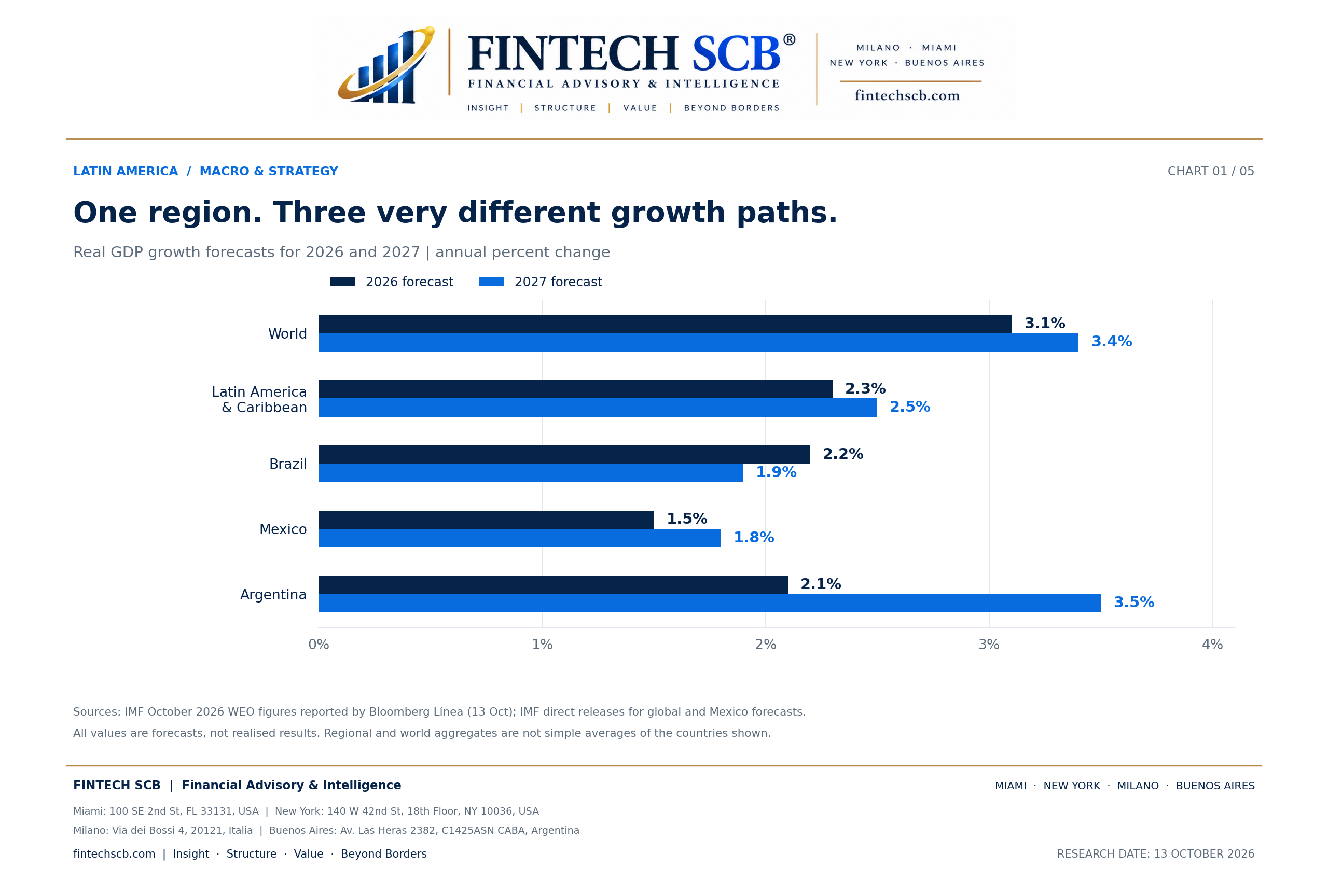
Latin America does not need another reminder that it has potential. It needs a more demanding definition of success. A country can export more, attract investment and register another year of positive GDP growth without fundamentally improving the opportunities available to its citizens. A recovery can repair yesterday’s damage without creating tomorrow’s productive capacity. And an economy can participate in a technological revolution without capturing enough of its benefits to transform living standards. These distinctions matter when reading the latest growth forecasts. The IMF projects global expansion of 3.1% in 2026 and 3.4% in 2027. Its October assessment describes an increasingly uneven world: technology-related investment cushions some economies, while energy costs and other shocks weigh more heavily on others. [1]
For Latin America and the Caribbean, the corresponding forecasts are 2.3% and 2.5%. Within the region, Brazil is projected to grow by 2.2% and 1.9%; Mexico by 1.5% and 1.8%; and Argentina by 2.1% and 3.5%. These are forecasts, not completed economic achievements. [2] The temptation is to turn those figures into a league table. Argentina looks faster next year. Brazil looks slower. Mexico appears to be recovering some momentum. But that reading mistakes the scoreboard for the explanation.
The more useful distinction is this: Brazil must turn scale into productivity. Mexico must turn proximity into capabilities. Argentina must turn stabilization into confidence that survives beyond the next political argument. Three economies. Three different tests. None can be passed by celebrating potential.
The revisions tell us something that the headline growth rates conceal. Compared with July, the IMF has cut Argentina’s 2026 forecast by 1.4 percentage points and its 2027 forecast by 0.5 points. Brazil’s forecasts have fallen by 0.2 and 0.3 points. Mexico’s 2026 projection has improved by 0.3 points, although its 2027 projection is 0.1 point lower. [2][3] Those changes are not interchangeable. A downward revision is not necessarily a recession. An upward revision is not necessarily a structural breakthrough. What matters is the mechanism behind the adjustment and whether the economy is becoming better equipped to grow after the immediate shock has passed.
Nor should the global average become a crude definition of success. Population growth, income levels, sector composition and the business cycle differ across countries. Faster total GDP growth does not automatically mean faster improvement in living standards. To assess that, we also need real output per person, productivity, employment quality and the distribution of gains. The criticism of Latin America should therefore be more precise than “the numbers are too low.” The stronger criticism is that temporary recoveries are too easily treated as substitutes for lasting increases in productive capacity.
A forecast tells us what may happen under a set of assumptions. A development strategy should explain how to improve those assumptions.
Brazil does not need to prove that it is an important economy. It needs to extract more value from the economic foundations it already possesses. There is a revealing observation in the IMF’s 2026 Article IV assessment: Brazil’s recent outperformance was driven principally by employment gains rather than by productivity growth or investment. That is an important qualification to the language of resilience. An economy can put more people to work and increase output without substantially improving how much value each worker can produce. [5]
Employment gains matter. They support incomes and should not be dismissed. But they cannot indefinitely substitute for better infrastructure, stronger skills, more effective management and more productive capital. The OECD’s structural assessment identifies weak investment and stagnant productivity alongside regulatory obstacles, infrastructure shortcomings and unequal access to good education. It also recognizes Brazil’s relatively clean energy system and the scope for further renewable investment. The picture is not one of absent advantages; it is one of advantages that require complementary capabilities. [6]
Consider what that means for an industrial business. Access to electricity is valuable, but less so if the connection is unreliable. A large customer base is useful, but less so if logistics absorb the margin. A technically promising project may still be postponed when compliance is expensive and the financing horizon is too short. These constraints interact: improving one while ignoring the others can produce disappointing returns. This is why a serious Brazilian growth agenda cannot be reduced to a demand for lower interest rates. Lower financing costs would help many viable investments, but cutting rates without a credible inflation and fiscal framework could undermine the confidence on which those investments depend. Equally, fiscal discipline that repeatedly sacrifices useful infrastructure would weaken the future tax base it is supposed to protect.
The IMF’s country assessment identifies fiscal rigidities, borrowing costs and structural bottlenecks as constraints, while recognizing the potential contribution of the consumption-tax reform now being implemented. The distinction between approving a reform and realizing its benefits is crucial. Administrative execution matters as much as the announcement. [5] The practical objective should be to make productive expansion less difficult: predictable project approvals, commercially sound infrastructure, competition that rewards efficient firms and training linked to actual business needs. These are less spectacular than announcing a national champion. They may also be more useful.
Brazil’s opportunity is not to abandon agriculture, energy or industry in pursuit of whichever technology is currently fashionable. It is to deepen the engineering, software, logistics and specialized services surrounding those strengths. A sophisticated agricultural exporter can generate demand for domestic machinery, data services and research. An energy project can support local technical capabilities rather than remaining an isolated source of export revenue. Brazil should not have to choose between being a commodity power and an innovative economy. The more demanding task is to make the first help finance and develop the second.
Its size is an asset. Treating size as a strategy is the mistake.
Mexico’s position inside North American production networks is a genuine advantage. It is not a guarantee of broad prosperity. The IMF’s October mission statement describes an economy gaining momentum, but still constrained primarily by external uncertainty. Its recommendations focus on infrastructure, regulatory predictability, security, trade integration and financial deepening. That is a rather different message from the idea that a border with the United States will do the economic work by itself. [7] For an investor considering a factory, a nearby market is only the beginning of the calculation. The investment also needs dependable energy, water, transport, skilled workers and enforceable contracts. Uncertainty about any of these can change the return, the financing terms or the decision to invest at all.
The same distinction applies to the domestic benefits of foreign investment. An export facility can create valuable jobs and foreign-exchange earnings while relying heavily on imported components, engineering and technology. That is not a reason to reject the investment. It is a reason to ask how local suppliers can become more capable and compete for a greater share of the work. The strategic question is not simply how many production lines arrive in Mexico. It is how many Mexican firms learn to supply them, how many workers acquire transferable skills, and how much expertise remains when the original project changes or moves.
The OECD’s 2026 survey adds an important layer: digital adoption among firms remains limited, and shortages of digital skills, cybersecurity weaknesses and telecommunications concentration can constrain the productivity gains from technology. The report also identifies crime and informality as obstacles to investment and growth. [8] These are not issues that can be solved by rebranding an industrial park as an innovation district. They require implementation inside firms and institutions. A useful Mexican industrial policy would help suppliers meet technical standards, make training commercially relevant and improve the infrastructure connecting businesses to customers. It should make competitive production easier, rather than use permanent protection to disguise uncompetitive production.
There is also a financial dimension. A supplier with a sound contract may need working capital, equipment finance or a guarantee tailored to the transaction. Its problem is not necessarily a shortage of venture capital. The appropriate instrument depends on the business model and the risk being financed. That distinction matters because development debates often prescribe the same fashionable funding solution to very different commercial problems. Mexico needs finance that supports a productive network, not just a larger collection of funding announcements.
The country does not need to become less connected to the United States. It needs to become more capable within that connection, while retaining options beyond it. Geography creates access. Capabilities create bargaining power.
Argentina invites extremes. Its supporters can mistake stabilization for a completed transformation; its critics can treat every disappointment as proof that improvement is impossible. Neither position is analytically useful. The OECD’s 2026 assessment recognizes progress from reform while emphasizing that productivity has declined over the preceding decade. It identifies a more favorable business environment as supportive of investment, but also notes constraints on consumption from high interest rates and the slow recovery of real wages. Progress and vulnerability can coexist. [9]
The IMF’s 2026 country assessment makes the conditional nature of the outlook equally clear. Its framework links more sustainable growth to fiscal credibility, improvements in monetary and exchange-rate arrangements, reserve accumulation and the functioning of markets. Those are mechanisms to examine, not political labels to applaud or reject. [10] My reading is that Argentina’s central challenge is to extend the planning horizon of the private economy. A company will not finance a long-lived asset solely because this quarter’s indicators have improved. It must also judge whether it can obtain inputs, retain customers, service its obligations and operate under reasonably predictable rules over several years. If those questions remain unresolved, a promising recovery can generate trading opportunities without producing an equally strong investment cycle.
That is why a rally in financial assets and a durable expansion of productive capacity should not be confused. A lower risk premium can improve funding conditions. But the decisive development outcome is what happens next: whether financing supports equipment, infrastructure, businesses and skills that continue generating income. The distinction should also shape how adjustment is judged. Inflation control and fiscal stabilization are essential, but their political durability depends partly on whether households eventually experience more reliable employment and purchasing power. Social outcomes are not an optional appendix to a credible reform programme. They affect whether the programme can last.
Argentina’s energy, agricultural and mineral opportunities offer routes to stronger exports. The OECD has documented the potential of the energy transition and the need for supporting infrastructure, competitive markets and responsible resource management. However, resource potential is not the same as completed investment, and an announced project is not the same as an operating one. [11] The appropriate test is therefore neither ideological enthusiasm nor automatic disbelief. It is a sequence of observable outcomes: projects financed, infrastructure completed, exports delivered, reserves strengthened and private-sector employment supported without recreating the imbalances that destabilized earlier cycles.
Argentina does not need confidence that is loud. It needs confidence that is patient. The real turnaround begins when businesses stop treating every new investment as a wager on the next political event.
The three economies do not begin from the same investment position. In the World Bank’s published 2024 country table, gross fixed capital formation was approximately 24% of GDP in Mexico, 17% in Brazil and 16% in Argentina, using the table’s rounded presentation. Chile was also around 24%, and Peru around 21%. These are historical observations, not 2026 forecasts. [12] The figures do not prove that a higher investment share automatically produces faster subsequent growth. Fixed investment includes buildings and equipment, and its economic return depends on what is built, where it is located, how it is used and what complements it. Nor is this an indicator of AI investment or innovation spending.
But the comparison challenges the idea that all three countries suffer from an identical shortage of capital. The volume, composition, financing and effectiveness of investment need to be considered separately. For Brazil and Argentina, increasing productive investment can be an important part of the agenda. For Mexico, a comparatively higher historical investment share makes the quality of connections between investment, domestic suppliers and productivity especially important. These are questions for deeper project-level analysis, not conclusions that a single ratio can settle.
The financial response should be equally differentiated. A software company without collateral may need risk-bearing equity. A supplier with receivables may need working-capital finance. A transmission project needs a credible long-term revenue arrangement. A productive small business may need a loan whose maturity matches its equipment rather than its next monthly payment. Governments can help where a specific market failure prevents a viable investment. But a public guarantee does not abolish risk; it allocates part of it to the public sector. Its cost, beneficiaries and contingent liabilities should be visible. The purpose should be to enable additional productive activity, not to make private returns appear safe by hiding the public exposure.
The missing ingredient is not always another pool of money. Sometimes it is a credible contract, a workable project, an accountable manager or an institution capable of matching the right funding to the right risk.
Latin America should take the technological transition seriously without turning it into another excuse for vague industrial ambition. The World Bank’s October regional update offers a useful corrective to the idea that access to AI automatically creates productivity. It finds that firms are adopting the technology, but often without integrating it into their core processes. Managerial capabilities, workforce skills and organizational change remain important barriers. [13] That observation matters more than another competition over which country announces the largest data centre.
A business can subscribe to sophisticated software without changing how it makes decisions. A public agency can purchase a digital platform without improving service delivery. A manufacturer can introduce automation without resolving the workflow that limits output. In each case, technology becomes an expense before it becomes a productive capability. Conversely, a country does not have to own a frontier AI model to benefit from using one. Imported technology can improve domestic productivity. The relevant question is whether local firms develop the skills, complementary systems and commercial relationships needed to turn access into sustained economic value.
For Brazil, that could mean better industrial maintenance, agronomic decisions or logistics. For Mexico, supplier coordination, quality control and more advanced manufacturing services. For Argentina, applications in energy operations, agricultural production and tradable professional services. These are possible development routes, not claims that the gains have already occurred. This is where the title’s question requires an important qualification. Owning the future does not mean owning every chip, platform or patent. It means developing enough productive capability to participate on better terms and retain the means to reinvest.
The wrong ambition is technological isolation. The right ambition is productive participation with greater local capability.
The two-year arithmetic is revealing, provided it is not asked to prove too much. Applying the October growth forecasts to a common 2025 base of 100 produces a 2027 output index of approximately 106.6 for the world, 105.7 for Argentina, 104.9 for Latin America and the Caribbean, 104.1 for Brazil and 103.3 for Mexico. These are FINTECH SCB calculations from the published forecast rates, not independently estimated GDP levels. This is not a measure of which country is richer, and it is not a test of per-capita convergence. Each economy starts from its own normalized base. The chart simply shows that a stronger second year does not erase the importance of the first, and that small annual differences accumulate.
The development question becomes clearer over a longer horizon. Consider a purely illustrative exercise in real GDP per person. Sustained annual growth of 1% increases the starting level by about 22% over twenty years. At 2%, the increase is about 49%. At 3%, it is about 81%. These are not forecasts for Brazil, Mexico or Argentina. They are compound-growth calculations, and they say nothing about how the gains would be distributed. Their purpose is to show why a persistent difference of one percentage point is not a trivial economic detail.
It is the difference between a policy debate concerned with the next announcement and one concerned with the opportunities available to the next generation. That is the standard I would apply to the region: not whether every quarter exceeds expectations, but whether policy and investment make a more productive economy possible over time.
A useful regional strategy begins by abandoning the assumption that one ideological formula can solve three different economic problems. For Brazil, I would place the emphasis on the productivity of investment and the execution of reforms. For Mexico, on the infrastructure, skills and supplier capabilities that turn international integration into domestic opportunity. For Argentina, on preserving stabilization while making long-term investment credible and socially sustainable. Across all three, the test should be commercial and institutional rather than rhetorical. Do new firms have a realistic route to customers? Can efficient suppliers compete? Is infrastructure usable? Are public risks disclosed? Can businesses finance expansion without relying on a permanently favorable political relationship?
Those questions also offer a better way to assess investment opportunities. A compelling national narrative cannot compensate for a weak balance sheet, an unfinanceable project or a price that assumes everything will go right. Equally, disappointing national growth does not mean every business in that country lacks opportunity. The country story is a starting point for analysis, not a substitute for it. The same discipline should apply to governments. Announced investment is not completed investment. Completed investment is not automatically productive investment. Productive investment does not automatically generate widely shared prosperity. Each transition requires execution, competition and institutions that can be held accountable.
Brazil should not be satisfied with being large. Mexico should not be satisfied with being close to the United States. Argentina should not be satisfied with recovering from its previous crisis. And Latin America should not confuse the absence of collapse with the presence of a development strategy. The IMF publishes forecasts. Governments announce plans. Investors price possibilities. Prosperity begins when those possibilities become productive businesses, better work and institutions that last longer than the people temporarily running them.
Latin America does not need another promise that its future will be extraordinary. It needs the machinery to stop postponing it.
Roberto Balbino
FINTECH SCB — Financial Advisory & Intelligence
Insight | Structure | Value | Beyond Borders
Originally published on Substack.
Segui Roberto Balbino su Substack