
The Next Five Years Will Not Look Like the Last Five
Where Should Investors Look Now — and How Should They Diversify?
The last five years rewarded investors who understood one simple reality: the United States was the dominant engine of global equity performance.
Technology, artificial intelligence, digital infrastructure, extraordinary corporate profitability and the depth of U.S. capital markets created a powerful combination.
But investors should be careful with one of the most dangerous assumptions in financial markets:
what worked yesterday will automatically work tomorrow.
The investment environment of 2026 is very different from the environment investors faced at the beginning of the decade.
U.S. equities remain essential. But valuations are considerably higher than in many other parts of the world. Japan is undergoing a structural transformation. Emerging Markets are trading at lower valuations while offering significant long-term growth potential. Bonds once again offer meaningful income. And gold has become an increasingly important instrument for diversification in an environment dominated by geopolitical uncertainty.
The question for the next five years is therefore not simply where returns have been highest.
The real question is:
Where can investors find the best combination of growth, valuation and diversification?
The United States: Still the Core, But No Longer the Whole Story
There is no rational reason to abandon the United States.
The American economy remains the world’s most important financial market and one of the strongest innovation ecosystems.
Artificial intelligence, semiconductors, cloud computing, software, biotechnology and digital infrastructure continue to attract enormous amounts of capital.
American companies also benefit from high profitability and access to the deepest capital markets in the world.
But there is a problem.
Investors already know all of this.
And when everybody knows that an asset is exceptional, the price investors are willing to pay becomes extremely important.
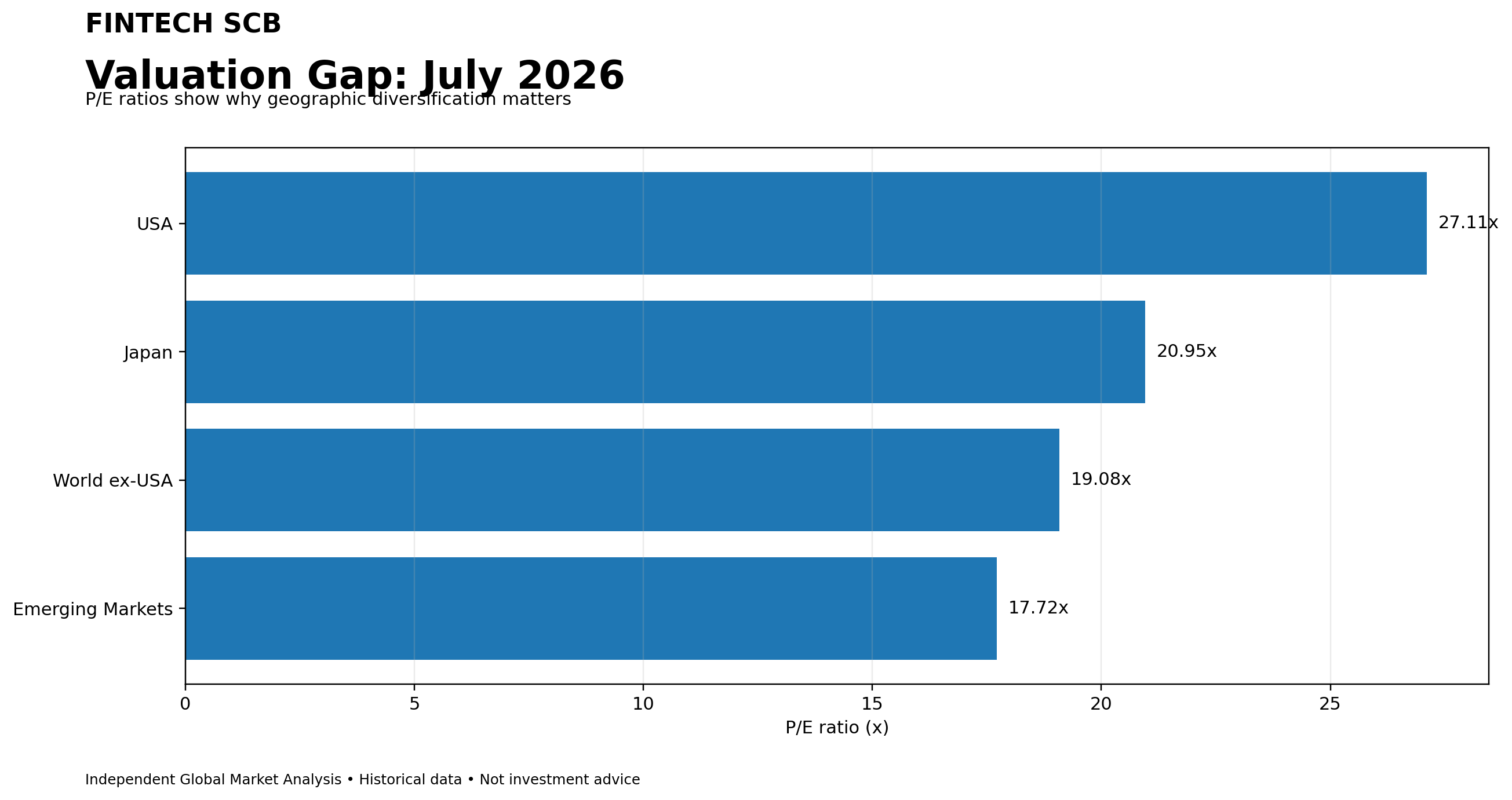
The U.S. market is currently trading at substantially higher valuation multiples than most major markets outside America.
That does not mean the U.S. is necessarily overvalued or destined to fall.
It means that expectations are already extremely high.
Future returns therefore depend increasingly on earnings growth continuing to justify those expectations.
This is why Fintech SCB believes that the United States should remain the largest individual geographic allocation in a global portfolio, but not necessarily dominate the entire portfolio.
The Last Five Years Tell an Important Story
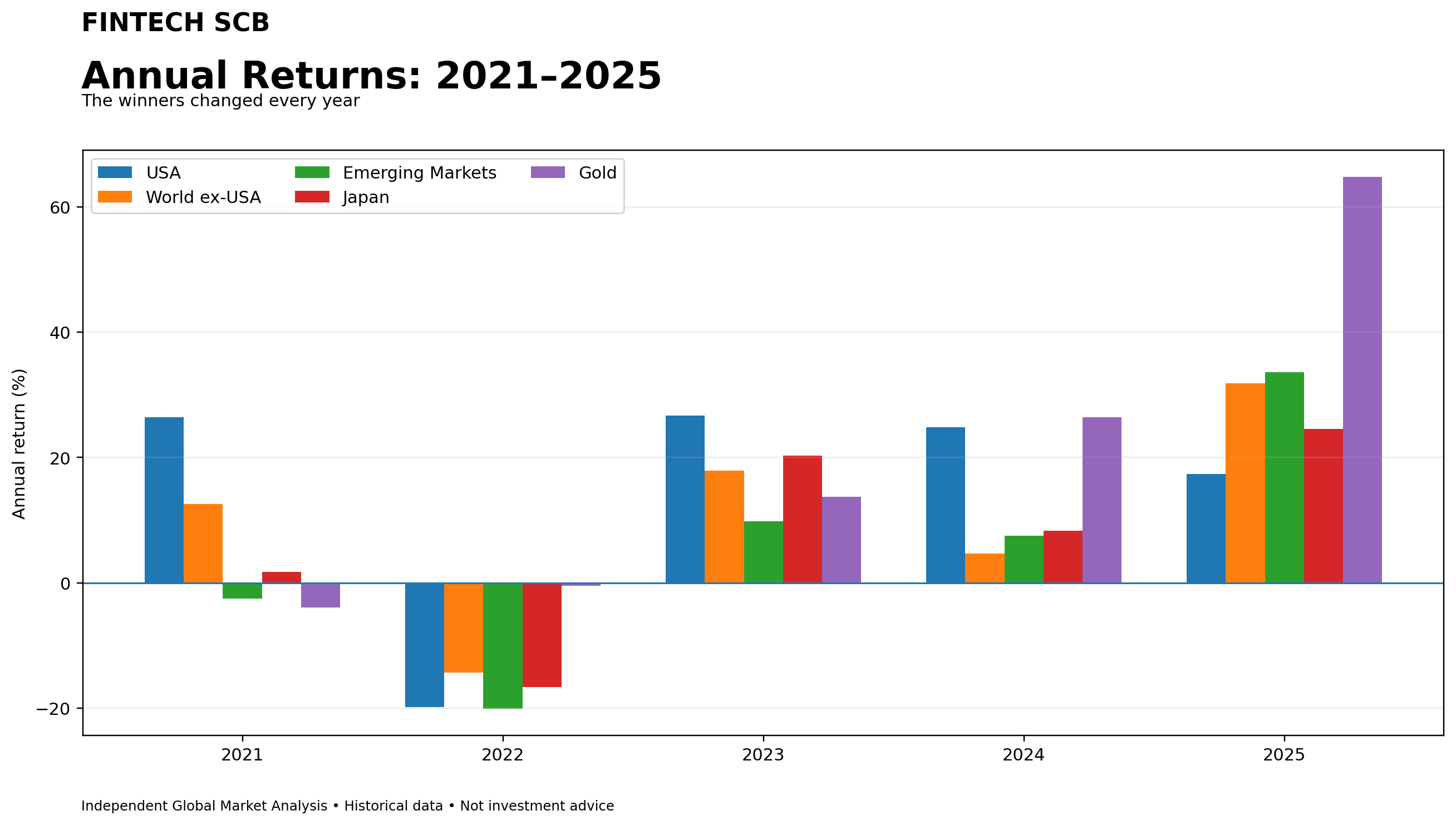
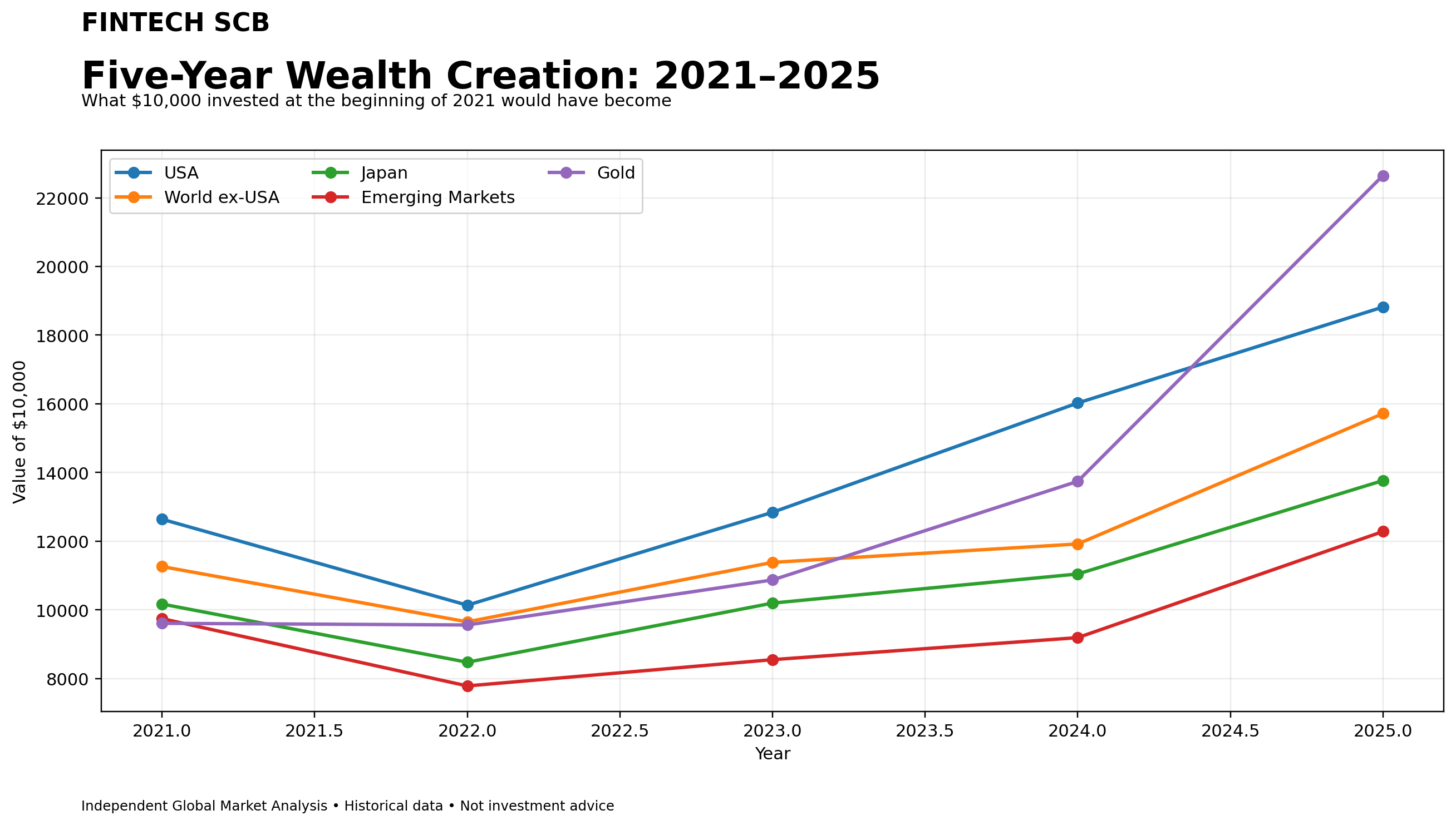
Looking back at 2021–2025, investors can see how dramatically market leadership changed from year to year.
The U.S. experienced a major correction in 2022 before recovering strongly.
Japan went through a powerful revival.
Emerging Markets suffered significant losses before recovering.
Gold initially moved sideways and then experienced an extraordinary acceleration.
Global bonds suffered one of their most difficult periods in decades as inflation forced central banks to raise interest rates.
The lesson is not that one asset class was always superior.
The lesson is that different assets behaved differently under different economic conditions.
That is precisely what diversification is supposed to achieve.
An investor who owns only one market must predict its future correctly.
An investor who owns several markets does not need to be right about everything.
Valuation May Become More Important Than Momentum
This is perhaps the most important issue for the next five years.
As of July 2026, the U.S. equity market was trading at approximately 27 times earnings.
Japan was around 21 times.
Developed Markets outside the U.S. were around 19 times.
Emerging Markets were below 18 times.
These differences do not tell us which market will perform best next year.
Markets can remain expensive for a very long time.
But valuation matters enormously over longer investment horizons.
When investors pay a very high price for future earnings, a larger proportion of future returns must come from actual earnings growth.
When investors pay a lower price, the starting point is potentially more favorable.
This is why Fintech SCB believes that the next five years deserve a more geographically balanced portfolio.
Japan: From Structural Problem to Structural Opportunity?
Japan is particularly interesting.
For decades, Japan was associated with deflation, weak economic growth and poor corporate capital allocation.
That investment story is changing.
Corporate governance reforms are encouraging companies to improve capital efficiency, return more capital to shareholders and rethink balance-sheet management.
Japanese companies are increasingly focused on profitability and shareholder value.
The transformation will not happen overnight.
But financial markets are forward-looking.
If corporate reform continues, Japan could remain an important source of long-term returns and diversification.
For this reason, Fintech SCB considers a strategic Japanese allocation appropriate for investors who already have substantial exposure to the United States.
Japan does not need to replace America.
It needs to complement it.
Emerging Markets: More Risk, But Also More Opportunity
Emerging Markets represent one of the most misunderstood areas of the global investment universe.
They are often treated as one single market.
They are not.
India, Taiwan, South Korea, Brazil, Mexico, Indonesia and China have completely different economic structures, demographics and political environments.
The common characteristic is higher risk.
Currency volatility can be substantial.
Political changes can rapidly affect markets.
Regulation can be unpredictable.
China remains particularly important because of its enormous economic weight and geopolitical significance.
But the other side of the equation is valuation.
Emerging Markets currently trade at significantly lower multiples than the United States.
That does not guarantee superior returns.
But for a long-term investor, the combination of lower valuations, demographic growth in selected economies and expanding middle classes deserves attention.
Fintech SCB therefore sees Emerging Markets as a strategic satellite allocation rather than as the core of a portfolio.
A position around 10% can provide meaningful diversification without making the portfolio excessively dependent on emerging economies.
Gold: Insurance, Not Speculation
Gold deserves a different discussion.
Gold does not produce earnings.
It does not pay dividends.
It does not generate cash flow.
And yet it has performed exceptionally well over the last several years.
Why?
Because gold serves a different purpose.
It can act as a hedge against geopolitical instability, monetary uncertainty, inflation expectations and currency risk.
The extraordinary performance of gold in 2024 and 2025 demonstrated how quickly investor demand can increase when uncertainty rises.
Fintech SCB does not view gold as a replacement for equities.
It should instead be considered a form of portfolio insurance.
A strategic allocation of around 5–10% can potentially improve diversification without turning the portfolio into a gold trade.
Bonds Are No Longer Dead Money
One of the biggest changes in the investment environment is the return of meaningful bond yields.
During the years of ultra-low interest rates, investors were forced toward equities and other risk assets because traditional fixed income offered very little income.
That environment disappeared when inflation surged.
Central banks responded by raising interest rates.
Bond prices fell sharply.
It was painful for investors who had assumed that bonds would always provide stability.
But there is another side to rising yields.
When investors buy bonds after yields have increased, they receive considerably more income than investors did during the zero-rate era.
This changes the strategic role of bonds.
Global investment-grade bonds can once again provide income, diversification and liquidity.
They can also potentially benefit if interest rates decline in the future.
For a diversified portfolio, completely ignoring fixed income is therefore no longer attractive.
What Should a Global Investor Do?
Fintech SCB’s approach is deliberately simple.
The United States should remain the largest geographic exposure because of its extraordinary economic and technological advantages.
But it should be surrounded by other engines of growth.
Developed Markets outside the United States provide diversification.
Japan offers a structural corporate-reform story.
Emerging Markets offer long-term growth and lower valuations, although with significantly higher risk.
Global investment-grade bonds provide income and balance.
Gold provides a potential hedge against geopolitical and monetary instability.
Cash or short-duration instruments provide flexibility when markets experience corrections.
The objective is not to predict the next market winner.
The objective is to construct a portfolio that remains functional even when the forecast is wrong.
The Fintech SCB View for 2026–2031
Fintech SCB would therefore maintain a strong allocation to the United States, but reduce the degree of portfolio concentration compared with the traditional U.S.-centric approach.
International developed markets deserve greater attention.
Japan deserves a structural allocation.
Emerging Markets deserve selective exposure.
Bonds deserve to return to strategic portfolios.
Gold deserves a permanent, but controlled, allocation.
And liquidity should never be underestimated.
This is not a prediction that the U.S. will underperform.
It is a recognition that the probability of diversification becoming increasingly valuable is rising.
The ETFs That Can Build This Strategy
For European investors using UCITS products, broad ETFs can provide relatively simple building blocks.
An investor seeking U.S. exposure could consider a broad MSCI USA UCITS ETF.
For developed markets outside America, an MSCI World ex-USA UCITS ETF can reduce dependence on the United States while maintaining exposure to Europe, Japan, Canada, Australia and other developed economies.
For Emerging Markets, a broad MSCI Emerging Markets IMI UCITS ETF provides exposure to a large number of companies across different emerging economies.
For Japan, an MSCI Japan UCITS ETF provides focused exposure to Japanese equities.
For fixed income, a Global Aggregate Bond UCITS ETF with EUR hedging can provide diversified investment-grade bond exposure while reducing the impact of currency fluctuations for euro-based investors.
For gold, a physically backed gold ETC can provide exposure to the metal without requiring investors to hold physical bullion themselves.
The important point is not the name of a particular ETF.
It is the architecture of the portfolio.
Low-cost, diversified instruments can be used to express a long-term global investment strategy without attempting to predict individual stocks.
The Real Lesson From 2021–2025
The greatest mistake investors can make is extrapolating the recent past indefinitely.
The U.S. may continue to outperform.
Artificial intelligence may continue to transform productivity.
American companies may continue to dominate global technology.
But markets are not economies.
And excellent companies can become poor investments when their prices already incorporate extremely optimistic expectations.
At the same time, less fashionable markets can become attractive when valuations are lower and expectations are more conservative.
That is why the next five years could look very different from the previous five.
Conclusion: Don’t Try to Predict the Future. Build for It.
Nobody knows which market will produce the highest return between 2026 and 2031.
Anyone claiming otherwise is selling certainty that does not exist.
The U.S. remains essential.
But the world is much bigger than the S&P 500.
Japan is changing.
Emerging Markets are evolving.
Europe remains undervalued in several areas but faces structural challenges.
Bonds have returned as an income-producing asset.
Gold has become a powerful diversification instrument.
The intelligent response is not to abandon the winners of the last decade.
It is to stop depending entirely on them.
Diversification is not a lack of conviction.
Diversification is an acknowledgment that nobody controls the future.
FINTECH SCB
Independent Global Market Analysis
Historical performance does not guarantee future results. This publication is for informational and educational purposes only and does not constitute personalized investment advice. ETF performance may differ from index performance because of fees, taxes, transaction costs, currency movements and tracking differences.
Originally published on Substack.
Segui Roberto Balbino su Substack