
The One-Cent Payment Myth
Cheap rails. Costly exits.
A payment travels across a digital network for one cent. The demonstration is impressive. The recipient still needs to turn the balance into money that pays the rent.
That final step is where a technological claim becomes an economic proposition.
The relevant question for a customer is how much spendable money arrives, in the required currency, by the required time, after every charge. A network fee can be genuinely tiny while the complete service remains expensive. A traditional provider can also advertise a modest explicit fee while earning substantially more through the exchange rate.
Neither a blockchain demonstration nor a bank’s fee schedule settles the comparison.
My argument is that the next serious stage of payment competition should be judged at the recipient’s end of the transaction. This requires accounting for conversion, access, liquidity, service reliability and recourse alongside the mechanics of transfer.
That test may favour a bank, a fintech or a stablecoin route in a particular case. It is more demanding than choosing a favourite technology, and considerably more useful.
The research behind the debate
A BIS paper published on 19 October 2026, by Wenxin Du, Catherine Huang and David Scharfstein, examines banks, fintechs and stablecoins through the combination of foreign-exchange markups and explicit charges. The stablecoin route includes conversion into a token and back into conventional money. [1]
The accompanying discussion by Tobias Adrian cautions that comparisons do not always match corridors, transaction sizes, dates and cost components. He notes evidence of stablecoin advantages in some comparisons, with substantial variation. These are research positions, not a simple institutional verdict declaring one technology the winner.
The publication date is also distinct from the observation dates: the paper includes earlier 2026 evidence and a September draft. Its prices are not live October retail quotes.
The valuable contribution is the question it forces us to ask: are we comparing the same complete service?
A complete payment has several jobs
Consider a person sending money to a relative in another country. The service may need to identify the customer, receive funds, exchange currencies, move value, make it accessible to the recipient and resolve an exception if something goes wrong.
Those functions need not be performed by one institution. They also need not occur in the order visible to the customer. A provider may pay the recipient from local balances and settle its own obligations later.
This means the speed of a customer payment and the speed of the provider’s underlying settlement are related but distinct. A provider can offer immediate availability by committing its own liquidity. Another can settle a token rapidly while the recipient waits for conversion or withdrawal.
A payment application is therefore a bundle of operational and financial arrangements. The attractive screen is only the interface.
The economics lie in the cost of supplying the bundle reliably, the price charged to the customer and the risks allocated along the way.
The one-cent illustration
Take a deliberately hypothetical transfer with a $1,000 principal. Express every cost in dollar-equivalent terms, using the same reference exchange rate, and assume the sender pays charges in addition to the principal.
The network transfer costs $0.01. Funding or entry costs $4. Currency conversion costs $7 relative to the benchmark. Withdrawal or payout costs $3.
The total is $14.01, or 1.401% of the principal. The network fee represents approximately 0.07% of those total costs.
These numbers are invented for explanation. They are not a quote from a bank, exchange, blockchain or payment company. If charges were deducted from a fixed $1,000 sender budget instead, the recipient amount would have to be calculated differently.
The purpose is to show why reducing one already tiny component cannot eliminate the rest. Even making the network transfer free would reduce the total bill by one cent in this example.
By contrast, reducing the conversion cost from $7 to $2 would save $5. Reducing the payout cost from $3 to $1 would save another $2. The largest improvement may therefore come from market access, liquidity or competition at an interface rather than from accelerating the central transfer.
This arithmetic applies to established providers too. If a bank cuts its visible fee but widens the exchange-rate spread, the customer may receive no meaningful benefit.
What the remittance data show
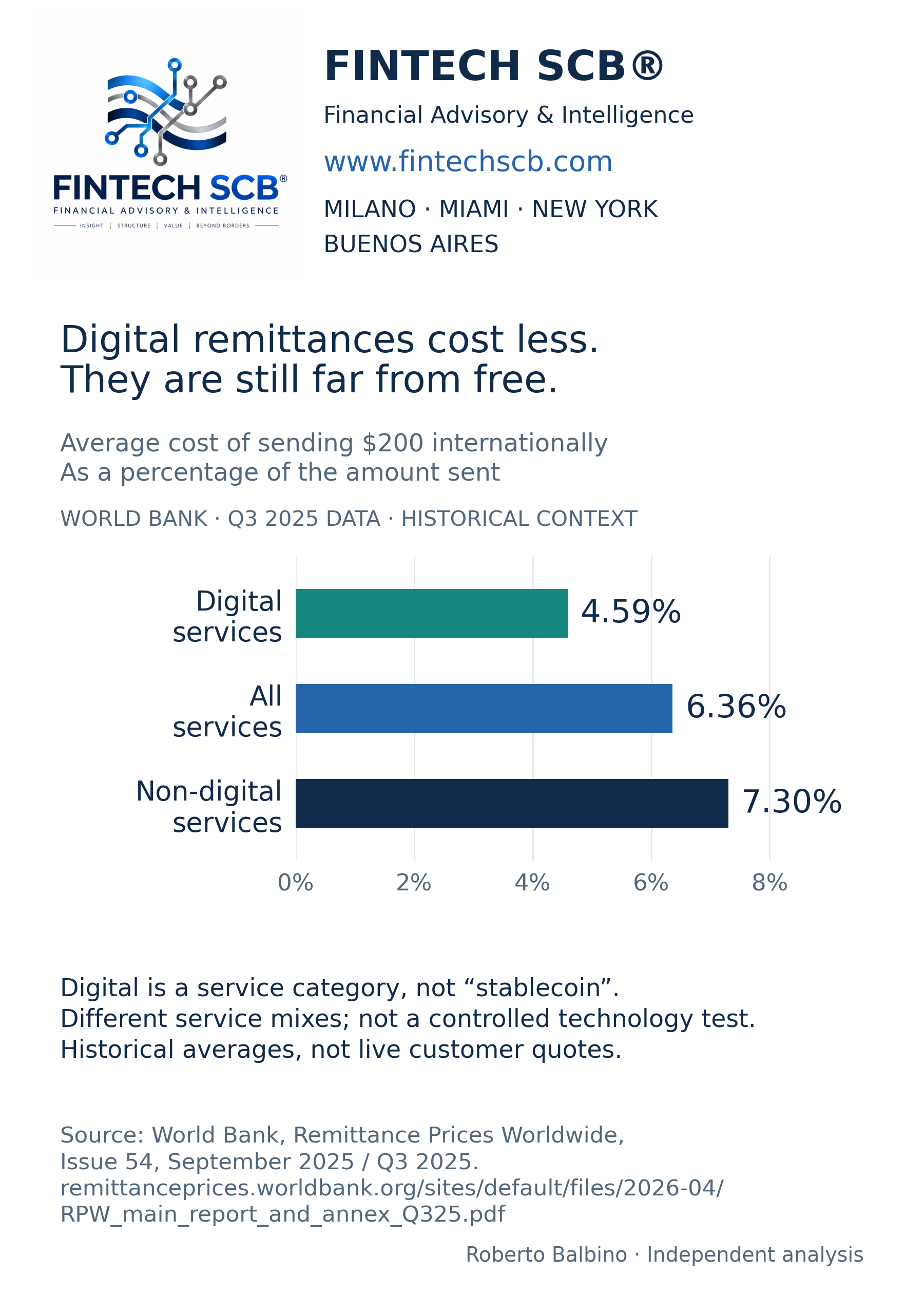
For the third quarter of 2025, the World Bank’s Remittance Prices Worldwide report records an average cost of 6.36% for sending $200. The digital average was 4.59%, compared with 7.30% for non-digital services. [2]
These historical averages provide context, not a current quote or a controlled comparison of otherwise identical customers. The chart labels the quarter clearly. “Digital” is a service category, not a synonym for stablecoin.
The difference demonstrates why digital access and competition deserve attention. It cannot isolate a causal technology effect: service mixes, corridors and customer choices differ. Nor does an average tell an individual sender which provider is cheapest for a particular transaction today.
For a low-income household receiving frequent transfers, small percentage differences can nevertheless be economically meaningful. Money lost in fees or spreads is money unavailable for food, education, housing or savings.
This is a welfare issue before it is a technology contest.
Why currency conversion is difficult to wish away
A payment crossing a border does not always need a currency conversion, but many household and commercial transactions do. Someone must supply the currency the recipient wants at the time it is needed.
A deep, competitive market can make that service inexpensive. A thin market, a one-sided flow or difficult access can make it costly. A low transfer fee does not itself create a willing counterparty at an attractive exchange rate.
Imagine a corridor in which almost everyone wants to send funds in one direction. A provider cannot indefinitely match those transfers against equal flows in the opposite direction if the opposite flows do not exist. It must source liquidity, replenish balances or arrange settlement elsewhere.
The cost depends on market structure and risk, not only on software. A more efficient architecture can lower it, but the financial task remains.
The distinction between price and cost matters as well. A provider with market power may charge more than its underlying expense. Better technology may improve its margin without automatically improving the customer’s price. Competition, switching costs and transparency influence how the benefit is shared.
Stablecoins can improve the route
There are use cases in which tokens can be valuable. Participants may already hold the same token, operate across time zones and have access to reliable conversion. Programmability can simplify conditional transfers or automated workflows. A business may value availability outside conventional operating hours.
If the recipient wants to retain the token, an immediate conversion into a local bank balance may not be necessary. A comparison that forces conversion in that situation would charge the stablecoin route for a service the customer did not ask for.
The reverse is equally true. If the recipient must pay a supplier in local currency, stopping the measurement at the arrival of a token omits a necessary part of the service.
This is why the intended use must be specified before the route is evaluated. The same technical transfer can be a completed payment for one user and an intermediate step for another.
The strongest case for innovation is therefore specific: a particular corridor, customer, amount, funding method and desired final asset. Broad claims become less convincing as those details disappear.
Access to money is a separate promise
A token is a claim or instrument within a particular legal and operational arrangement. The ability to transfer it does not establish that every holder can redeem it under identical conditions, instantly and without cost.
The BIS’s June 2026 monetary-system analysis discusses the importance of redemption, interoperability, reserve arrangements and liquidity under stress. It also distinguishes technological improvements from the institutional properties that support trust in money. [3]
For a customer, the practical questions are direct. Who owes me the value? Which entity holds the relevant assets? How do I obtain usable money? What happens if an intermediary suspends operations? Which jurisdiction and procedure govern a dispute?
These questions apply in different forms to banks, payment institutions, exchanges and token issuers. Answering them does not require rejecting innovation. It requires knowing what product has actually been delivered.
A cheap service that works in ordinary conditions may still have costs associated with a rare failure. The right comparison includes the protections and service quality the customer needs, without assuming that every user values them identically.
The cost of a failed payment
Consider a small importer that must pay a supplier before a shipment is released. One route is cheaper by $10 but occasionally creates a delay that ties up the shipment. The economic cost of the delay could exceed the fee saving.
Alternatively, an established bank route may be slow and opaque while a well-designed fintech service delivers a reliable final amount immediately. The higher-priced incumbent cannot justify its price merely by invoking tradition.
The useful measure combines money received, time to availability, probability of failure and the cost of resolving an exception. Precise weighting will vary by customer.
A family sending monthly support may care most about the final amount and convenient cash access. A corporate treasury may prioritise predictable settlement, audit records and liquidity management. A platform may value automated processing across thousands of small payments.
There is no reason to expect one product to dominate every combination of those requirements.
The history of reform is a coordination problem
The G20 cross-border payments roadmap began in 2020. In July 2026, FSB Deputy Secretary General Martin Moloney described continuing problems involving market incentives, foreign-exchange dependencies, fragmented authority and implementation across institutions. His remarks are useful context for why better technology alone has not completed the task. [4]
A payment can cross systems with different operating hours, customer data requirements and local practices. Improving one institution does not automatically align the others.
There is a familiar commercial incentive problem here. The party paying for an improvement may capture only part of its benefit. A provider may also profit from existing customer inertia. Coordination requires more than agreement that faster and cheaper payments would be desirable.
This creates room for entrants, but it also explains why entrants often still need partnerships, local access and credible operational arrangements. Replacing the visible middle of a process does not automatically replace its legal and economic endpoints.
The geopolitical question: whose currency travels?
If a payment innovation makes foreign-currency balances easier to hold, its significance can extend beyond transaction fees. Users may value access to a different currency as well as a new transfer mechanism.
That can be attractive to households facing uncertainty about their domestic money. It can also change the environment in which local banks and central banks operate.
The June BIS analysis discusses potential dollarisation and funding implications if foreign stablecoins become widely used. These are conditional channels, not proof that every token payment removes deposits from domestic banks by the same amount. Reserve placement and the way funds circulate matter. [3]
The relevant policy question is how to improve domestic monetary credibility and payment quality while managing cross-border risks. Attempting to solve poor service exclusively by protecting existing institutions would leave the underlying customer demand untouched.
For the United States, wider dollar use may carry strategic advantages. For other jurisdictions, convenient access to dollar instruments can complicate the relationship between domestic economic conditions and monetary control. A small retail fee can sit inside a much larger institutional choice.
A better standard for comparison
I would ask every provider to state the same outcome: for this amount, at this time, using this funding method, how much of the requested currency will the recipient be able to use, and when?
The comparison should include the exchange-rate benchmark, all explicit charges, any recipient fee, quote expiry, access requirements and the treatment of exceptions. Promotional pricing should be separated from recurring pricing.
Tests should cover more than one transfer size and more than one corridor. A fixed charge has a different impact on $200 than on $20,000. A deep currency pair cannot stand in for a thin one. A weekday observation cannot establish weekend performance.
Researchers should also distinguish customer prices from providers’ underlying costs. A route may be technically efficient while expensive to the customer, or temporarily cheap because its price is subsidised.
My view would change in favour of a particular route if repeated, comparable observations showed a better final outcome with appropriate reliability and protection. A compelling demonstration of one component would not be enough.
The next winner in cross-border payments may be the provider that combines several technologies well and makes the result simple for the customer. The customer should not need to admire the architecture to receive value from it.
A payment is economically complete when the recipient has the money the transaction required. That is where the measurement should end, and where the competition should begin.
Sources and data notes
[1] Wenxin Du, Catherine Huang and David Scharfstein, Competing rails for cross-border payments: banks, fintechs and stablecoins, BIS Working Paper 1385, published 19 October 2026; includes Tobias Adrian’s discussion. Publication date is not the date of every quote or observation.
https://www.bis.org/publications/working-paper-1385-competing-rails-crossborder-payments-banks-fintechs-and-stablecoins
[2] World Bank, Remittance Prices Worldwide, Issue 54, September 2025 / Q3 2025 data, PDF hosted in April 2026. Chart values are historical averages for sending $200; digital and non-digital samples are not controlled matches.
https://remittanceprices.worldbank.org/sites/default/files/2026-04/RPW_main_report_and_annex_Q325.pdf
[3] BIS, Annual Economic Report 2026, Chapter III: Anchoring trust in money: innovation beyond stablecoins, June 2026.
https://www.bis.org/publications/aer-2026/anchoring-trust-money
[4] Martin Moloney, Cross-border payments: towards the next chapter, remarks published by the FSB, 8 July 2026. The views are attributed to the speaker, not presented as a binding institutional conclusion.
https://www.fsb.org/2026/07/cross-border-payments-towards-the-next-chapter/
The $1,000 cost example is a Fintech SCB illustration, not a provider quote. All amounts use a common dollar-equivalent basis; fees are paid on top of principal. No current provider ranking is inferred from historical or unmatched data.
Roberto Balbino — Founder & CEO, Fintech SCB
Independent analysis of finance, economics, geopolitics and global markets
www.fintechscb.com
#Payments #Stablecoins #Fintech #CrossBorderPayments #Banking #DigitalMoney #RobertoBalbino #FintechSCB
Originally published on Substack.
Segui Roberto Balbino su Substack