
THE TRADWIFE ILLUSION: SELLING DEPENDENCE AS FREEDOM
From Yesteryear to the economics of unpaid work, household power and national prosperity.
The most expensive sentence in the traditional-family debate may be the most ordinary: “My wife does not work.”
If she raises children, prepares food, cleans, manages appointments, supports elderly relatives and organises the conditions under which somebody else can earn a salary, she works. What she may lack is a wage, an employment contract, an independent pension and a readily marketable claim on the value she creates.
That distinction contains an entire economic system. It separates production from payment, contribution from ownership, affection from bargaining power. It also explains why the tradwife phenomenon deserves a more serious examination than either admiration for beautiful kitchens or contempt for women who enjoy domestic life.
Here, tradwife means the public ideal of the “traditional wife”: domesticity and a gendered division of responsibilities presented as a desirable way to organise marriage, often around a male provider. It is not a useful label for every mother at home, every religious household or every person who enjoys cooking. Those categories contain widely different beliefs and financial arrangements.
Caro Claire Burke’s Yesteryear, published in April 2026 and being adapted into a film starring Anne Hathaway, provides an unusually effective starting point. Its protagonist, Natalie Heller Mills, markets a perfect domestic existence supported by modern equipment and people working behind the scenes. The publisher’s synopsis then places her in the brutal conditions of 1855. The premise exposes the distance between displaying an idealised past and bearing its material costs. [1]
For an economist, the revealing question begins before the historical nightmare. Who pays for the apparently effortless household? Who owns the business? Who does the invisible work? Who can stop performing without losing everything?
A woman filming, editing, negotiating sponsorships, managing customers and selling products is running a business. Her kitchen may be a studio. Domesticity may be the product. A husband visible at home tells us remarkably little about who generates the household’s income. The image of dependence can itself become a source of entrepreneurial independence.
The viewer buying the aspiration may have none of those revenues, assets or safeguards.
There is nothing inherently irrational about choosing to devote time to family care. The serious economic problem begins when a highly specific arrangement is advertised as a universal formula, while its capital requirements, opportunity costs and distribution of risk disappear from view.
The traditional household always depended on women’s work. Its institutions determined how much of that work would be paid, who would own the resulting resources and what options remained available to the person performing it.
To understand that arrangement, we have to begin much earlier than the suburban kitchen.
For much of economic history, production and domestic life occupied the same physical space. Farms, workshops and family businesses combined household survival with market activity. Women cultivated land, processed food, made textiles, traded, took in paid work and provided care. The modern distinction between a person “at work” and a person “at home” fits this world poorly.
Claudia Goldin’s historical research challenged the assumption that female labour-force participation simply rose alongside economic development. Reconstructing activities that older records often failed to count, she identified a U-shaped pattern in the United States: participation declined during the transition from an agricultural to an industrial economy and later increased with the expansion of services, education and opportunities for women. [2]
This matters because an absence from an employment register is not evidence of an absence from production. Counting conventions can turn a working woman into a statistical dependent without removing a single task from her day.
Industrialisation also changed the location of production. When more activity moved into factories and offices, the wage became a more visible marker of contribution. Work performed inside the household could remain essential while appearing economically secondary. The distinction acquired cultural force: the breadwinner brought home money; the homemaker supposedly merely spent it.
Yet the wage earner’s availability had to be produced somewhere. Food, clean clothes, rest, the care of dependants and the management of daily life were inputs into paid employment. Treating those inputs as naturally available concealed their cost. It also encouraged an incomplete view of labour productivity: the measured output of one worker could depend on substantial unmeasured effort by another.
The familiar mid-twentieth-century American household was one configuration within this much longer history. Even at the symbolic height of the homemaker ideal, women were present in the labour market. US Bureau of Labor Statistics historical data put women’s labour-force participation at 33.9% in 1950; the annual rate eventually reached 60.0% in 1999. These figures concern the civilian noninstitutional population aged 16 and over, not married mothers alone. [3]
The historical lesson is narrower, and stronger, than a claim that every family followed the same pattern. The image of universal female withdrawal is false. A household’s ability to rely on one salary depended on the level and stability of that salary, housing costs, family size, wealth, available services and the standard of living being financed.
For a prosperous household, domestic specialisation could be a preferred allocation of time. For another, a single income could mean severe material constraint. For a third, several family members had to work regardless of what respectable society considered ideal. Treating these arrangements as one timeless tradition removes class from the analysis precisely where class matters most.
The rights attached to marriage also changed the economic calculation. In England and Wales, the Married Women’s Property Acts of 1870 and 1882 progressively strengthened married women’s control over earnings and property. France’s 1965 reform enabled married women to work and open bank accounts without their husbands’ authorisation. The US Equal Credit Opportunity Act of 1974 prohibited credit discrimination on grounds including sex and marital status. Italy’s 1975 family-law reform established equal marital rights and duties and recognised contributions through both professional and domestic work. [4–7]
These were changes to the rules governing assets, contracts and economic agency. A nostalgic image that retains contemporary property rights, financial access and consumer technology while praising an earlier hierarchy is assembling a selective version of history.
The distinction is fundamental. A woman who can own assets, access money and return to employment may choose domestic specialisation on terms unavailable to an earlier generation. The observable activity can look similar while the underlying distribution of power is completely different.
Women’s entry into professional careers also required changes in the time horizon over which decisions could be made. Goldin and Lawrence Katz’s research on access to the contraceptive pill connected greater control over the timing of marriage and childbearing with investment in lengthy professional education. Their argument concerns the ability to make credible plans for a future career, not simply an additional consumer product. [8]
An education that takes years to complete is an investment under uncertainty. The expected return depends on whether the person can use it. Reproductive autonomy, access to employment and enforceable rights therefore enter the economics of human capital directly. They influence which skills are acquired, how long those skills remain in use and whether society receives a return on the resources devoted to developing them.
This brings us to the economic case traditionally made for household specialisation.
Gary Becker’s 1965 analysis of the allocation of time treated households as producers that combine purchased goods with their members’ time. A meal, for example, requires more than ingredients; care requires more than expenditure. This framework made it possible to examine domestic activity as production rather than as a blank space outside the economy. [9]
Specialisation can generate benefits. If one partner has a substantially higher market wage, allocating more paid work to that person may increase current household income. Another partner may prefer care work, or provide it at a quality the family particularly values. A sensible analysis must allow for those preferences and gains.
But a decision that appears efficient today can create dependence tomorrow.
Suppose one partner initially earns somewhat less. The couple allocates most care responsibilities to that person. Reduced hours then limit experience, promotion and future earnings. At the next decision point, the wage difference is larger, strengthening the apparent economic case for the same allocation. The result can become self-reinforcing even when the initial difference was small.
Calling the final arrangement a revelation of natural comparative advantage would miss the process that produced it. The wage gap used to justify specialisation may itself reflect earlier specialisation, institutional constraints or discrimination. A static comparison of today’s salaries can therefore conceal a dynamic loss of options.
There is also a distributional question inside the household. Maximising combined income does not establish that both partners share equally in the benefits, control the assets or bear comparable risks.
Shelly Lundberg, Robert Pollak and Terence Wales examined a UK policy change that redirected child-related resources towards wives in the late 1970s. Their study found a change in expenditure patterns towards women’s and children’s clothing relative to men’s clothing. The result challenged the simple assumption that it makes no difference which partner receives household income. [10]
The general implication should not be exaggerated into a rule about every marriage. It is that the household cannot automatically be treated as a single person with one preference, one bank account and one degree of security. Income distribution within a family can affect outcomes even when its total resources are unchanged.
Two households with the same income may consequently contain very different levels of individual freedom. In one, both adults have information, access and enforceable claims. In another, one person must request permission for ordinary spending. A household-income statistic will not reliably reveal that difference.
The scale of the work concealed by these arrangements is enormous.
The ILO’s 2018 care-work report estimated that unpaid care absorbed 16.4 billion hours each day worldwide, with women performing 76.2% of the total. Valuing this work at an hourly minimum wage produced an estimate equivalent to roughly 9% of global GDP. These are the report’s historical estimates, not a new measurement for 2026. [11]
A separate ILO exercise, published in October 2024 using estimates for 2023, found that care responsibilities kept 708 million women and 40 million men aged 15 and over outside the labour force. The ILO explicitly cautions that changes in methodology prevent a straightforward comparison with its earlier estimate. [12]
These are people engaged in activities that sustain other people’s capacity to live and work. The label “outside the labour force” describes a statistical relationship with employment and job seeking. It does not establish idleness, low effort or a lack of social contribution.
National accounting adds another complication. Standard GDP generally excludes unpaid domestic and personal services produced within households, while including equivalent services purchased in the market. It also contains important exceptions to any simplistic paid-versus-unpaid distinction, including imputed owner-occupied housing services and certain goods produced for own use. [13]
If a household hires a cleaner, the service enters measured market production. If a household member performs the same cleaning without pay, that service generally does not. The activity remains useful in both cases. What changes is the transaction and the accounting boundary.
This creates a trap for arguments on both sides. Moving care into paid employment can increase measured GDP without an equivalent increase in the quantity or quality of care. Conversely, moving care back into the household can reduce measured GDP without eliminating the service. Neither observation settles whether people are better off.
Mexico provides a concrete example of how satellite accounts make this work visible. INEGI valued unpaid domestic and care work in 2024 at approximately 8 trillion pesos, equivalent to 23.9% of the country’s GDP. Women generated 72.6% of that imputed value. The release incorporated new time-use information and revised the historical series. [14]
The Mexican figure and the ILO’s global estimate should not be placed in a league table: their coverage, valuation methods and reference periods differ. Neither represents cash waiting to be collected. A shadow price measures the estimated value of an activity; it does not establish a market capable of purchasing all of it at that price.
Nor does recording that value create an income for the caregiver. Recognition, remuneration and ownership are separate institutional decisions. A woman can produce a large imputed contribution and still have no money available in her own name.
The private financial consequences become clearer when we follow a household through time.
Consider an explicitly illustrative case. One adult earns €30,000 a year after tax. Continuing paid work requires €15,000 annually in additional childcare and commuting costs. On these assumptions, employment adds €15,000 to the household’s annual cash position. A five-year exit would forgo €150,000 in net earnings but avoid €75,000 in those expenses, leaving a €75,000 cash difference.
This is arithmetic under stated assumptions, not an estimate for a typical European family. It excludes wage growth, changes in taxes and benefits, other expenses and differences in the quality of care. It also leaves out several potentially important long-term effects.
The first is career progression. A five-year interruption can affect the wage received after returning, the occupations available and the ability to reach senior positions. The second is pension accumulation. The third is access to employer benefits and training. The fourth is resilience if the partner who earns the salary becomes unemployed, ill or unable to work.
These consequences cannot be calculated responsibly by multiplying a current salary by the number of years remaining until retirement. Some people return successfully; some switch careers; some receive pension credits; others face persistent losses. The direction and magnitude depend on institutions, occupation, age, the duration of the interruption and the division of care after returning.
Evidence nevertheless shows that parenthood can leave a substantial and persistent earnings gap. Henrik Kleven, Camille Landais and Jakob Egholt Søgaard, using Danish administrative data from 1980 to 2013, estimated a long-run gender earnings gap associated with children of around 20%, operating through participation, hours and wage rates. It is a result for that setting and research design, not a universal deduction to apply to every mother’s salary. [15]
The pension consequences are visible decades later. Eurostat reported that the average gross pension income of women aged 65 and over in the EU was 24.5% below men’s in 2024. The indicator includes old-age benefits, survivors’ benefits and regular pensions from individual private plans. It reflects many accumulated differences; it is not a causal estimate of the effect of homemaking alone. [16]
For household financial planning, the relevant unit is therefore the entire life cycle. A decision can improve life with a young child and simultaneously weaken later financial security. A good arrangement should address both realities rather than pretending that one cancels the other.
An unpaid caregiver also faces a particular investment problem. Consider the person who relocates for a partner’s career, suspends professional activity and takes responsibility for the home. The investment may increase the other partner’s future earning capacity. Much of the return is then attached to that partner’s qualifications, professional relationships and position in the labour market.
Domestic contributions can be recognised through property arrangements, pension rights and family law. But those protections differ by jurisdiction and circumstance. The economic point is that the person supplying the support does not automatically receive a portable asset equivalent to the career being advanced.
A household relying on one salary also concentrates earnings risk. Two salaries do not provide perfect diversification: both partners may work in the same industry or be hit by the same recession. Nevertheless, retaining employability can provide an additional way to respond to a shock. A decision to specialise should assess that option value alongside immediate childcare savings.
The same analysis applies to a father who becomes the unpaid caregiver. It applies to households beyond the heterosexual breadwinner template. Changing the sex of the person at home does not remove the underlying questions of access to money, independent entitlements and the ability to re-enter employment.
There is a cost for the sole breadwinner too. Concentrating financial responsibility in one person can make a career interruption, an occupational change or a reduction in hours difficult for that person. The arrangement can constrain both adults, although it does so in different ways.
The language of complete protection is therefore misleading unless somebody explains what happens when earnings stop, care needs change or the relationship ends. Security is an arrangement that continues to function under adverse conditions. An attractive current standard of living is insufficient evidence of it.
Employers help shape these choices.
In her 2014 work on gender convergence, Goldin argued that pay disparities are linked to how firms organise and reward time. Some occupations disproportionately reward very long hours, particular hours and continuous availability. Greater flexibility and the ability to substitute between workers can reduce the penalty attached to caring responsibilities. [17]
Imagine a firm that pays a large premium for being available whenever a client calls. A worker who can offer that availability may have a partner handling every school closure, medical appointment and family emergency. Part of the worker’s professional advantage rests on the partner’s time.
This does not make the employee’s contribution imaginary. It means the workplace is drawing on a household arrangement it may never acknowledge. When employers assume that somebody else will absorb disruptions, they help turn domestic specialisation into an economic necessity.
An exhausted woman may reasonably find the promise of withdrawal attractive. If paid employment has been added to most of the unpaid work, the lived experience of “having it all” can be a shortage of time, rest and control. Dismissing that frustration as ignorance would weaken any serious critique of the tradwife message.
The promise becomes deceptive when relief from a badly organised present is sold without examining the dependence built into the proposed alternative. A sustainable solution has to change the distribution of work, the availability of services or the terms of employment. Moving a burden into a prettier room leaves the burden intact.
At the national level, the issue extends beyond how many people hold jobs.
A useful accounting identity decomposes output per person into the employment-to-population ratio, hours per employed person and output per hour. Expanding opportunities for women can affect all three terms, but it is a mistake to assume that an increase in employment translates mechanically into an identical increase in GDP or welfare.
New workers need jobs, equipment, skills and demand for what they produce. Their average hours may differ from those already employed. Changes in home production must also be considered. Capital investment and improvements in organisation may raise the eventual gains; poor job matching or insufficient services may reduce them.
Take a simple numerical illustration. In a population of 100 working-age adults, with 50 women and 50 men, male employment of 80% and female employment of 60% produce 70 employed people. Raising female employment to 80% would increase that number to 80: a 14.3% rise in employment. It would not, by itself, prove a 14.3% increase in national output, household welfare or tax revenue.
The stronger economic argument concerns the allocation of talent. If social arrangements restrict who becomes an engineer, entrepreneur, scientist, manager or physician, the economy chooses from an artificially limited pool. An extra worker matters; a better match between ability and occupation can matter more.
Chang-Tai Hsieh, Erik Hurst, Charles I. Jones and Peter J. Klenow estimated that improved allocation of talent across gender and racial groups explained between 20% and 40% of growth in US market output per person between 1960 and 2010, depending on the model specification. This is a model-based historical contribution involving both gender and race. It does not mean that women alone generated 40% of GDP. [18]
The World Bank similarly presents large potential gains from reducing gender gaps in employment and entrepreneurship, including an estimate around 20% of global GDP. Such figures describe counterfactual possibilities under modelling assumptions. They are neither an annual growth forecast nor a sum that can be added to the estimated value of unpaid care. [19]
The mechanism is nevertheless relevant to ageing countries. A smaller potential workforce makes barriers to productive participation more costly. Raising the number of births today cannot supply trained workers tomorrow. Removing obstacles facing adults who already possess skills can operate on a different, and potentially shorter, time horizon.
There is a fiscal dimension as well. More paid employment can broaden the tax base and contributions to social insurance. Providing childcare and long-term care requires resources. Their net fiscal effect depends on costs, take-up, labour-supply responses and the quality of services. Calling every expenditure an investment does not demonstrate that it will finance itself.
Equally, leaving care unpaid does not make it costless. It places part of the cost on household time, earnings and future security. A government may save expenditure on one budget line while households lose income and the state collects less tax elsewhere.
International comparisons show why no single employment statistic can settle the debate.
For a consistent European benchmark, Eurostat’s 2025 annual employment data for women aged 20–64 show 79.8% in Sweden, 79.6% in the Netherlands, 77.7% in Germany, 72.6% in France, 67.6% in Spain and 58.0% in Italy. The EU average was 71.3%. These percentages describe women in employment; they do not measure full-time work, equal pay or control over household assets. [20]
For Italy, the difference from the EU average is 13.3 percentage points. Put plainly, out of every 100 women in that age group, roughly 13 fewer were employed than at the EU average. This is a comparison of rates, not a claim that enough suitable vacancies already exist or that every woman outside employment wants the same arrangement.
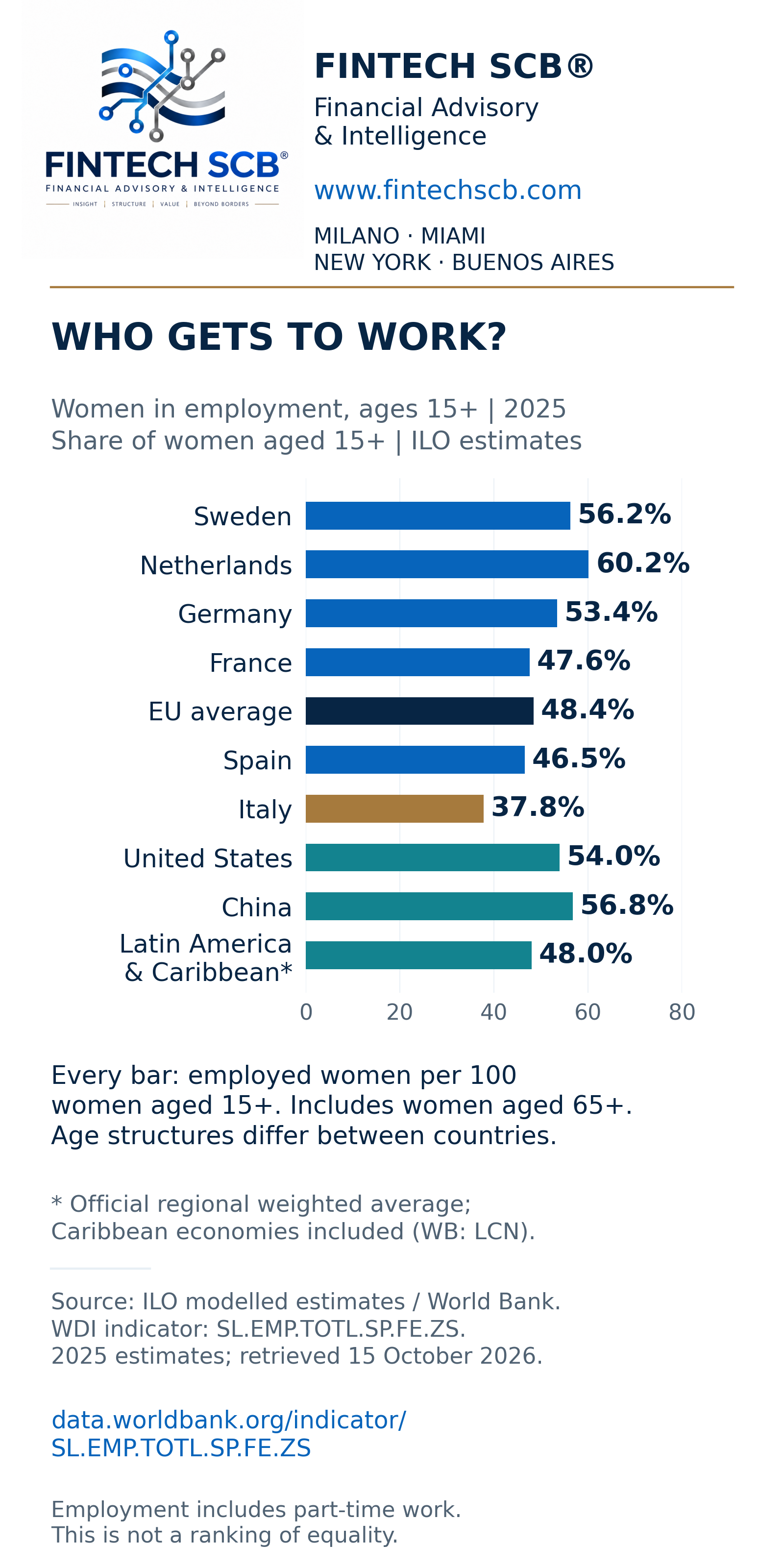
Extending the comparison to the United States, China and Latin America requires a common statistical basis. The World Bank’s ILO-modelled series supplies a separate 2025 comparison for women aged 15 and over. On this definition, the employment rate was 54.0% in the United States and 56.8% in China. The official weighted aggregate for Latin America and the Caribbean was 48.0%. The regional coverage includes Caribbean economies; it is not a simple average giving every country the same weight. [29]
On precisely the same 15-and-over basis, the Netherlands stood at 60.2%, Sweden at 56.2%, Germany at 53.4%, France at 47.6%, Spain at 46.5% and Italy at 37.8%. The EU aggregate was 48.4%. These figures are different from the preceding Eurostat comparison because the population includes women aged 65 and over as well as younger women, and the statistical series is different. They must not be mixed with the rates for ages 20–64. [29]
This broader measure is useful for showing the share of the adult female population engaged in employment. It is also influenced by demographic structure, retirement patterns and education. The figures are modelled estimates, not a ranking of equality, job quality or freedom. Where observations have been imputed, uncertainty is greater; small differences should not be treated as precise evidence that one social model is superior.
The United States, China and Latin America therefore belong in the discussion without being reduced to stereotypes. An employment rate cannot tell us whether an American household can afford childcare, whether a Chinese worker controls her income, or whether a Latin American woman’s job provides reliable pension contributions. Those require additional evidence. The general economic lesson is that entering employment, receiving adequate compensation and acquiring durable financial security are three separate outcomes.
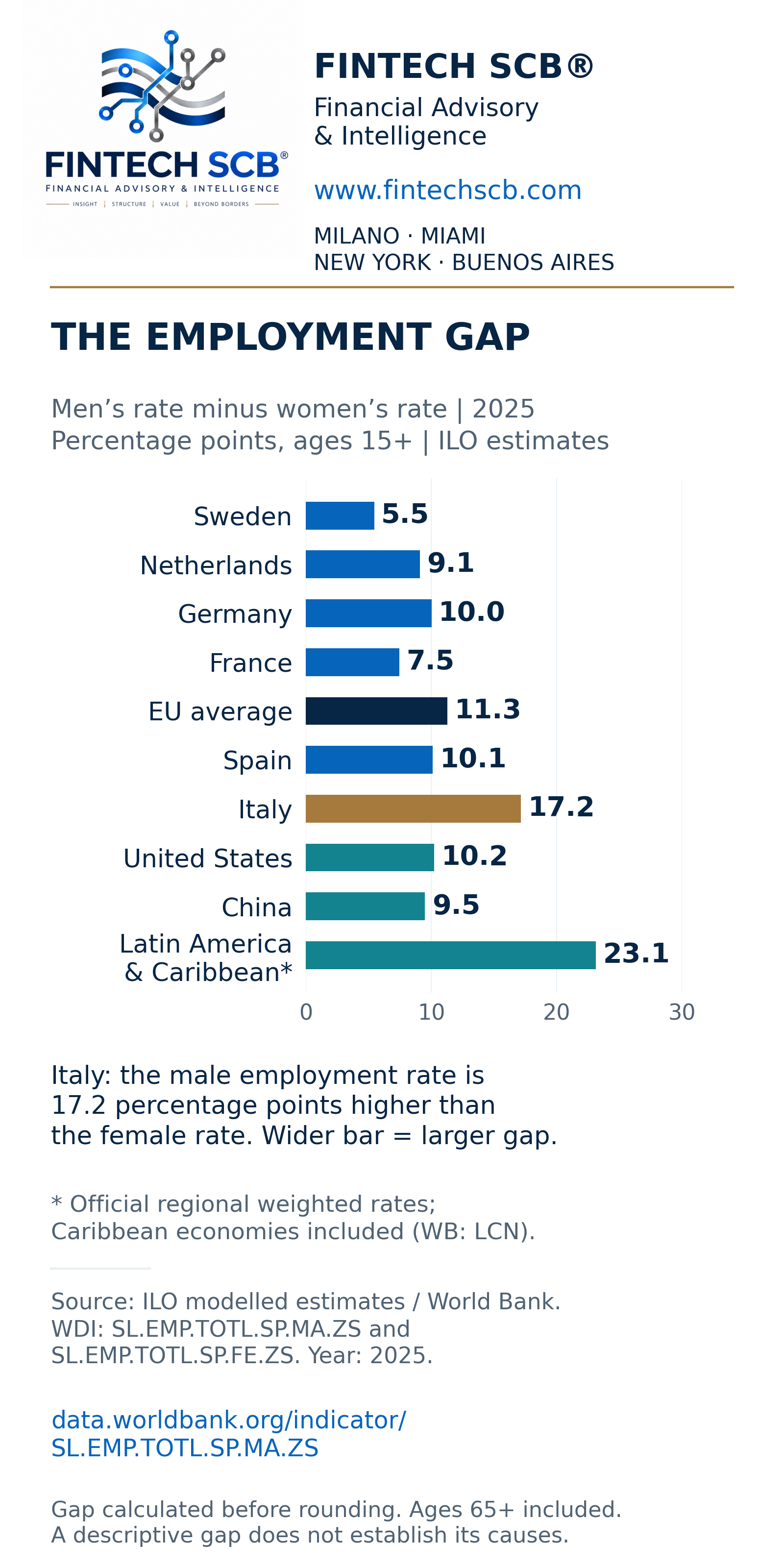
The comparison becomes more revealing when women’s employment is set against men’s on the same age basis. In 2025, the male employment rate exceeded the female rate by 10.2 percentage points in the United States and 9.5 points in China. The difference was 23.1 points in Latin America and the Caribbean. Italy’s gap was 17.2 points, compared with 11.3 for the EU, 10.1 for Spain, 10.0 for Germany, 9.1 for the Netherlands, 7.5 for France and 5.5 for Sweden. These differences are calculated from the unrounded ILO-modelled rates. [29–30]
For example, Italy’s 17.2-point gap is the difference between an estimated male employment rate of 55.0% and a female rate of 37.8%, with each measured against its own population aged 15 and over. It is a difference in percentage points, not a statement that women are 17.2% less likely to work. The measure includes older adults, so retirement patterns and population structure also matter.
The larger Latin American and Caribbean gap identifies a substantial difference in recorded employment across the region. It does not establish how much is caused by care, job availability, discrimination or individual preferences, and it conceals considerable variation between countries. Conversely, a smaller gap in China than in the United States does not demonstrate greater freedom within households. Employment, pay, working conditions, asset ownership and bargaining power require separate evidence. Counting the worker is the beginning of the analysis.
The Italian case raises a question about feasible choice. A parent cannot choose a job that is unavailable, a nursery place that does not exist or a working schedule incompatible with necessary care. Preferences matter, but observed behaviour reflects the options actually available. The task of analysis is to separate preference from constraint rather than assigning every absence from employment to either tradition or personal failure.
Sweden’s higher rate demonstrates that extensive female employment is compatible with a very different institutional setting. It does not prove that Swedish households have eliminated unequal care, career penalties or low fertility. A country can perform relatively well on access to employment and still leave important problems unresolved.
The Netherlands and Germany illustrate a second distinction: employment versus hours. Eurostat’s 2024 figures show that 66.6% of employed Dutch women aged 25–54 with children worked part-time; the corresponding figure for Germany was 66.1%. Across the EU it was 31.7%, compared with 5.1% among employed men of the same age with children. [21]
Part-time work can be a valuable preference and a means of retaining labour-market attachment. Its consequences depend on whether it is chosen freely, how jobs are designed and whether reduced hours also reduce advancement disproportionately. A society can move beyond the one-earner household while continuing to organise family life around one full career and one constrained career.
Long-term indicators should be read alongside that distinction. The Netherlands had a 36.3% average gender pension gap in Eurostat’s 2024 release. Today’s employment rate and older people’s pension incomes concern different cohorts; one cannot infer that current part-time work caused the observed gap. Together, however, they show why employment access and lifetime income security must be assessed separately. [16]
Japan adds the question of employment quality. The OECD’s 2024 economic survey reported that around 55% of female employees were in non-regular employment. It connected labour-market dualism with lower wages, weaker career prospects and limitations on training. This is a statistic from that survey’s reference period, not a new estimate for October 2026. [22]
An economy can employ more women while failing to use their qualifications fully. Returning to a job with limited progression after a period of care can preserve some earnings without restoring the career that was interrupted. Counting heads alone obscures this loss.
South Korea highlights the difficulty of combining professional life and family formation. OECD research examines the interaction of demanding employment conditions, unequal responsibilities, housing and education costs, and very low fertility. Its diagnosis concerns a system in which work and family can become difficult to reconcile. Reducing that interaction to a claim that educated women have become insufficiently interested in motherhood substitutes blame for analysis. [23]
India requires another methodological caution. Its official survey for July 2023–June 2024 put female labour-force participation among people aged 15 and over at 41.7% under the usual-status measure, up from 23.3% in 2017–18. Within the same 2023–24 survey, participation was 47.6% in rural areas and 28.0% in urban areas. [24]
These figures cannot be directly ranked against the European employment rates above: they use a different age range, count participation rather than employment alone and apply a different reference-period concept. Higher rural participation also cannot automatically be interpreted as greater financial autonomy. Participation, the form of work, remuneration and control over income are separate questions.
That distinction is essential beyond affluent societies. Leaving an exhausting low-paid job may express a desire for dignity. Working in a family enterprise may not deliver an independent income. An unpaid caregiver and an unpaid contributing family worker may also occupy different statistical categories. A defensible comparison must explain what is being counted.
There is a further class dimension: some households combine demanding careers with domestic comfort by employing other people to provide care. The ILO’s 2021 report estimated 75.6 million domestic workers worldwide, of whom 76.2% were women; 81.2% were in informal employment. These are the report’s historical estimates. [25]
Hiring support can benefit both the employing household and the worker. The concern is the distribution of wages, protection and bargaining power. If one woman’s professional freedom depends on another woman’s insecure employment, the care problem has changed location without necessarily being resolved.
This is why a compelling visual example can be economically unrepresentative. A large house, extensive equipment, flexible work, domestic assistance or family wealth can make a particular lifestyle possible. Removing those conditions while retaining the same expectations changes the proposition completely. What looks like a lesson in values may depend on a balance sheet the audience never sees.
The natality argument deserves particularly careful examination.
The claim that sending women home will reliably restore birth rates confuses a possible individual response with an established national result. Some people may want more time at home with children. It does not follow that a country with lower female employment will have more births, or that reducing women’s economic options will make parenthood more attractive.
Eurostat’s 2024 total fertility rates were 1.61 children per woman in France, 1.43 in Sweden, 1.36 in Germany, 1.18 in Italy and 1.10 in Spain. Finland stood at 1.25. The EU average was 1.34. These period indicators reflect the age-specific fertility rates of that year; they are not a prediction of the completed family size of today’s young women. [26]
Italy and Spain therefore provide no simple evidence that lower employment guarantees higher fertility. At the same time, Sweden and Finland show that strong institutions and high female employment do not guarantee replacement-level fertility. Selecting only the countries that fit a preferred ideology would produce a misleading result in either direction.
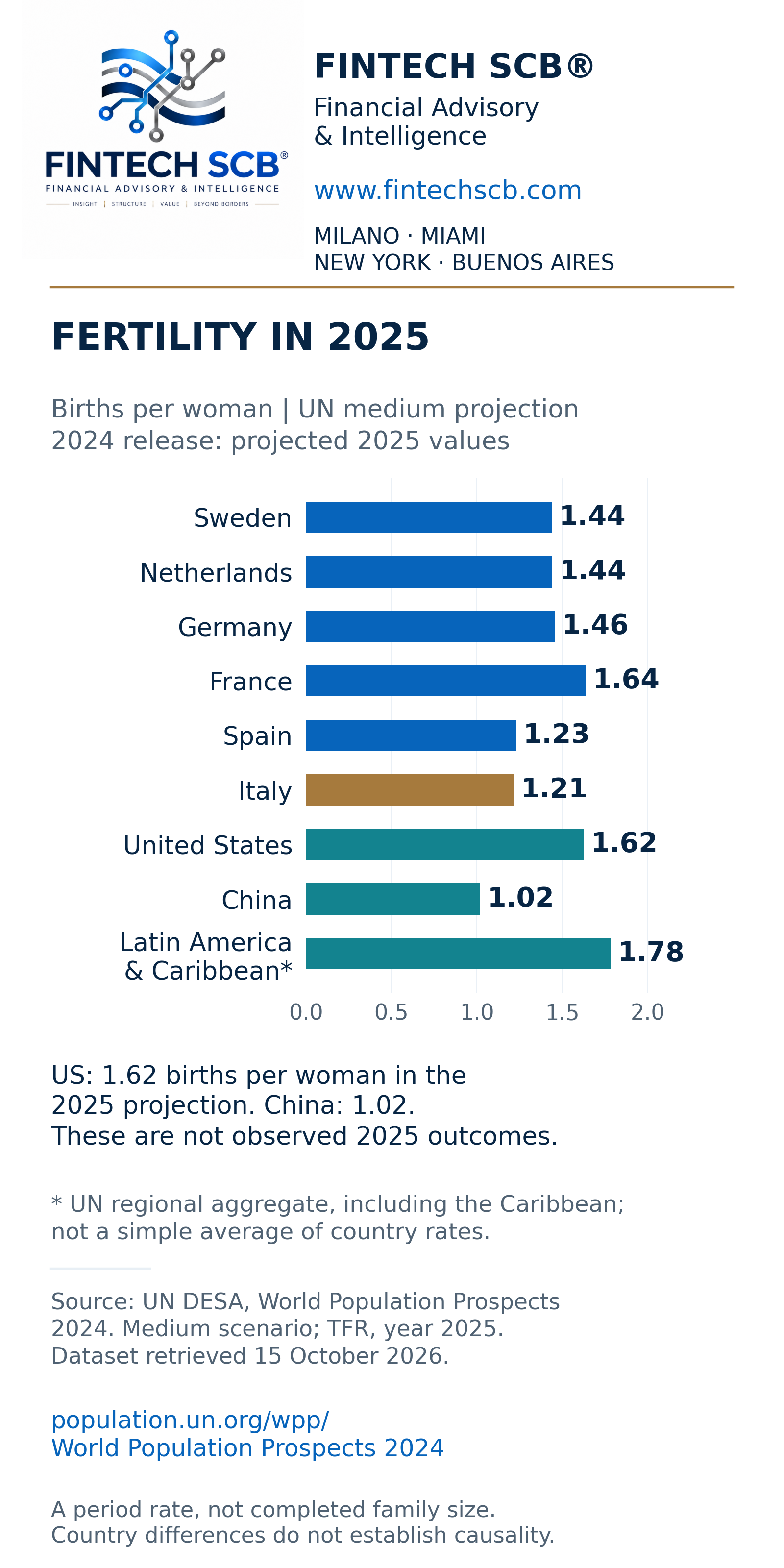
For a 2025 international comparison, a common UN series extends the picture to the United States, China and Latin America and the Caribbean. The medium scenario in World Population Prospects 2024 projected 1.62 births per woman for the United States in 2025, 1.02 for China and 1.78 for Latin America and the Caribbean. On the same projection basis, the figures were 1.64 for France, 1.46 for Germany, 1.44 for both Sweden and the Netherlands, 1.23 for Spain and 1.21 for Italy. The regional figure is the UN aggregate, not a simple mean of national rates. [31]
These numbers are projections for 2025 from the 2024 revision, not observed 2025 birth outcomes. They must not be presented as proof that an employment arrangement caused a particular fertility result. Their role here is to provide a consistently defined demographic comparison across the same major economies. Observed national releases can differ from this projection vintage.
The economic point concerns the joint cost of earning, caring and raising children. A society may have extensive female employment and very low fertility. Another may have lower female employment and also very low fertility. Neither pattern supplies evidence for a universal prescription to send women home. A demographic strategy needs to examine housing, employment security, care provision, time and preferences together.
The OECD’s Society at a Glance 2024 explains that the cross-country relationship between female employment and fertility has changed over time. It finds positive associations with the ability to combine work and family, while also examining housing costs, uncertainty and changing preferences. It explicitly notes that family policies alone do not explain fertility differences or the recent declines. [27]
The economic mechanism is understandable. A second income can help make housing and children affordable. Predictable childcare can reduce the career cost of parenthood. A partner who shares care can reduce the expected time burden. None guarantees an additional birth, and none entitles a government to demand one.
Policies should expand people’s ability to form the families they want. Treating women as an instrument for meeting a demographic target is both an impoverished account of freedom and a weak basis for economic policy.
What, then, can responsibly be said about the tradwife phenomenon itself?
The sources used here do not establish a harmonised international count of self-identified tradwives, nor a causal estimate of their effect on female employment or GDP. A stream of highly visible content cannot supply either. The economic evidence concerns care, employment and household institutions; it should not be misrepresented as a measurement of the size of an online movement.
The cultural phenomenon can nevertheless be analysed as a commercial proposition. Where creators monetise idealised domesticity, the underlying business sells attention, products or access to an audience. An economic critique should inspect that business model rather than assume that the image on screen is a complete description of the household.
There is an important difference between enjoying a video and making an irreversible financial decision based on it. Someone can admire a garden or a recipe without adopting the creator’s account of marriage. The concern arises when commercial success is presented as evidence that financial dependence is broadly safe or inherently superior.
The asymmetry is sharp. A successful creator may accumulate income, professional experience and a valuable brand while promoting an aesthetic of withdrawal. A follower who leaves employment without comparable assets may accumulate none of those protections. The same story can produce independence for its seller and vulnerability for its purchaser.
That observation does not require speculation about any named influencer’s private finances. It is a reason to ask for evidence before converting a curated lifestyle into advice about household organisation.
The policy response should be equally concrete.
Care must be measured and treated as essential economic activity. Time-use surveys and satellite accounts reveal contributions that market-income measures miss. Measurement helps identify who supplies care, who lacks access to it and which groups bear the heaviest time burdens. It does not replace the separate task of giving caregivers income and rights.
The design of childcare and long-term care matters as much as nominal availability. Services must operate at useful times, be accessible where people live and provide acceptable quality. Care workers need training, decent compensation and reliable conditions. Expanding a system through poorly supported workers can undermine the service on which everyone else depends.
Employers should examine whether their working arrangements needlessly penalise people with caring responsibilities. Predictable schedules, workable handovers and credible career paths after leave can preserve productive capacity. Flexibility that quietly removes a worker from promotion opportunities is only a partial solution.
Taxes, benefits and leave arrangements should be evaluated for the incentives they create for each adult. A system that makes additional earnings barely worthwhile can encourage withdrawal even when a parent would prefer employment. A family policy that recognises fathers only as salary providers can also perpetuate an unnecessarily narrow division of work.
Choosing unpaid care should not require surrendering financial visibility or reasonable protection. Depending on the jurisdiction, relevant mechanisms can include pension credits, appropriate insurance, access to household funds, recognition of domestic contributions in asset arrangements and realistic routes back into paid work. The appropriate instruments vary; the economic objective is to keep a choice from becoming a trap.
Public support must be costed honestly. ILO modelling of care-policy packages examines both the spending required and the potential employment effects across countries. Those exercises illustrate why the expenditure and return sides belong in the same analysis, while remaining conditional projections rather than guaranteed fiscal outcomes. [28]
A state cannot assume that unpaid female time will expand indefinitely to absorb an ageing population, inadequate services and incompatible work schedules. A company cannot indefinitely treat household support as an unlimited free input. A family cannot evaluate a decades-long allocation of labour solely by comparing this month’s salary with this month’s nursery bill.
The appropriate ambition is broader than maximising paid hours. It includes adequate care, sustainable working lives, higher productivity and meaningful choice. A mother who genuinely prefers full-time care should not be demeaned. A father who wants to provide it should not be treated as economically defective. A parent who wants paid employment should not be blocked by a system built on the assumption that somebody will always remain at home.
The test is whether the arrangement preserves consent, shares risk and allows adaptation over time. Can both adults understand the finances? Can the caregiver build security? Can either person revise the division of work? Is the household robust enough to survive a change in circumstances?
Those questions bring us back to Yesteryear. Its premise exposes what happens when the attractive surface of domestic nostalgia is separated from the modern resources that make it comfortable. Economic analysis has to perform the same exercise with income, rights and risk.
An apron tells us little about the distribution of power. The bank account, the pension record, the ownership documents and the available alternatives tell us much more.
The tradwife ideal becomes economically dangerous when it encourages people to stop asking those questions. A beautiful household can contain a fair partnership. It can also contain a large transfer of unpaid effort whose return belongs disproportionately to someone else. Appearance cannot distinguish the two.
Any serious defence of family life should begin by making the labour that sustains it visible. It should then ensure that the person performing that labour can share in the wealth, retain dignity and remain free to choose again.
An economy that needs women’s work while refusing to account for its cost is running a subsidy on their time.
Calling that subsidy tradition does not settle the bill.
Roberto Balbino — Founder & CEO, Fintech SCB. Independent analyst of finance, economics, geopolitics and global markets.
FINTECH SCB®
Financial Advisory & Intelligence
www.fintechscb.com
MILANO · MIAMI · NEW YORK · BUENOS AIRES
Sources and methodological notes
Research cut-off: 15 October 2026. The three accompanying charts refer to 2025. Employment levels and gaps are ILO-modelled estimates. Fertility values are UN medium-scenario projections from the 2024 revision, not observed 2025 outcomes. Historical evidence retains its original reference years.
The cultural starting point is the novel Yesteryear and its announced film adaptation, not a review of a released film.
The European employment comparison uses Eurostat data for ages 20–64. The global comparison and employment charts use World Bank / ILO modelled estimates for ages 15+, including people aged 65 and over. The two age bases are not interchangeable. Latin America and the Caribbean employment figures use the World Bank’s official weighted aggregate, LCN, including high-income economies.
Country comparisons are descriptive and do not establish causality. Household calculations are illustrative arithmetic. No quantified macroeconomic effect is attributed to the tradwife movement itself.
[1] Fourth Estate / HarperCollins and Penguin Random House — Yesteryear, Caro Claire Burke: publication information, synopsis and announced film adaptation.
https://www.harperreach.com/products/yesteryear-caro-claire-burke-9780008742775/
https://www.penguinrandomhouse.com/books/780686/yesteryear-a-gma-book-club-pick-by-caro-claire-burke/
[2] Royal Swedish Academy of Sciences — The Prize in Economic Sciences 2023: Claudia Goldin’s research on women’s labour-market outcomes.
https://www.nobelprize.org/uploads/2023/10/popular-economicsciencesprize2023.pdf
[3] US Bureau of Labor Statistics — Women in the Labor Force: A Databook, 2020, historical participation series.
https://www.bls.gov/opub/reports/womens-databook/2020/home.htm
[4] UK Parliament — Marriage: property and children; Married Women’s Property Acts of 1870 and 1882.
https://www.parliament.uk/about/living-heritage/transformingsociety/private-lives/relationships/overview/propertychildren/
[5] Institut national de l’audiovisuel — 13 juillet 1965, les femmes mariées s’émancipent.
https://www.ina.fr/ina-eclaire-actu/13-juillet-1965-les-femmes-mariees-s-emancipent
[6] US Consumer Financial Protection Bureau — Equal Credit Opportunity Act: historical background.
https://www.consumerfinance.gov/archive/blog/what-you-need-know-about-equal-credit-opportunity-act-and-how-it-can-help-you-why-it-was-passed-and-what-it/
[7] Senato della Repubblica — Session of 12 May 2020: discussion of Law 151/1975 and contributions to family life through professional and domestic work.
https://www.senato.it/show-doc?id=1151723&idoggetto=0&leg=18&part=doc_dc-ressten_rs-gentit_ddm100227t3e100231cpaea157c3drpdgesadl&tipodoc=Resaula
[8] Claudia Goldin and Lawrence F. Katz — The Power of the Pill: Oral Contraceptives and Women’s Career and Marriage Decisions, Journal of Political Economy, 2002; NBER working paper 7527.
https://www.nber.org/papers/w7527
[9] Gary S. Becker — A Theory of the Allocation of Time, The Economic Journal, 1965, 75(299), 493–517.
https://academic.oup.com/ej/article/75/299/493/5250146
[10] Shelly J. Lundberg, Robert A. Pollak and Terence J. Wales — Do Husbands and Wives Pool Their Resources? Evidence from the United Kingdom Child Benefit, Journal of Human Resources, 1997.
https://sjlundberg.weebly.com/uploads/1/1/0/0/110062333/uk_jhr_1997.pdf
[11] International Labour Organization — Care Work and Care Jobs for the Future of Decent Work, 2018, executive summary.
https://www.ilo.org/sites/default/files/wcmsp5/groups/public/%40dgreports/%40dcomm/%40publ/documents/publication/wcms_633166.pdf
[12] International Labour Organization — Unpaid care work prevents 708 million women from participating in the labour market, 29 October 2024; estimates for 2023.
https://www.ilo.org/resource/news/unpaid-care-work-prevents-708-million-women-participating-labour-market
[13] Australian Bureau of Statistics — Household satellite account and unpaid work, Australian System of National Accounts: Concepts, Sources and Methods, 2020–21.
https://www.abs.gov.au/statistics/detailed-methodology-information/concepts-sources-methods/australian-system-national-accounts-concepts-sources-and-methods/2020-21/chapter-23-satellite-accounts/household-satellite-account-and-unpaid-work
[14] INEGI — Cuenta Satélite del Trabajo No Remunerado de los Hogares de México 2024, press release 148/25, 25 November 2025.
https://www.inegi.org.mx/contenidos/saladeprensa/boletines/2025/tnrh/CSTNRHM2024_CP.pdf
[15] Henrik Kleven, Camille Landais and Jakob Egholt Søgaard — Children and Gender Inequality: Evidence from Denmark, American Economic Journal: Applied Economics, 2019; NBER working paper 24219.
https://www.nber.org/papers/w24219
[16] Eurostat — Women’s pension 25% lower than men’s in 2024, 25 February 2026. Average pension figures used in this article.
https://ec.europa.eu/eurostat/web/products-eurostat-news/w/ddn-20260225-1
[17] Claudia Goldin — A Grand Gender Convergence: Its Last Chapter, American Economic Review, 2014, 104(4), 1091–1119.
https://www.aeaweb.org/articles?id=10.1257/aer.104.4.1091
[18] Chang-Tai Hsieh, Erik Hurst, Charles I. Jones and Peter J. Klenow — The Allocation of Talent and U.S. Economic Growth, Econometrica, 2019.
https://onlinelibrary.wiley.com/doi/10.3982/ECTA11427
[19] World Bank — Women, Business and the Law 2026: potential economic gains from reducing gender gaps.
https://wbl.worldbank.org/
[20] Eurostat — Employment and labour force by sex and age, annual data, lfsi_emp_a. Employment rate; female; ages 20–64; percentage of population; 2025. Retrieved 15 October 2026.
https://ec.europa.eu/eurostat/databrowser/view/lfsi_emp_a/default/table?lang=en
[21] Eurostat — Part-time and full-time employment statistics, 2024 data; employed women and men aged 25–54 with children.
https://ec.europa.eu/eurostat/statistics-explained/index.php?title=Part-time_and_full-time_employment_-_statistics
[22] OECD — OECD Economic Surveys: Japan 2024; labour-market dualism and non-regular employment.
https://www.oecd.org/en/publications/2024/01/oecd-economic-surveys-japan-2024_9289b572.html
[23] OECD — Women’s Employment and Fertility in Korea, 2024.
https://www.oecd.org/en/publications/women-s-employment-and-fertility-in-korea_ac53879e-en.html
[24] Government of India, Ministry of Statistics and Programme Implementation — Periodic Labour Force Survey Annual Report, July 2023–June 2024; usual-status participation, ages 15+.
https://www.pib.gov.in/Pressreleaseshare.aspx?PRID=2057970&lang=2®=48
[25] International Labour Organization — Making Decent Work a Reality for Domestic Workers, 2021; official release and report presentation.
https://www.ilo.org/resource/news/10-years-domestic-workers-still-fight-equality-and-decent-work
https://www.ilo.org/infostories/en-GB/Campaigns/report/domestic-workers
[26] Eurostat — Fertility statistics; reference year 2024, data extracted 19 February 2026; dataset demo_find, indicator TOTFERRT.
https://ec.europa.eu/eurostat/statistics-explained/SEPDF/cache/1273.pdf
[27] OECD — Society at a Glance 2024; executive summary and analysis of fertility trends.
https://www.oecd.org/en/publications/society-at-a-glance-2024_918d8db3-en/full-report/executive-summary_412b52a0.html
[28] International Labour Organization — Costs and Benefits of Investing in Transformative Care Policy Packages: A Macrosimulation Study in 82 Countries, Working Paper 55, 2022.
https://webapps.ilo.org/static/english/intserv/working-papers/wp055/index.html
[29] World Bank / ILO Modelled Estimates — Employment to population ratio, 15+, female (%), SL.EMP.TOTL.SP.FE.ZS. Reference year 2025; WDI update 8 October 2026; retrieved 15 October 2026. Latin America and Caribbean: LCN, weighted regional aggregate.
https://data.worldbank.org/indicator/SL.EMP.TOTL.SP.FE.ZS
https://databank.worldbank.org/metadataglossary/world-development-indicators/series/SL.EMP.TOTL.SP.FE.ZS
[30] World Bank / ILO Modelled Estimates — Employment to population ratio, 15+, male (%), SL.EMP.TOTL.SP.MA.ZS. Reference year 2025. Employment gaps calculated as male minus female rates before rounding, expressed in percentage points.
https://data.worldbank.org/indicator/SL.EMP.TOTL.SP.MA.ZS
[31] United Nations, Department of Economic and Social Affairs, Population Division — World Population Prospects 2024, Demographic Indicators, Medium scenario, year 2025, total fertility rate. Latin America and the Caribbean: geographic region 904. These are projections from the 2024 revision.
https://population.un.org/wpp/
https://population.un.org/wpp/assets/Files/WPP2024_Methodology-Report_Final.pdf
Substack tags: Economics, Economic History, Tradwives, Unpaid Care, Labour Markets, Gender Economics, Financial Independence, Public Policy.
#Tradwives #Economics #EconomicHistory #UnpaidCare #FinancialIndependence #FintechSCB
Originally published on Substack.
Segui Roberto Balbino su Substack