Fintech SCB — Editoriale

Roberto BalbinoInsights

Analisi indipendenti su finanza, economia, geopolitica e le forze che plasmano il nostro mondo.

Prospettive indipendenti su finanza globale, mercati, economia, geopolitica e business internazionale — scritte da Roberto Balbino, Founder & CEO di Fintech SCB.

ANALISI INDIPENDENTE SU FINANZA, ECONOMIA E GEOPOLITICA.

Segui Roberto Balbino su Substack e ricevi le nuove analisi direttamente nella tua casella email.

Ultime analisi

  1. Revolut Is Not Under Investigation. Its Operating Model Is.

    A Milan court has placed the Italian business of Europe’s most valuable fintech under judicial administration. The sums involved are small. The number that matters is 265 to zero.

  2. Personal Consultations for Founding Members: How It Works

    The plan that adds my personal answer to your own financial questions.

  3. China Wants the Chair. It Does Not Want the Bill.

    Shenzhen will show what Chinese leadership looks like: tightly scripted, well attended and lightly funded. The harder question is who underwrites a world order that two powers want to run and neither

  4. The Productivity Trap: Why More Immigration Doesn't Automatically Mean a Richer Country

    The OECD’s 2026 Migration Outlook quietly retires the West’s favorite demographic fairy tale. America and Italy show why, from opposite ends of the same barbell.

  5. My Information Has a Value. From Today, This Substack Is Paid.

    After months of articles, this work now goes to the readers who pay for it.

  6. Nvidia Lost Its Founder. AI Did Not Lose Its Customers.

    A scandal, an election and a $1.4 trillion listing in ten days. The price of artificial intelligence is being cut, in the stock market and at the till. Its use is not, and the real risk sits where the

  7. The Price of Yesterday

    How protecting existing wealth can make tomorrow’s opportunities more expensive

  8. Big Tech Stopped Buying Its Own Shares. It Started Selling Them to You.

    Alphabet’s buyback machine ran for 33 quarters. In 2026 it went into reverse, and the whole AI build-out followed it — from cash, to debt, to equity, at the top of the cycle.

  9. Private Credit Doesn’t Want Your Savings. It Wants Savings That Can’t Leave.

    Twenty billion dollars of redemption requests, a door that opens 5% a quarter, and a rule written to open 401(k)s — what the gate reveals about the product.

  10. SPAIN VOTES ON 29 NOVEMBER. WHAT HAPPENS TO YOUR MONEY?

    Sánchez, the right and the economic choices that will matter for Spanish households, businesses and investors.

  11. The Exit That Never Really Exits

    Private Equity, Continuation Funds and the New Economics of Keeping What You Sell

  12. Florida Does Not Persuade Voters. It Selects Them.

    Migration, ownership and money built a Republican majority by subtraction. The cost of living inside the Florida dream is now the patient’s chart.

  13. The App Worked. The Balance Sheet Didn't.

    Paraguay's ueno bank served six in ten adults, held about $869 million of public money and answered to a central bank led by its former chairman. A president has resigned. The bill has not been paid.

  14. After Mid Trump: What I Invest In Now

    Democrats took the House and the Senate. On Sunday I published three portfolios; this is the one I’m running, line by line. The full 88-page FINTECH SCB insight is free at fintechscb.com/insights.

  15. THE PRESIDENT CAN LOSE CONGRESS. THE ECONOMY KEEPS THE BILL.

    Why an electoral correction cannot automatically reverse the financial consequences of concentrated executive power.

  16. The Minerals Are Not the Money

    Who captures the value? A Fintech SCB Sunday Read

  17. MID TRUMP

    How the decisions of one presidency changed the price of goods, energy, money and risk, and why Tuesday’s vote matters far beyond America

  18. The Euro’s Quiet Expansion

    Follow the credit.

  19. The Inflation Aftershock

    Cheaper oil\. Costlier living\.

  20. America’s 3.4% Boom and the Cost of Waiting

    A data centre can contribute to economic growth years before its investors receive an adequate return. A household’s bills fall due every month.

  21. The restructuring dividend: who gets paid when the workforce gets smaller?

    Deloitte’s 45% pay rise, the incentives inside Salesforce’s margin targets, and the question boards should answer before rewarding a transformation.

  22. Europe's Debt Has Three Clocks

    The bill comes in stages

  23. How North Korea Pays for the Bomb—and Makes Its People Pay for Survival

    Kim Jong Un’s new bridges to China and Russia reveal an economy less isolated than it looks, and a state increasingly able to secure resources without giving its citizens greater economic freedom

  24. The One-Cent Payment Myth

    Cheap rails. Costly exits.

Cover: Forced to Sell. Chosen to Buy.

FINTECH SCB Insight · November 2026 · by Roberto Balbino

Forced to Sell. Chosen to Buy.

Forced to Sell. Chosen to Buy. — FINTECH SCB Insight

How governments became the largest creators of special situations, and who collects the discount

In 1997 Joel Greenblatt explained that the best bargains appear where somebody is compelled to sell for reasons that have nothing to do with value. In 2026 the largest compelled sellers are no longer fund managers. They are companies acting under the order of a government, and the buyer is no longer whoever does the best analysis. It is whoever obtains permission.

The sales that matter in 2026 come from somewhere else. A statute obliged ByteDance to sell control of TikTok’s American business. Sanctions obliged Lukoil to dispose of an international portfolio first valued at $22 billion. A federal court ordered the sale of Citgo to pay Venezuela’s creditors. Panama’s Supreme Court annulled the concession for two canal ports that were already part of a $22.8 billion sale.

For families and entrepreneurs with assets in more than one jurisdiction, the useful question is no longer how to buy from a forced seller. It is how to avoid becoming one. This insight ends with three questions: which state can order me to sell, how long would I have, and who would be allowed to buy.

80 pages · 22 chapters · 9 exhibits · 73 source notes · current to November 17, 2026

First Edition · November 2026 · English · PDF

General information and education, not individual investment, tax or legal advice. Capital is at risk.

EUR 1,99, tasse escluse — pagamento unico

Eventuali tasse applicabili vengono aggiunte al pagamento.

Nell'app non sono disponibili nuovi acquisti di questo servizio. I contenuti già acquistati restano accessibili dopo l'accesso.

Copertina: L’informazione è gratis. Il filtro no.

FINTECH SCB Insight · Novembre 2026 · di Roberto Balbino

L’informazione è gratis. Il filtro no.

L’informazione è gratis. Il filtro no. — FINTECH SCB Insight

Commissioni, attenzione e il processo che protegge un patrimonio

L’informazione finanziaria è diventata gratuita. Il conflitto di interessi no: ha solo cambiato forma, e in molti casi si è raddoppiato. Questo Insight nasce dall’introduzione di un libro italiano sugli investimenti e arriva a una tesi che riguarda chiunque abbia un patrimonio da proteggere.

Il conflitto delle commissioni, quello di chi viene pagato dal prodotto che colloca, non è stato risolto. Il 12 novembre 2026 il Parlamento europeo ha respinto per 14 voti la direttiva che doveva stringere le regole. Accanto al primo è cresciuto un altro conflitto, quello dell’attenzione. Chi pubblica contenuti gratuiti è pagato dal tempo di chi guarda.

La risposta non è cercare una fonte disinteressata, perché non esiste, compreso chi scrive. La risposta è un processo: decisioni prese prima, per iscritto, da applicare quando il mercato si muove. Per un patrimonio che attraversa confini il processo non finisce con la scelta di cosa comprare. Dove sono custoditi gli attivi, in quale valuta, sotto quale legge e a nome di chi sono domande che nessun modello di mercato risolve.

53 pagine · 9 figure · 12 tabelle · 32 note con le fonti · chiusura della ricerca: 17 novembre 2026

Prima edizione · Novembre 2026 · Italiano · PDF

Informazione generale ed educativa. Non costituisce consulenza individuale in materia di investimenti, fiscale o legale. Il capitale è a rischio.

EUR 1,99, tasse escluse — pagamento unico

Eventuali tasse applicabili vengono aggiunte al pagamento.

Nell'app non sono disponibili nuovi acquisti di questo servizio. I contenuti già acquistati restano accessibili dopo l'accesso.

Cover: The Money Is There. The Trust Is Not.

FINTECH SCB Insight · November 2026 · by Roberto Balbino

The Money Is There. The Trust Is Not.

The Money Is There. The Trust Is Not. — FINTECH SCB Insight

From Brussels to Buenos Aires, governments are courting the private saver. Families should decide before someone decides for them.

In the summer of 2026 two governments with almost nothing in common made the same admission. In Paris, the President of the European Commission told French employers that Europe has savings and that those savings are idle. In Buenos Aires, Argentina’s economy minister presented his second law in seven months to draw dollars out of safe-deposit boxes and mattresses. Neither of them was short of capital. Both were short of the confidence that moves it.

This Insight follows that admission through five capitals. It measures the stock of household money that sits still, describes the levers governments are pulling to make it move, and tests those levers against the evidence available in November 2026. Its conclusion is addressed to families and entrepreneurs whose capital lives in more than one country: idle capital is never neutral. It is a decision, and if the owner does not take it, someone else will.

It is not a warning that deposits are about to be seized. The European plan gives no institution any power over anyone’s bank account; it works through incentives and market infrastructure. The subject here is quieter and, for long-term capital, more consequential: who writes the menu from which savers choose.

60 pages · 8 chapters · 5 figures · 70 source notes · data and sources as of November 17, 2026

First Edition · November 2026 · English · PDF

General information and education, not individual investment, tax or legal advice. Capital is at risk.

EUR 1,99, tasse escluse — pagamento unico

Eventuali tasse applicabili vengono aggiunte al pagamento.

Nell'app non sono disponibili nuovi acquisti di questo servizio. I contenuti già acquistati restano accessibili dopo l'accesso.

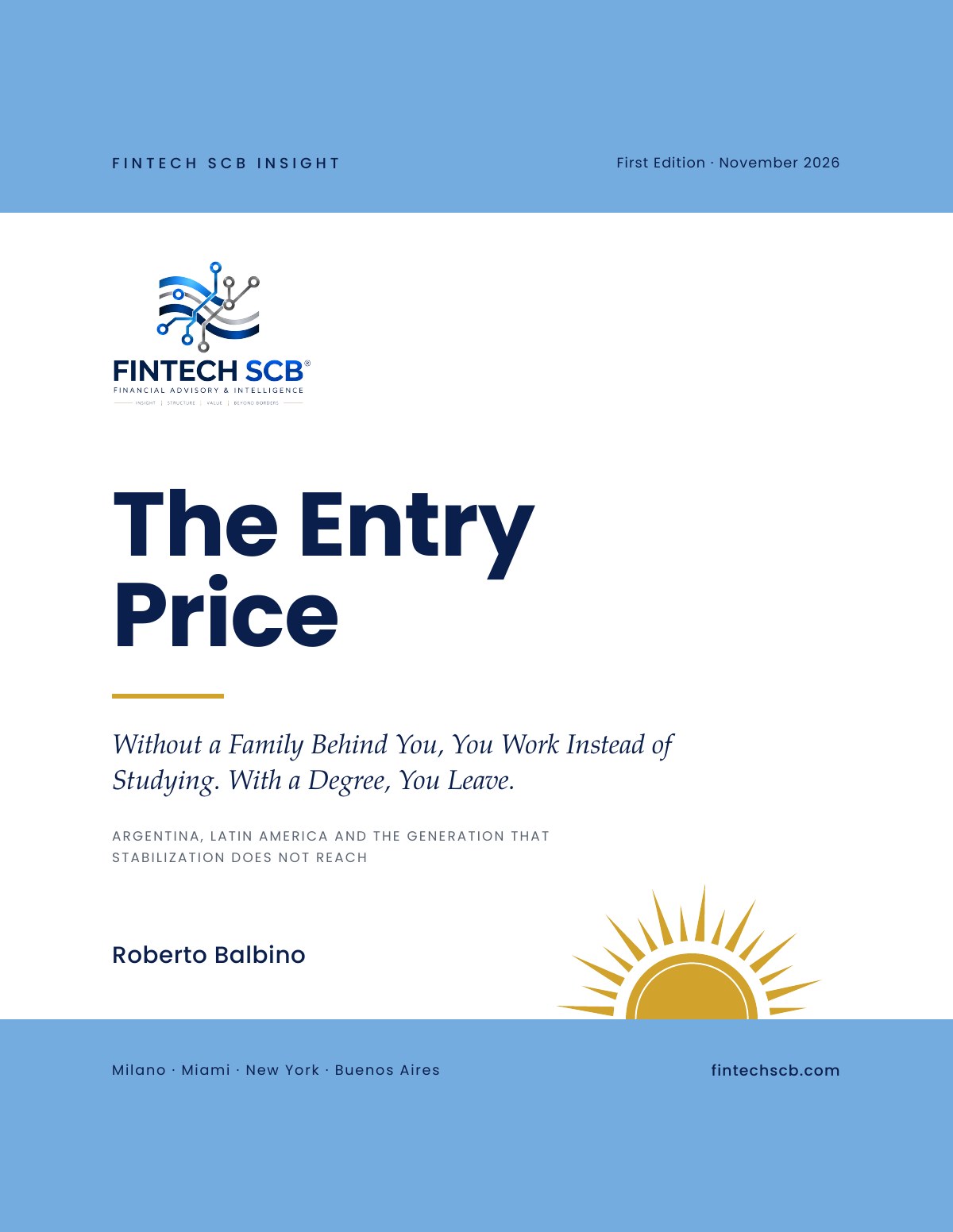
Cover of The Entry Price, a FINTECH SCB Insight by Roberto Balbino

FINTECH SCB Insight · November 2026 · by Roberto Balbino

Argentina, Latin America and the Generation That Stabilization Does Not Reach

The Entry Price

The Entry Price — FINTECH SCB Insight

Without a Family Behind You, You Work Instead of Studying. With a Degree, You Leave.

On November 8, 2026, in Buenos Aires, Pope Leo XIV asked where a nation has failed when its young people have to leave. This Insight answers with three prices: a roof, a degree and a first wage.

Inflation has fallen from 211% to 33%. A studio still costs 56% of a young salary, the national scholarship covers two days of the month, and 17% of young Argentines hold a degree, fewer than the adults ahead of them. Family wealth settles who pays the three prices. Those without it work instead of studying. Those who graduate leave, on a passport inherited from a grandparent.

From Buenos Aires to Santiago, Mexico City and Medellín, the same mechanism appears in different proportions, on the eve of the sharpest fall in births the region has recorded.

62 pages · 12 charts · 2 tables · 75 source notes · research cutoff November 12, 2026

First Edition · November 2026 · English · PDF

General information and education, not individual investment, tax or legal advice. Capital is at risk.

EUR 4,99, tasse escluse — pagamento unico

Eventuali tasse applicabili vengono aggiunte al pagamento.

Nell'app non sono disponibili nuovi acquisti di questo servizio. I contenuti già acquistati restano accessibili dopo l'accesso.

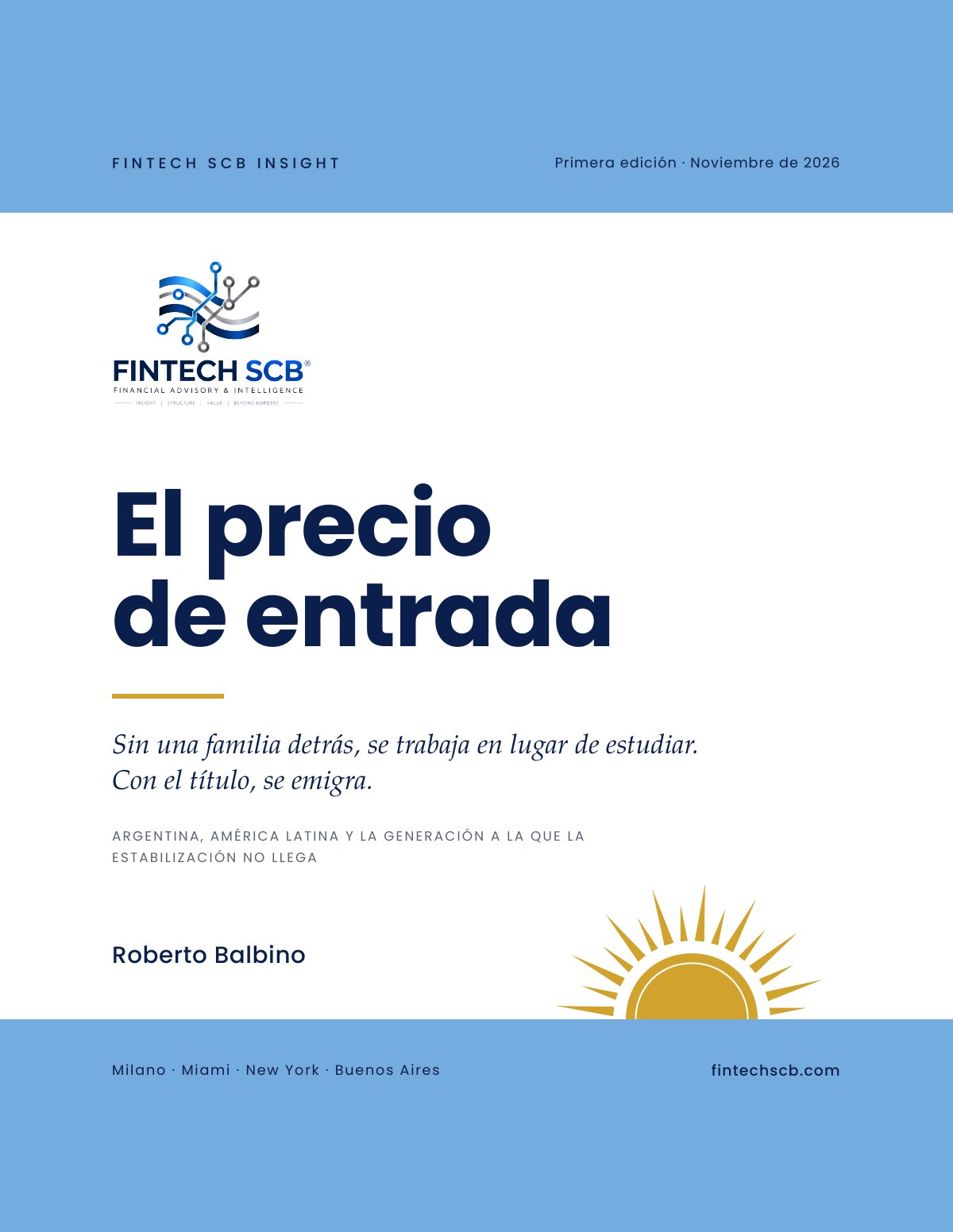
Portada de El precio de entrada, un FINTECH SCB Insight de Roberto Balbino

FINTECH SCB Insight · Noviembre de 2026 · por Roberto Balbino

Argentina, América Latina y la generación a la que la estabilización no llega

El precio de entrada

El precio de entrada — FINTECH SCB Insight

Sin una familia detrás, se trabaja en lugar de estudiar. Con el título, se emigra.

El 8 de noviembre de 2026, en Buenos Aires, el papa León XIV preguntó en qué ha fallado una nación cuando sus jóvenes deben irse. Este Insight responde con tres precios: un techo, un título y un primer sueldo.

La inflación bajó de 211% a 33%. Un monoambiente sigue costando el 56% de un sueldo joven, la beca nacional cubre dos días del mes, y el 17% de los jóvenes argentinos tiene un título, menos que los adultos que van adelante. El patrimonio familiar decide quién paga los tres precios. Quien no lo tiene trabaja en lugar de estudiar. Quien se recibe se va, con un pasaporte heredado de un abuelo.

De Buenos Aires a Santiago, Ciudad de México y Medellín, el mismo mecanismo aparece en otras proporciones, en vísperas de la mayor caída de nacimientos que registró la región.

63 páginas · 12 gráficos · 2 tablas · 75 notas de fuentes · cierre de la investigación: 12 de noviembre de 2026

Primera edición · Noviembre de 2026 · Español · PDF

Información general y educativa, no asesoramiento individual de inversión, fiscal o legal. El capital está en riesgo.

EUR 4,99, tasse escluse — pagamento unico

Eventuali tasse applicabili vengono aggiunte al pagamento.

Nell'app non sono disponibili nuovi acquisti di questo servizio. I contenuti già acquistati restano accessibili dopo l'accesso.

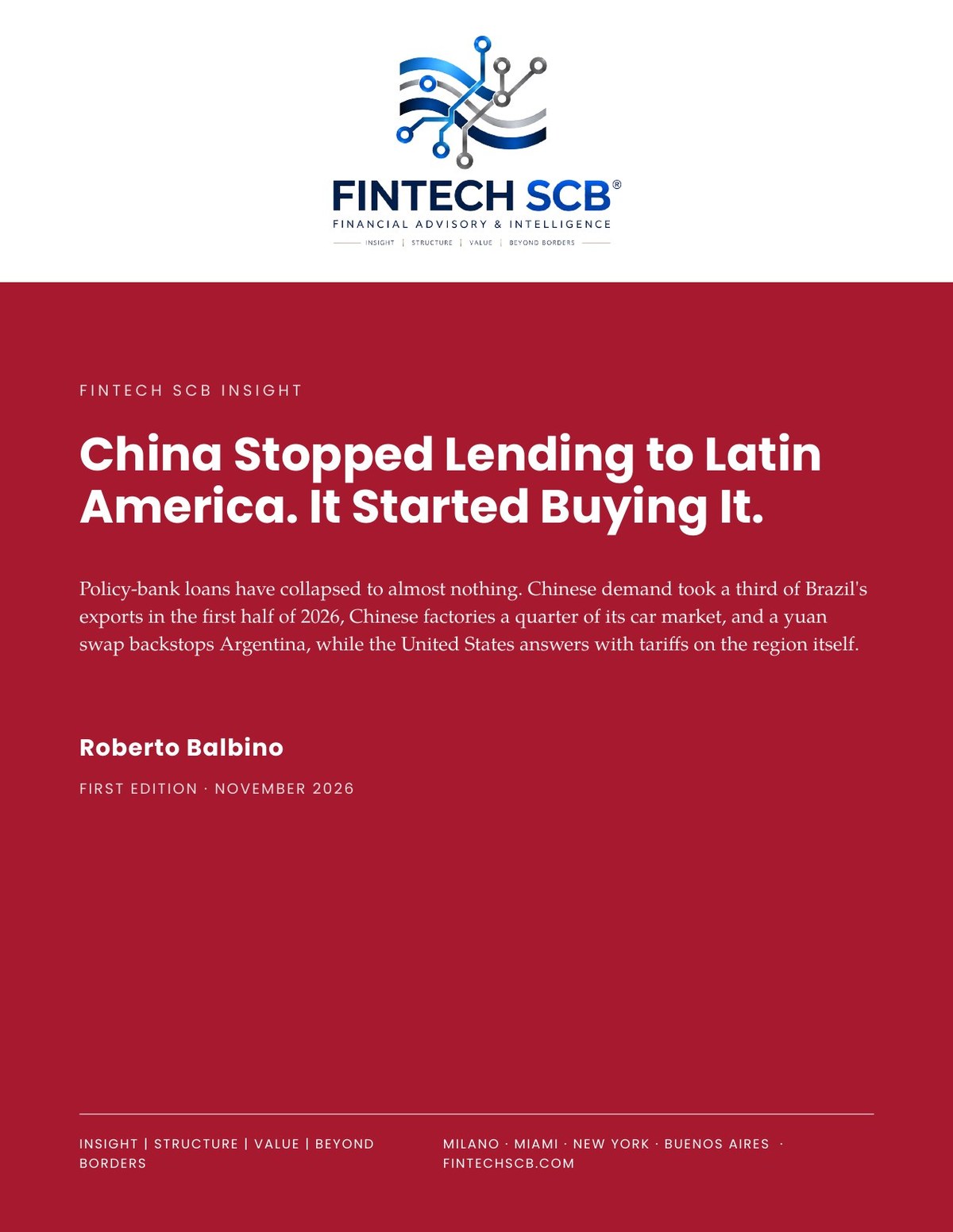
Cover: China Stopped Lending to Latin America. It Started Buying It.

FINTECH SCB Insight · November 2026 · by Roberto Balbino

China Stopped Lending to Latin America. It Started Buying It.

China Stopped Lending to Latin America — FINTECH SCB Insight

Policy-bank loans have collapsed to almost nothing. Chinese demand took a third of Brazil's exports in the first half of 2026, Chinese factories a quarter of its car market, and a yuan swap backstops Argentina, while the United States answers with tariffs on the region itself.

For a decade the debate about China in Latin America was a debate about debt. The data say that debate is over: Chinese policy banks committed $24.5 billion to the region in 2010 and $2.8 billion in 2024, four-fifths of it to Brazilian state banks, while the loans to Venezuela that made up half the total are being repaid in oil that no longer arrives.

What replaced the loans is not one instrument but three, and they allocate risk in the opposite direction. China now buys a third of Brazil's exports and more than a third of Chile's and Peru's; it assembles cars inside the tariff wall Brazil built against it and owns a tenth of Brazil's grid, a quarter of Peru's copper and the port of Chancay; and it backstops Argentina with a yuan swap worth 38 percent of that country's gross reserves. A lender carries the risk of its borrower. A buyer, an owner and a swap counterparty carry very little, and the people who used to be borrowers are now exposed to them.

This insight follows the money through the four instruments with figures that can be checked: Comex Stat, BCRA, USTR, Boston University's loan database, Fenabrave, the AEI tracker, the IMF. It separates the oil price from oil volumes in the 2026 surge, measures what the American tariffs on Brazil actually hit, and sets out three paths to 2028 with the observations that would prove the argument wrong. It ends with the fifteen indicators the author will follow, and with what a company, an investor and a policymaker should do differently once they stop reading the ledger of 2015.

69 pages · 19 charts · 3 tables · 86 source notes · research cutoff November 9, 2026

First Edition · November 2026 · English · PDF

General information and education, not individual investment, tax or legal advice. Capital is at risk.

EUR 4,99, tasse escluse — pagamento unico

Eventuali tasse applicabili vengono aggiunte al pagamento.

Nell'app non sono disponibili nuovi acquisti di questo servizio. I contenuti già acquistati restano accessibili dopo l'accesso.

FINTECH SCB Insights / Wealth Management

Wealth, Freedom and Control — FINTECH SCB Insights
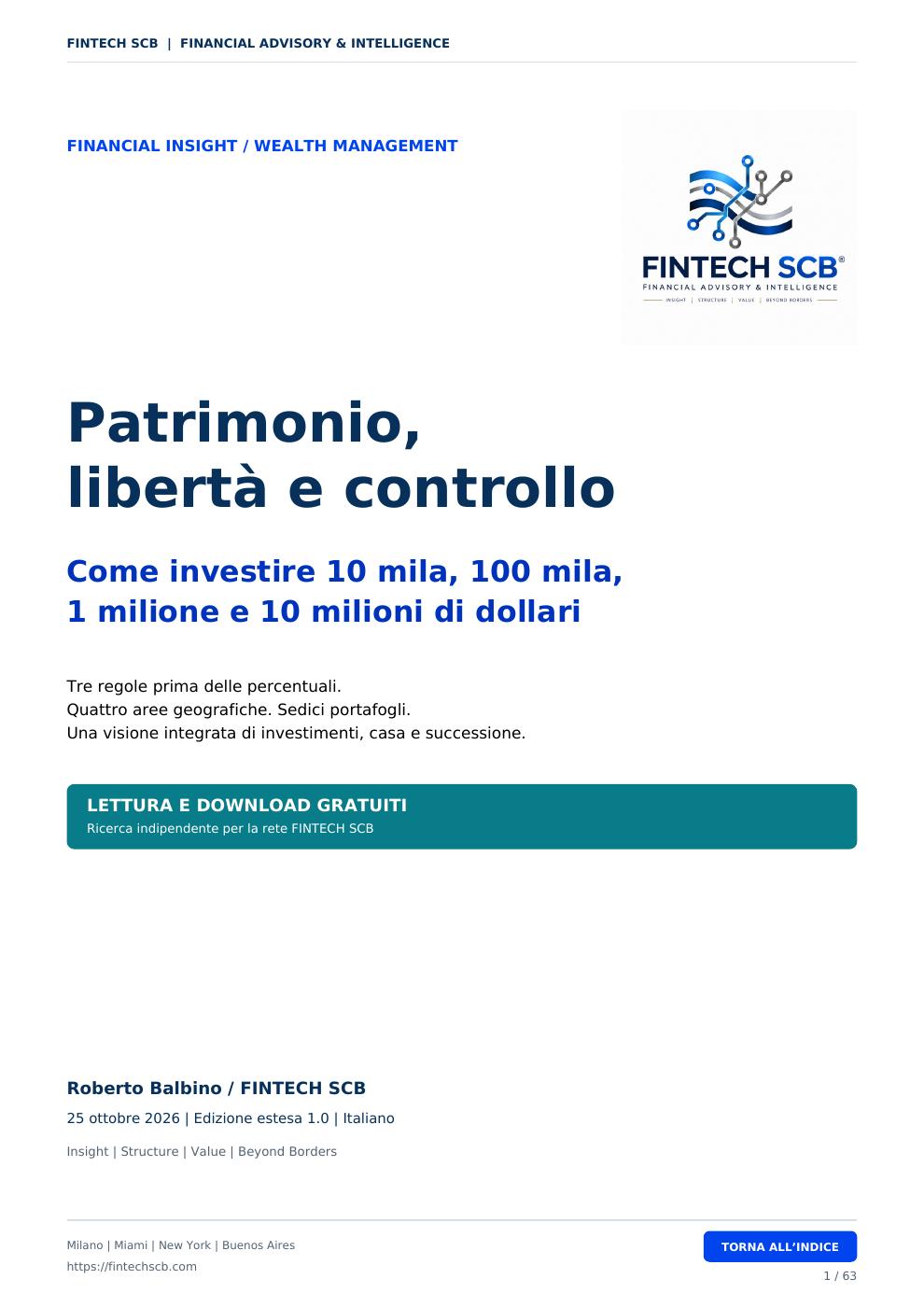
Patrimonio, libertà e controllo — Roberto Balbino / FINTECH SCB — Italiano

Italiano

Patrimonio, libertà e controllo

Come investire 10 mila, 100 mila, 1 milione e 10 milioni di dollari

Tre regole prima delle percentuali. Quattro aree geografiche. Sedici portafogli. Una visione integrata di investimenti, casa e successione.

Roberto Balbino / FINTECH SCB
Ricerca indipendente per la rete FINTECH SCB

25 ottobre 2026 · Edizione estesa 1.0 · 63 pagine · PDF
Wealth, Freedom and Control — Roberto Balbino / FINTECH SCB — English

English

Wealth, Freedom and Control

How to invest $10,000, $100,000, $1 million and $10 million

Three rules before percentages. Four geographic areas. Sixteen portfolios. An integrated view of investment, homes and succession.

Roberto Balbino / FINTECH SCB
Independent research for the FINTECH SCB network

25 October 2026 · Extended edition 1.0 · 63 pages · PDF

Patrimonio, libertad y control — Roberto Balbino / FINTECH SCB — Español

Español

Patrimonio, libertad y control

Cómo invertir 10 mil, 100 mil, 1 millón y 10 millones de dólares

Tres reglas antes de los porcentajes. Cuatro áreas geográficas. Dieciséis carteras. Una visión integrada de inversión, vivienda y sucesión.

Roberto Balbino / FINTECH SCB
Investigación independiente para la red FINTECH SCB

25 de octubre de 2026 · Edición ampliada 1.0 · 63 páginas · PDF

EUR 4,99, tasse escluse — pagamento unico

Eventuali tasse applicabili vengono aggiunte al pagamento.

Nell'app non sono disponibili nuovi acquisti di questo servizio. I contenuti già acquistati restano accessibili dopo l'accesso.

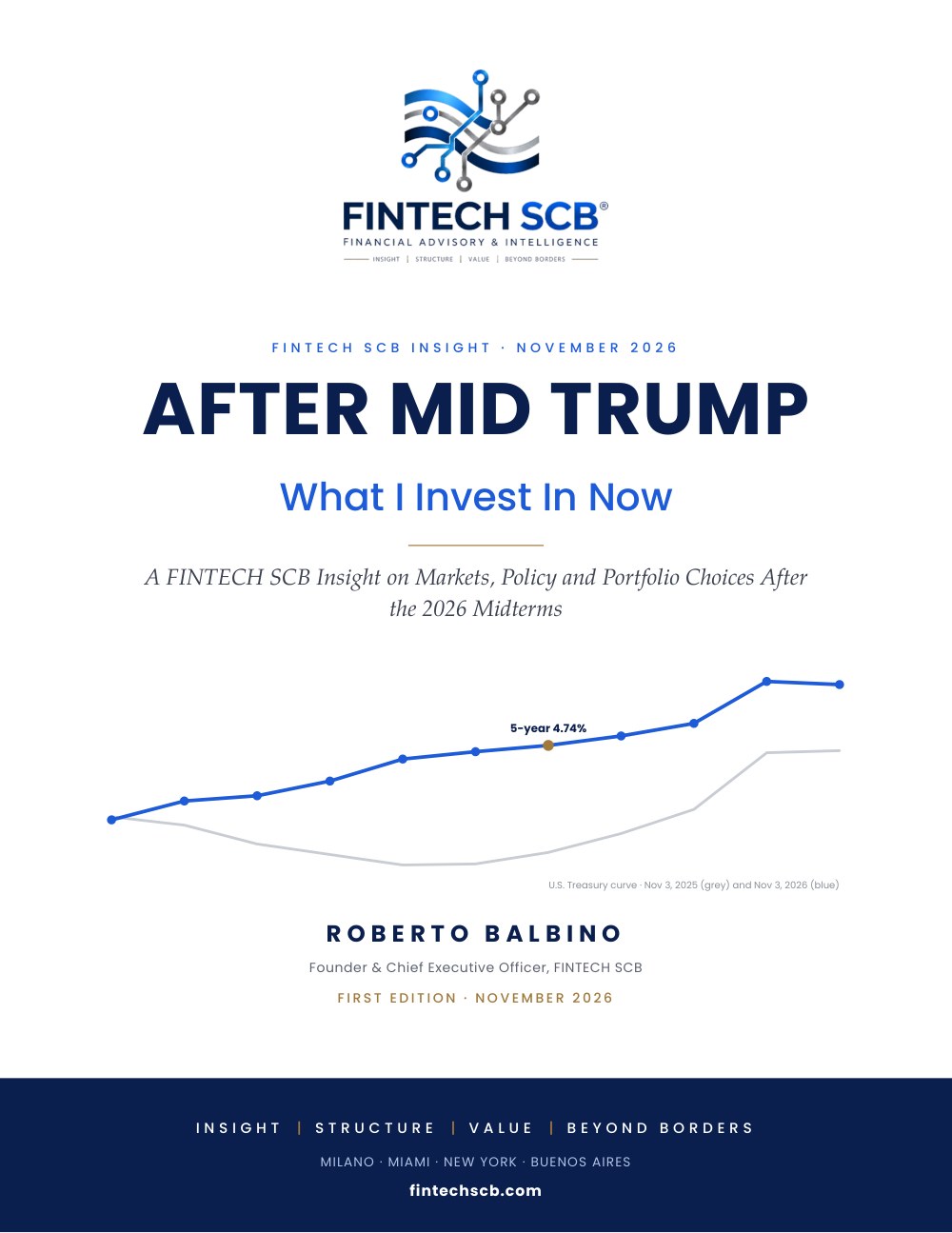
Cover of After Mid Trump: What I Invest In Now by Roberto Balbino, FINTECH SCB Insight, November 2026

FINTECH SCB Insight · November 2026 · by Roberto Balbino

After Mid Trump

After Mid Trump — FINTECH SCB Insight

What I Invest In Now

On November 3, 2026, American voters gave Democrats the House and the Senate. Markets sold the result overnight and bought it back by breakfast; the bond market moved first.

After Mid Trump turns that night into decisions: the policies that can still become law under divided government, why the middle of the Treasury curve beats the long end, and a model portfolio built position by position, with the signals that would prove the author wrong.

88 pages · 17 charts · 228 source notes · research cutoff November 4, 2026

General information and education, not individual investment, tax or legal advice. The model portfolio is illustrative. Capital is at risk.

EUR 4,99, tasse escluse — pagamento unico

Eventuali tasse applicabili vengono aggiunte al pagamento.

Nell'app non sono disponibili nuovi acquisti di questo servizio. I contenuti già acquistati restano accessibili dopo l'accesso.

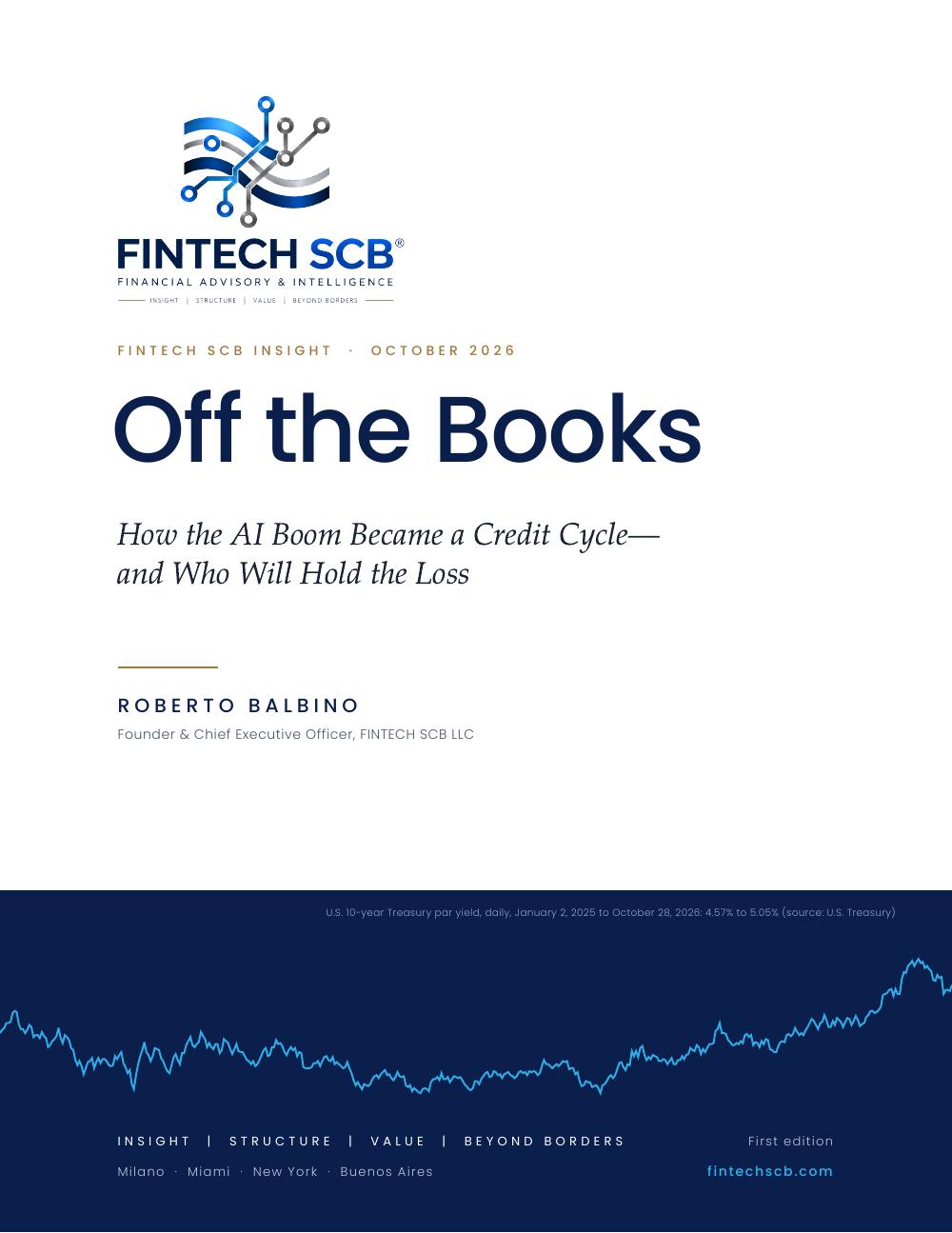
Cover of Off the Books by Roberto Balbino, FINTECH SCB Insight, October 2026

FINTECH SCB Insight · October 2026 · by Roberto Balbino

Off the Books

Off the Books — October 2026 Insight

How the AI Boom Became a Credit Cycle—and Who Will Hold the Loss

The debate over artificial intelligence is still argued as a stock-market question. The money has already moved somewhere else.

In 2026 the largest spenders on AI stopped paying for the build-out out of their own cash. In the first half of the year, capital expenditure at Microsoft, Alphabet, Amazon, Meta and Oracle absorbed 96 percent of the cash their businesses generated. At Alphabet, Amazon and Oracle it now exceeds it. Their reported debt has more than doubled in less than two years, to about $496 billion. Another $1.2 trillion of leases, signed mostly for data centers not yet delivered, sits outside their balance sheets.

Off the Books follows the contracts. It looks at joint-venture bonds backed by residual value guarantees, vehicles that own the chips, loans secured on hardware that ages faster than the debt, and guarantees written by the chipmakers themselves. It identifies who holds the claims: life insurers and the annuities behind them, semi-liquid private credit funds, and the banks that lend to the lenders. These are the institutions least able to leave when the numbers turn.

The Insight tests its own argument against the strongest objections and sets out three paths to 2028. It also states in advance the evidence that would prove it wrong. It closes with practical guidance and a dashboard of indicators for savers, entrepreneurs, credit investors and policymakers.

Shareholders can sell in a second. The people financing the AI build-out cannot.

78 pages · 23 figures and tables · fully sourced · data to October 29, 2026

EUR 4,99, tasse escluse — pagamento unico

Eventuali tasse applicabili vengono aggiunte al pagamento.

Nell'app non sono disponibili nuovi acquisti di questo servizio. I contenuti già acquistati restano accessibili dopo l'accesso.

Cover of Before the Return by Roberto Balbino, Fintech SCB educational master, October 2026

Fintech SCB Insights / Educational Master

Before the Return

Before the Return — FINTECH SCB Insights

How to Read Markets, Build Portfolios and Evaluate Hedge Fund Processes

A 64-page guide by Roberto Balbino, Founder & CEO of Fintech SCB, exploring market indicators, hedge fund strategies, portfolio construction, liquidity, leverage and performance evaluation. Includes analytical charts, practical worksheets, a glossary and institutional references. An independent framework for understanding investment decisions and questioning performance claims.

October 2026 edition · English · PDF

EUR 4,99, tasse escluse — pagamento unico

Eventuali tasse applicabili vengono aggiunte al pagamento.

Nell'app non sono disponibili nuovi acquisti di questo servizio. I contenuti già acquistati restano accessibili dopo l'accesso.

Yellow cover of I'd trade all of my tomorrows for one single yesterday by Roberto Balbino, FINTECH SCB Insight, 7 November 2026

FINTECH SCB Insight · 7 November 2026 · by Roberto Balbino

I'd trade all of my tomorrows for one single yesterday

Selling Tomorrow — FINTECH SCB Insight

The economics of protecting yesterday's wealth at the expense of tomorrow's opportunities

An economy can recover the price of an asset without recovering the opportunities lost when it fell. This Insight follows the connections between housing, asset prices, debt, wages and crisis responses, and examines how protecting existing wealth can affect access to opportunity for later generations.

From the intergenerational balance sheet to the Tomorrow Capacity Test, it asks what a society chooses to preserve — and what it is willing to leave to those who come next.

From “Me and Bobby McGee” by Kris Kristofferson and Fred Foster, performed by Janis Joplin.

67 pages · English edition · 7 November 2026

EUR 4,99, tasse escluse — pagamento unico

Eventuali tasse applicabili vengono aggiunte al pagamento.

Nell'app non sono disponibili nuovi acquisti di questo servizio. I contenuti già acquistati restano accessibili dopo l'accesso.

THE COMPLETE EDITORIAL ARCHIVE — ROBERTO BALBINO

L’archivio raccoglie 205 pubblicazioni, dal 21 agosto al 17 novembre 2026, su finanza, economia, banche, mercati, geopolitica, tecnologia, società, business e sport.

Cosa troverai

FINANZA GLOBALE

Mercati, banche, investimenti e tendenze finanziarie.

ECONOMIA

Analisi indipendenti su politiche economiche, crescita, inflazione, debito e cambiamenti strutturali.

GEOPOLITICA

Come le decisioni politiche ridisegnano mercati, flussi di capitale ed economia globale.

BUSINESS INTERNAZIONALE

Finanza cross-border, business internazionale, mercati emergenti e opportunità globali.

Chi è Roberto Balbino

Roberto Balbino è un International Finance & Banking Executive e Founder & CEO di Fintech SCB, con oltre 40 anni di esperienza in finanza, banking, private banking, wealth management, corporate finance, M&A e business internazionale.

Le sue analisi uniscono decenni di esperienza finanziaria a una visione indipendente e spesso non convenzionale delle forze che plasmano mercati ed economie globali.

Perché seguire Roberto Balbino?

Perché i mercati finanziari non sono determinati solo dai numeri.

Sono determinati da politica, potere, politiche monetarie, tecnologia, flussi di capitale e decisioni umane.

Insights collega queste forze e mette in discussione le narrazioni convenzionali.

INDIPENDENTE

Nessuna agenda di investimento istituzionale.

GLOBALE

Finanza ed economia osservate oltre i confini nazionali.

NON CONVENZIONALE

Analisi pensate per mettere in discussione il consenso, non per ripeterlo.

Segui. Leggi. Approfondisci.

Segui Roberto Balbino su Substack e ricevi le nuove analisi direttamente nella tua casella email.

La pubblicazione Substack è in abbonamento.

Non è richiesto alcun pagamento per seguire la pubblicazione.