예시 사례

예시 사례와 이탈리아어, 영어 및 스페인어 보고서를 살펴보세요.

Fintech SCB — 에디토리얼

Roberto BalbinoInsights

금융, 경제, 지정학 그리고 세계를 움직이는 힘에 대한 독립적 분석.

글로벌 금융, 시장, 경제, 지정학, 국제 비즈니스에 대한 독립적 시각 — Fintech SCB 창업자 겸 CEO 로베르토 발비노 집필.

팔로우는 언제나 무료입니다.

Substack에서 로베르토 발비노를 팔로우하고 새로운 분석을 메일로 받아보세요.

Latest analysis

  1. The Minerals Are Not the Money

    Who captures the value? A Fintech SCB Sunday Read

  2. MID TRUMP

    How the decisions of one presidency changed the price of goods, energy, money and risk, and why Tuesday’s vote matters far beyond America

  3. The Euro’s Quiet Expansion

    Follow the credit.

  4. The Inflation Aftershock

    Cheaper oil\. Costlier living\.

  5. America’s 3.4% Boom and the Cost of Waiting

    A data centre can contribute to economic growth years before its investors receive an adequate return. A household’s bills fall due every month.

  6. The restructuring dividend: who gets paid when the workforce gets smaller?

    Deloitte’s 45% pay rise, the incentives inside Salesforce’s margin targets, and the question boards should answer before rewarding a transformation.

  7. Europe's Debt Has Three Clocks

    The bill comes in stages

  8. How North Korea Pays for the Bomb—and Makes Its People Pay for Survival

    Kim Jong Un’s new bridges to China and Russia reveal an economy less isolated than it looks, and a state increasingly able to secure resources without giving its citizens greater economic freedom

  9. The One-Cent Payment Myth

    Cheap rails. Costly exits.

  10. China's Uneven Recovery

    Factories surge. Investment retreats.

  11. SEX MAKES BILLIONS. WHO PAYS FOR THE RISK?

    The financial machinery of desire, the unequal cost of sexually transmitted infections, and the uncomfortable evidence that should change how we invest in prevention

  12. The Rules Behind Private Credit

    Regulation moved the lender

  13. Inflation Before the Oil

    Prices arrive first

  14. The Founder Can Leave. The Business Should Be Able to Grow.

    We have an oddly sentimental way of discussing entrepreneurship. We celebrate founders for creating something valuable, then sometimes treat their decision to sell it as a failure of character.

  15. LSEG, OCTUS AND THE PRICE OF TRUST IN THE AI ECONOMY

    Why a $3.535 billion acquisition challenges the idea that cheaper artificial intelligence will automatically make financial intelligence cheaper.

  16. PASSIVE INCOME, ACTIVE ILLUSIONS

    From laundromats and self-service dog washes to rental properties, vending machines, digital products and investment portfolios: what the evidence actually says about buying financial freedom.

  17. The AI Productivity Reckoning: Who Captures the Value When Intelligence Gets Cheaper?

    The AI boom is reaching a more demanding phase. Capability still matters, but the financial question is becoming unavoidable: how much economic value survives after the technology has been purchased, integrated, supervised and used?

  18. THE TRADWIFE ILLUSION: SELLING DEPENDENCE AS FREEDOM

    From Yesteryear to the economics of unpaid work, household power and national prosperity.

  19. The Global Economy Is Growing. But Who Actually Owns the Future?

    Brazil, Mexico and Argentina face different problems. Latin America’s common challenge is turning economic advantages into prosperity that lasts.

  20. THE SUNDAY LONG READ Canada’s Prosperity Paradox

    Why growth is not reaching households—and what Europe could offer.

  21. Europe’s €10 Trillion Missing Link

    Financing the future requires a different financial system.

  22. LEFT, RIGHT OR DICTATORSHIP? 193 COUNTRIES PUT 25 YEARS OF ECONOMIC PROMISES ON TRIAL

    Who held power, who delivered growth, and what the numbers actually reveal.

  23. The companies that became banks without choosing to

    How late payments can make a strong buyer look healthier while making its supply chain more expensive to finance

  24. When the Athlete Becomes the Asset

    Mbappé leaves Nike for On. But the real story is bigger: elite athletes are evolving from sponsored celebrities into distribution networks, intellectual property and, increasingly, shareholders.

FINTECH SCB Insights / Wealth Management

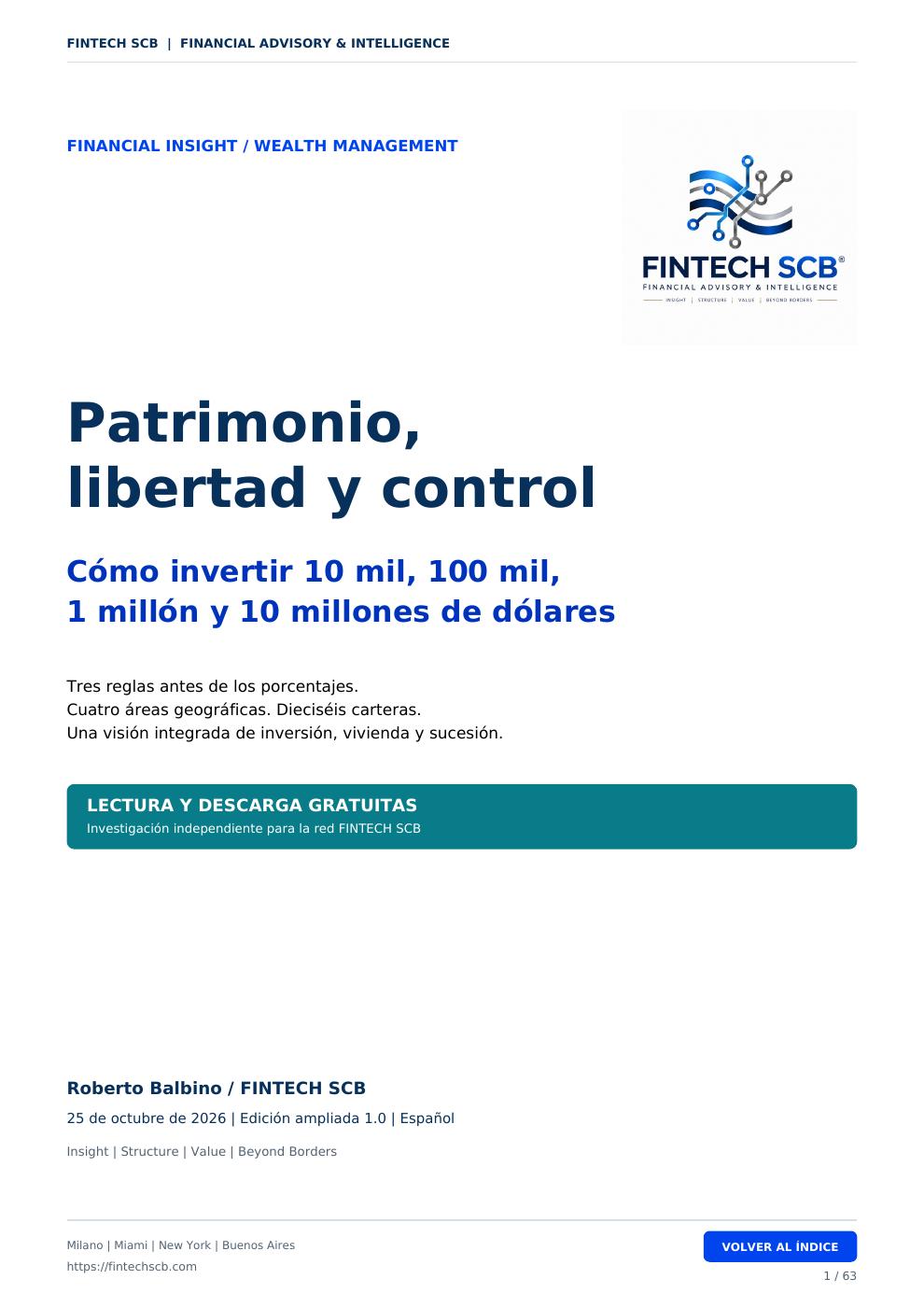
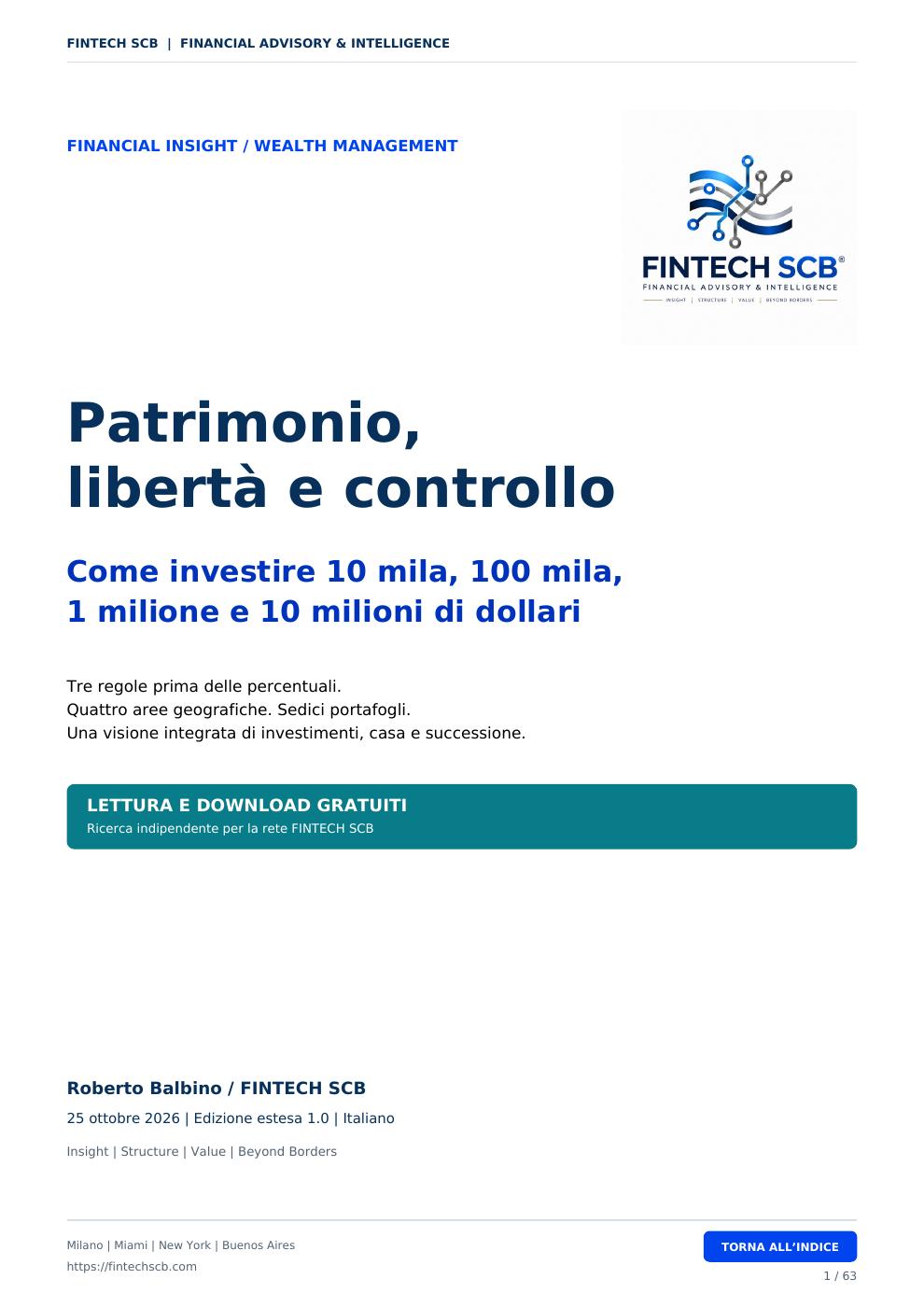
Patrimonio, libertà e controllo — Roberto Balbino / FINTECH SCB — Italiano

Italiano

Patrimonio, libertà e controllo

Come investire 10 mila, 100 mila, 1 milione e 10 milioni di dollari

Tre regole prima delle percentuali. Quattro aree geografiche. Sedici portafogli. Una visione integrata di investimenti, casa e successione.

Roberto Balbino / FINTECH SCB
Ricerca indipendente per la rete FINTECH SCB

25 ottobre 2026 · Edizione estesa 1.0 · 63 pagine · PDF

Lettura e download gratuiti
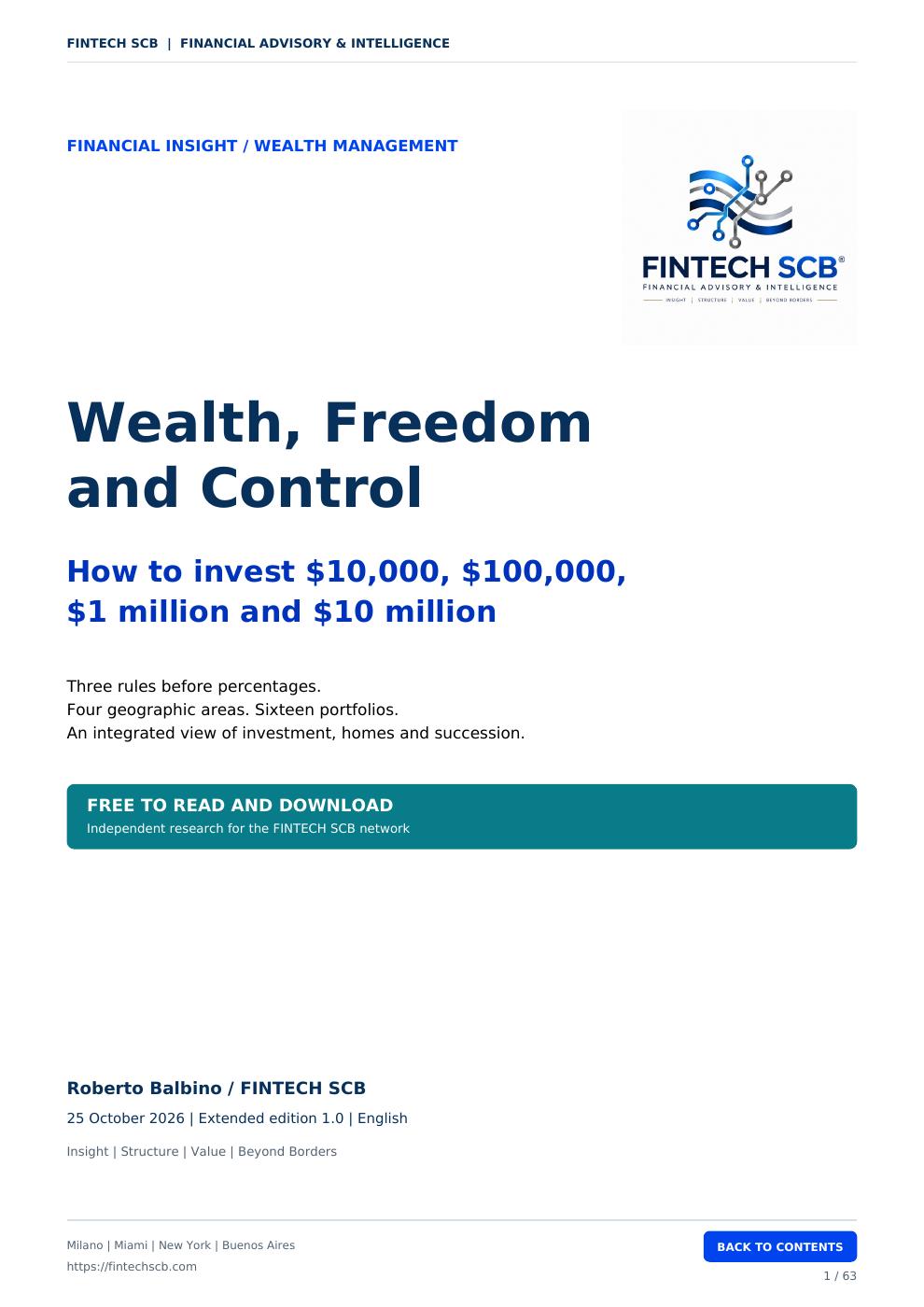
Wealth, Freedom and Control — Roberto Balbino / FINTECH SCB — English

English

Wealth, Freedom and Control

How to invest $10,000, $100,000, $1 million and $10 million

Three rules before percentages. Four geographic areas. Sixteen portfolios. An integrated view of investment, homes and succession.

Roberto Balbino / FINTECH SCB
Independent research for the FINTECH SCB network

25 October 2026 · Extended edition 1.0 · 63 pages · PDF

Free to read and download

Patrimonio, libertad y control — Roberto Balbino / FINTECH SCB — Español

Español

Patrimonio, libertad y control

Cómo invertir 10 mil, 100 mil, 1 millón y 10 millones de dólares

Tres reglas antes de los porcentajes. Cuatro áreas geográficas. Dieciséis carteras. Una visión integrada de inversión, vivienda y sucesión.

Roberto Balbino / FINTECH SCB
Investigación independiente para la red FINTECH SCB

25 de octubre de 2026 · Edición ampliada 1.0 · 63 páginas · PDF

Lectura y descarga gratuitas

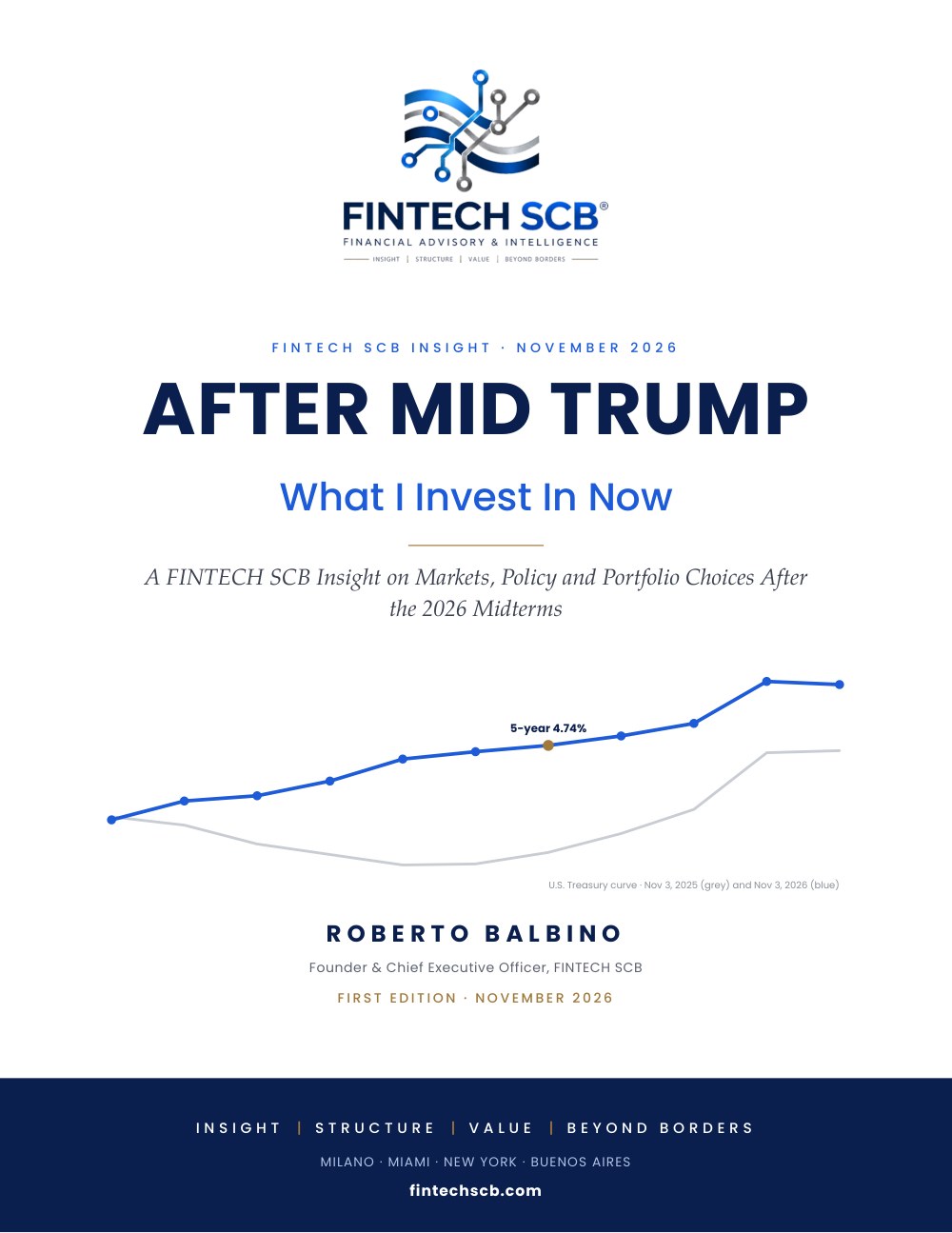
Cover of After Mid Trump: What I Invest In Now by Roberto Balbino, FINTECH SCB Insight, November 2026

FINTECH SCB Insight · November 2026 · by Roberto Balbino

After Mid Trump

What I Invest In Now

On November 3, 2026, American voters gave Democrats the House and the Senate. Markets sold the result overnight and bought it back by breakfast; the bond market moved first.

After Mid Trump turns that night into decisions: the policies that can still become law under divided government, why the middle of the Treasury curve beats the long end, and a model portfolio built position by position, with the signals that would prove the author wrong.

88 pages · 17 charts · 228 source notes · research cutoff November 4, 2026

General information and education, not individual investment, tax or legal advice. The model portfolio is illustrative. Capital is at risk.

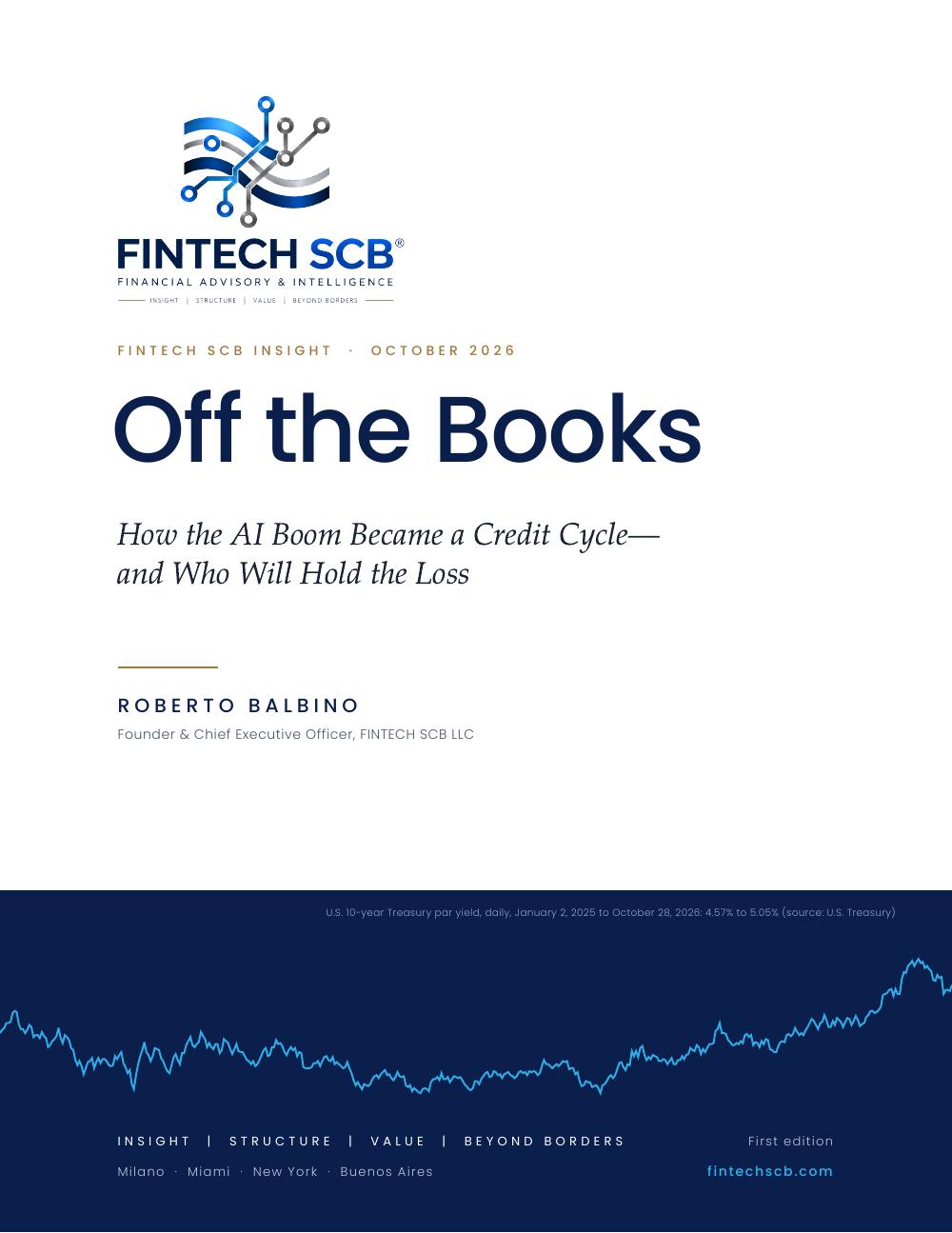
Cover of Off the Books by Roberto Balbino, FINTECH SCB Insight, October 2026

FINTECH SCB Insight · October 2026 · by Roberto Balbino

Off the Books

How the AI Boom Became a Credit Cycle—and Who Will Hold the Loss

The debate over artificial intelligence is still argued as a stock-market question. The money has already moved somewhere else.

In 2026 the largest spenders on AI stopped paying for the build-out out of their own cash. In the first half of the year, capital expenditure at Microsoft, Alphabet, Amazon, Meta and Oracle absorbed 96 percent of the cash their businesses generated. At Alphabet, Amazon and Oracle it now exceeds it. Their reported debt has more than doubled in less than two years, to about $496 billion. Another $1.2 trillion of leases, signed mostly for data centers not yet delivered, sits outside their balance sheets.

Off the Books follows the contracts. It looks at joint-venture bonds backed by residual value guarantees, vehicles that own the chips, loans secured on hardware that ages faster than the debt, and guarantees written by the chipmakers themselves. It identifies who holds the claims: life insurers and the annuities behind them, semi-liquid private credit funds, and the banks that lend to the lenders. These are the institutions least able to leave when the numbers turn.

The Insight tests its own argument against the strongest objections and sets out three paths to 2028. It also states in advance the evidence that would prove it wrong. It closes with practical guidance and a dashboard of indicators for savers, entrepreneurs, credit investors and policymakers.

Shareholders can sell in a second. The people financing the AI build-out cannot.

78 pages · 23 figures and tables · fully sourced · data to October 29, 2026

Cover of Before the Return by Roberto Balbino, Fintech SCB educational master, October 2026

Fintech SCB Insights / Educational Master

Before the Return

How to Read Markets, Build Portfolios and Evaluate Hedge Fund Processes

A 64-page guide by Roberto Balbino, Founder & CEO of Fintech SCB, exploring market indicators, hedge fund strategies, portfolio construction, liquidity, leverage and performance evaluation. Includes analytical charts, practical worksheets, a glossary and institutional references. An independent framework for understanding investment decisions and questioning performance claims.

October 2026 edition · English · PDF · Free download

THE COMPLETE EDITORIAL ARCHIVE — ROBERTO BALBINO

이 아카이브에는 2026년 8월 21일부터 10월 17일까지 발행된 금융, 경제, 은행, 시장, 지정학, 기술, 사회, 비즈니스 및 스포츠 관련 기사 172편이 수록되어 있습니다.

다루는 내용

글로벌 금융

시장, 은행, 투자 및 금융 트렌드.

경제

경제 정책, 성장, 인플레이션, 부채, 구조적 변화에 대한 독립적 분석.

지정학

정치적 결정이 시장, 자본 흐름, 세계 경제를 어떻게 바꾸는가.

국제 비즈니스

국경을 넘는 금융, 국제 비즈니스, 신흥시장, 글로벌 기회.

로베르토 발비노 소개

로베르토 발비노는 국제 금융·뱅킹 임원이자 Fintech SCB의 창업자 겸 CEO로, 금융, 뱅킹, 프라이빗 뱅킹, 자산관리, 기업금융, M&A, 국제 비즈니스 분야에서 40년 이상의 경험을 보유하고 있습니다.

그의 분석은 수십 년의 금융 경험과 글로벌 시장·경제를 움직이는 힘에 대한 독립적이고 종종 비관습적인 시각을 결합합니다.

왜 로베르토 발비노를 팔로우해야 할까요?

금융시장은 숫자만으로 움직이지 않기 때문입니다.

정치, 권력, 통화정책, 기술, 자본 흐름, 그리고 인간의 결정이 시장을 형성합니다.

Insights는 이 힘들을 연결하고 통념에 의문을 제기합니다.

독립적

기관 투자 어젠다가 없습니다.

글로벌

국경을 넘어 금융과 경제를 봅니다.

비관습적

합의를 반복하기보다 질문하도록 설계된 분석.

무료로 팔로우하고 제한 없이 읽으세요.

Substack에서 로베르토 발비노를 팔로우하고 새로운 분석을 메일로 받아보세요.

팔로우는 무료입니다.

이 퍼블리케이션을 팔로우하는 데 결제가 필요하지 않습니다.